
~$3,500 or Less — High-Accuracy CNC Router for Tiny Bits

Critical Specs for Tiny-Bit Work (< 1 mm diameter)
Spindle runout: must be under 0.01 mm. Cheap 300W spindles often exceed 0.03 mm — that'll snap tiny bits instantly.
Ballscrew grade: C5 or better. C7 (±0.05 mm/300 mm) is standard on hobby machines. C5 is 4× more precise.
Z-axis rigidity: the #1 overlooked spec. Any Z flex under 0.1 mm ruins fine detail in brass/aluminum.
Machining Parameters — 1 mm End Mill in 6061 Aluminum
Spindle RPM: 18,000–24,000
Feed rate: 300–600 mm/min
Depth of cut: 0.1–0.2 mm per pass
Coolant: mist or air blast essential — no dry cutting at this scale
$3,500 Comparison
| Model | Price | Rails | Drive | Spindle | Work Area | Weight | Repeatability | Support |
|---|---|---|---|---|---|---|---|---|
| Shapeoko 5 Pro | ~$3,500 | Linear | Ballscrew | 1.5KW | 1000×1000 mm | ~60 kg | ±0.02 mm | US-based |
| Onefinity Elite | ~$2,500 | 15 mm linear | 1610 ballscrew | 1.5KW | 800×800 mm | ~40 kg | ±0.02 mm | 2-year |
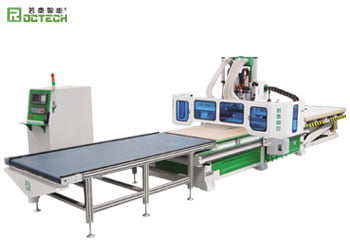
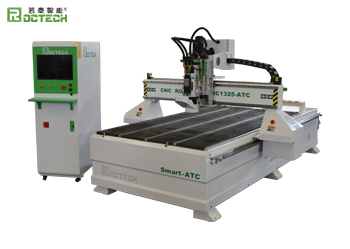
| ROCTECH RC1313 | ~$4,500+ | 25 mm HIWIN | Rack + ballscrew | 3.0KW HSD | 1300×1300 mm | ~1450 kg | ±0.01 mm | 24/7 global |
The Work-Area Tradeoff
At a fixed budget, every 100 mm increase in work area = ~15–20% decrease in effective rigidity. A 1000×1000 mm machine with a 40 kg gantry will flex more than a 400×400 mm machine of the same weight. ROCTECH solves this differently — their RC1313 uses a welded steel frame at 1450 kg, so the work area is large (1300×1300 mm) without sacrificing rigidity. That's an industrial approach, not a hobby one.
Controller Recommendation for High Accuracy
GRBL on Arduino: works but limited to ~30 kHz step rate — fine for 0.1 mm accuracy, borderline for 0.01 mm
LinuxCNC + Mesa card: gold standard for precision, real-time kernel, 1 MHz+ step rate
DSP standalone controllers (ROCTECH standard): industrial-grade, real-time motion planning, no PC jitter. These are the controllers on actual production machines.
Looking for more information about our CNC machines and services? Contact us today.
ContactTop Reviews
Related FAQ
-
~$3,500 or Less — High-Accuracy CNC Router for Tiny Bits
-
Engineering Instructor Looking for CNC Guidance (Software, Machines)
-
Recommendation for small CNC router for soft metal
-
Hobbyist CNC Router — What to Buy for ~$1,000?
-
Any suggestions for a ~1000 dollar CNC router for aluminum?
-
Advice for beginner friendly desktop CNC router
-
First CNC router advice (cutting 1,100 surplus PCBs)
-
Best 4×8 CNC Router for High School Makerspace