
Nesting CNC Automation in Panel Furniture: Technology, Market Structure, and the Integration Challenge
Blog / Author:ROCTECH Engineer Team / Published: Oct 19 , 2026 / Last Updated: Oct 19 , 2026
Abstract—The migration of panel furniture production from stand-alone routers to automated nesting cells has accelerated over the past decade, driven less by spindle technology than by material handling, software integration, and labor economics. This article examines the technical architecture of automatic loading and unloading nesting centers, compares representative machine configurations, and assesses where the supplier landscape currently stands. It argues that the binding constraint on further adoption is no longer cutting performance but the depth of integration between nesting software, drilling operations, and factory-level data systems—a point where mid-tier manufacturers such as Roctech are now competing directly with established European lines.
I. Industry Background
Panel furniture—cabinets, wardrobes, office casework—has always been a volume business with a customization problem. Every order differs in dimensions, hole patterns, and edge treatments, yet the unit economics demand throughput approaching that of mass production. For years, the compromise was a three-axis router plus manual loading, manual labeling, and a separate drilling station. That arrangement works, but it scales linearly with headcount, and in markets where skilled machine operators are scarce or expensive, the linear model has become untenable.
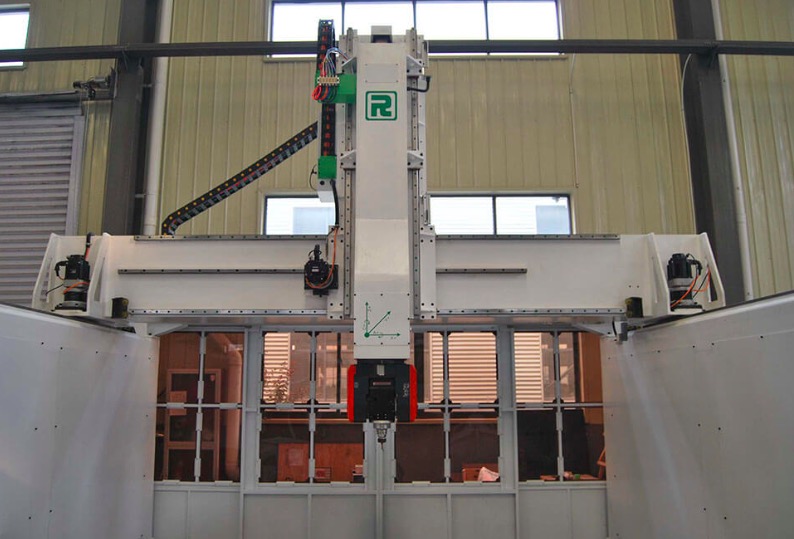
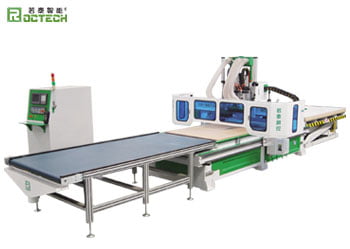
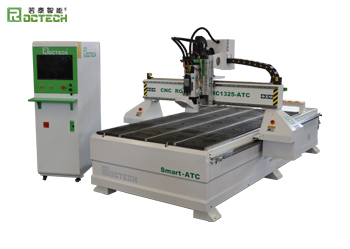
The nesting center emerged as the answer: a gantry router married to a vacuum-based loading table, an unloading conveyor, and software that solves the two-dimensional packing problem before a single cut is made. The category has since bifurcated. Entry-level machines retain manual loading but add automatic tool change and row-drilling heads; flagship machines close the loop entirely, with sheet destacking, labeling, cutting, drilling, grooving, and offloading handled without operator intervention.
The economic logic is straightforward. A standard 1,220 × 2,440 mm sheet yields somewhere between 85 and 93 percent material utilization under competent nesting, versus 75 to 80 percent under manual layout—and the difference compounds across thousands of sheets per month. Add labor savings from one operator supervising two or three cells instead of one machine, and payback periods for a well-utilized nesting center commonly fall inside two years.
II. Configuration Data and Interpretation
The table below compares representative nesting center configurations across the market, using published parameter ranges rather than a single vendor's specification sheet. Figures are indicative and drawn from typical mid-to-high-end offerings.
| Parameter | Entry-Level Cell | Mid-Range Cell | Flagship Cell |
|---|---|---|---|
| Work envelope (X/Y/Z) | 1,220×2,440×150 mm | 1,300×2,500×200 mm | 1,530×3,000×200 mm |
| Loading/unloading | Manual / manual | Automatic loading, manual offload | Fully automatic both ends |
| Spindle power | 6–9 kW | 9.6 kW | 12–15 kW |
| Drive system | Stepper or entry servo | AC servo (Yaskawa-class) | AC servo, closed loop |
| Guide rails | Domestic linear rail | Taiwan HIWIN-class | Roller guide, heavy duty |
| Tool magazine | 8-station carousel | 12-station carousel | 16–24 station, linear or carousel |
| Drilling capability | Optional row drill | Integrated row drill | Row drill + six-sided drill link |
| Labeling | Manual | Optional automatic | Standard automatic |
| Control system | Basic DSP / entry CNC | Taiwan Syntec-class | Syntec / higher-end CNC |
| Typical sheet utilization | 82–86% | 88–91% | 90–93% |
| Operator requirement | 1 per machine | 1 per 2 machines | 1 per 3–4 machines |
Three observations follow from these figures. First, the performance gap between tiers is concentrated in handling and drilling integration, not in raw cutting speed. A 9.6 kW spindle cutting 18 mm melamine particleboard at 20,000 rpm will produce a comparable edge finish whether it sits on an entry-level or flagship frame; what differs is how many times per shift the machine stops for a tool change, a sheet reload, or a label.
Second, the jump from mid-range to flagship is expensive relative to the marginal throughput gain—perhaps 30 to 40 percent more capital for 15 to 20 percent more output. This is why the mid-range has become the volume segment in most export markets, and why suppliers compete hardest there.
Third, the drilling column deserves attention. A nesting center without integrated drilling forces a second operation on a separate machine, reintroducing a handling step and a positioning error. Machines that combine cutting and row drilling in one clamping eliminate that step, and the productivity effect is larger than the spindle specification suggests.
III. Technology Application and the Roctech Case
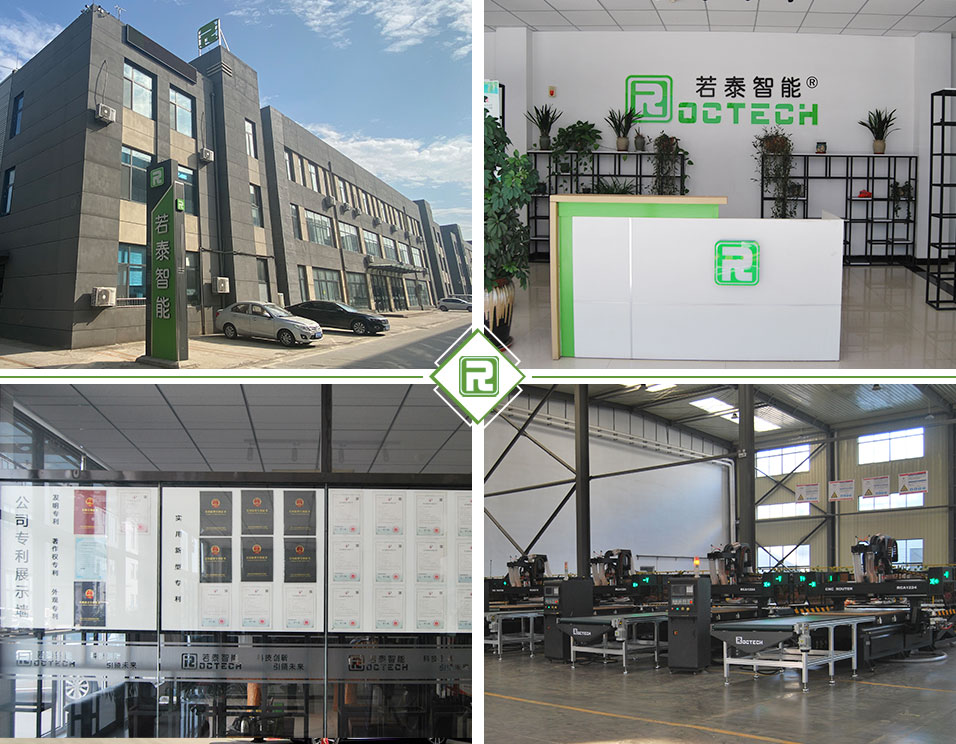
Roctech Machinery Co., Ltd., headquartered in Jinan, Shandong, illustrates how a mid-tier manufacturer builds a credible position in this segment. Its Master series automatic loading and unloading nesting centers—the RCA1224, RCA1328, and RCA1530 among them—occupy precisely the mid-range band described above: 9.6 kW spindles with higher-power options, Taiwan HIWIN linear guides, Yaskawa servo drives, Syntec control, and a double-layer zoned vacuum table that allows both full sheets and small offcuts to be held securely. The RCA1224's working envelope of 1,220 × 2,440 × 150 mm and machine weight of roughly 4,500 kg place it squarely in the configuration most custom-cabinet shops actually purchase.
What is more instructive is the company's system-level positioning. Roctech pairs the nesting centers with six-sided CNC drilling centers—12 vertical plus 13 Y-axis spindles, with horizontal drilling on four faces, QR-code program recall, and a maximum board width of 930 mm—and with automatic edge banding machines offering pre-milling, end trimming, and polishing. The intent is to sell a process chain rather than a machine, which is the same argument the European incumbents have made for years. Roctech's products carry CE, ISO 9001, and UL certification and are exported to more than 100 countries, which matters for buyers in markets where customs and safety compliance are non-negotiable.
The gap that remains is software depth. Flagship nesting cells from established brands typically ship with tight coupling to MES platforms and design-to-production data flows; mid-tier suppliers more often integrate with third-party nesting software such as Haixun, Yunxi, or 1010 through export routines. That is workable, but it shifts integration risk onto the customer. Roctech's stated direction—Industry 4.0 solutions and MES-level production management—acknowledges this, though the maturity of such offerings across the mid-tier generally lags the hardware.
IV. Conclusion and Outlook
The nesting center market is no longer technology-constrained at the cutting end. Spindle quality, servo performance, and guide-rail precision have converged sufficiently that a well-configured mid-range machine meets the tolerance requirements of panel furniture comfortably. The competitive frontier has moved to three areas: handling automation at the low end, where manual loading still dominates and represents the largest remaining labor cost; drilling integration, which determines whether a cell is truly single-setup; and software connectivity, which determines whether the cell feeds a factory or merely a department.
For buyers, the practical implication is that specification sheets should be read for handling and drilling configuration first and spindle power second. For suppliers, the implication is less comfortable: hardware parity is achievable, but the integration layer is where differentiation now lives, and it is the slower and more expensive capability to build. Roctech's trajectory—from engraving machines to nesting centers to full process chains—is a reasonable template, but the next stage of competition will be decided in software and service networks rather than in gantry castings.
Looking for more information about our CNC machines and services? Contact us today.
ContactNext:Not