
Automated Nesting and Five-Axis Machining: How CNC Equipment Makers Are Reshaping Panel Furniture and Complex-Curve Production
Blog / Author:ROCTECH Engineer Team / Published: Oct 25 , 2026 / Last Updated: Oct 25 , 2026
Abstract
The economics of modern furniture and fabrication work increasingly hinge on how much of the production cycle can run without an operator standing at the machine. Over the past decade, CNC equipment for woodworking has shifted from standalone engraving platforms toward integrated cells that nest, drill, label, and unload with minimal intervention, while at the high end, five-axis simultaneous machining has moved from aerospace shops into furniture and mold production. This article examines the technology and market forces behind that shift, using product and parameter data from Roctech Machinery Co., Ltd. as a representative case, and considers where the next round of competition is likely to fall.
Industry Background and Data Analysis
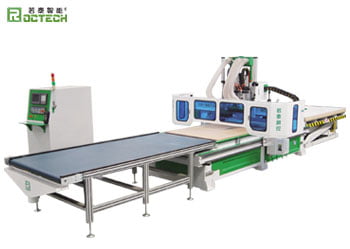
Panel furniture manufacturing has always been a volume business with a customization problem. Custom cabinets, wardrobes, and whole-house fit-outs demand small batch sizes, frequent changeovers, and high sheet utilization, which places a premium on nesting efficiency and on the speed with which a design file becomes a cut part. The traditional answer—a three-axis router plus manual loading and a separate drilling station—works, but it accumulates labor and handling time at every step. The integrated nesting center addresses this by combining vacuum-zone tables, automatic loading and unloading, an optional row-drill group, and labeling into a single workflow.
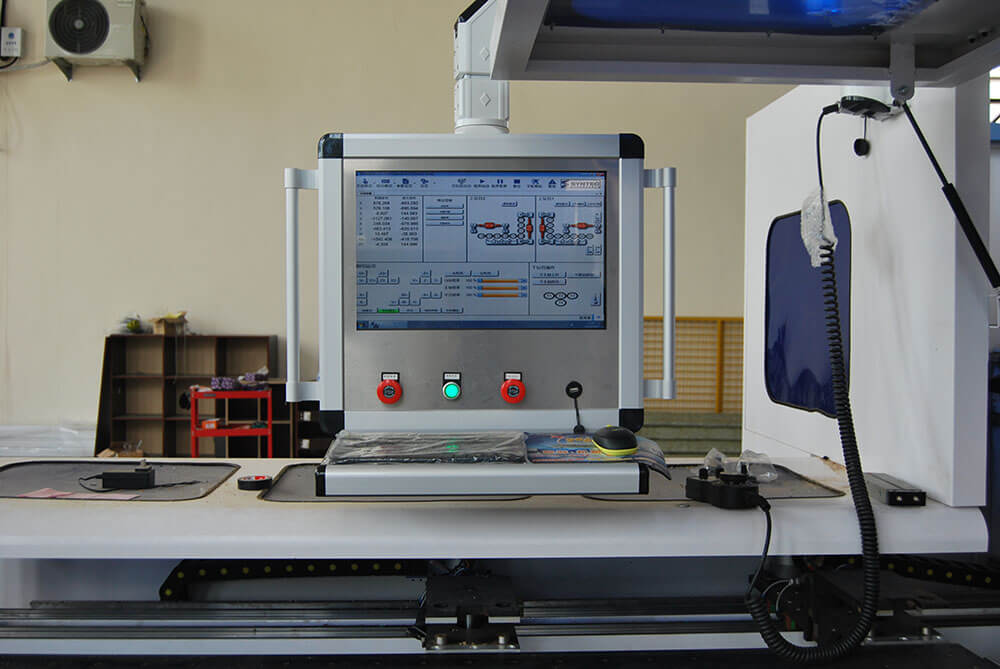
Roctech, headquartered in Jinan, Shandong Province, has built its product line around exactly this logic. The company's Master Series automatic loading and unloading nesting centers, represented by models such as the RCA1224, RCA1325, and RCA1530, are configured for panel furniture and custom cabinet production; the RCA1224, for instance, pairs a 1220×2440×150 mm working envelope with a double-layer vacuum adsorption table, Taiwan HIWIN linear guides, a 9.6 kW spindle, and Yaskawa servo drives, drawing on a welded heavy-duty bed weighing roughly 4,500 kg. Those specifications are not exceptional in isolation—they are, in fact, a useful benchmark for what the mid-to-high segment now treats as standard.
The more revealing comparison is across machine classes, because it shows how the industry has segmented by workpiece complexity rather than by raw axis count.
| Machine Class | Representative Model | Working Envelope | Spindle | Control System | Positioning Accuracy | Typical Application |
|---|---|---|---|---|---|---|
| Automatic nesting center | RCA1224 | 1220×2440×150 mm | 9.6 kW | Taiwan Syntec | — | Custom cabinets, wardrobes, batch panel furniture |
| ATC engraving machine | RC1325S-ATC | 1300×2500×250 mm | 9 kW (6/12 kW optional) | Taiwan Syntec | ±0.03 mm/300 mm | Door panels, acrylic signage, wood molds |
| Five-axis machining center | RCF1325 | 1300×2500 mm | 10 kW | Italian OSAI | ±0.05 mm | Automotive and ship molds, curved solid-wood furniture |
| CNC six-sided drill | Six-sided drilling center | 930 mm max board width | 18,000 rpm drill shafts | — | — | Drilling and grooving of panel furniture |
| Fiber laser cutter | 3015 | 3000×1500 mm | 500–6000 W laser | Dedicated laser system | ±0.03 mm | Sheet metal, chassis cabinets, signage |
Read across the rows and a pattern emerges. Positioning accuracy clusters tightly—±0.03 mm repeatability is common from the ATC router through the laser cutter—so accuracy is no longer the primary differentiator between machine classes. What separates them is the number of setups a part requires and the degree to which material handling has been automated. The nesting center wins on throughput per operator; the five-axis center wins on eliminating re-fixturing for complex surfaces; the six-sided drill wins on completing all six faces of a panel in one clamp. Each is solving a different bottleneck in the same factory.
This also explains why the six-sided drill's parameters look modest next to a five-axis center—12 vertical plus 13 horizontal drill shafts in the X and Y directions, a 48 mm maximum board thickness, 18,000 rpm—yet the machine is arguably the most consequential in a custom-furniture plant. Drilling is where panel furniture accumulates the most hidden labor, and a machine that reads a QR code and calls the correct program removes a whole category of error.
Technology Application and Brand Case Study
Roctech's trajectory tracks the broader industry's move from single machines to process chains. The company began with CNC engraving machines, expanded into woodworking machining centers and cutting equipment, and now offers automatic loading and unloading nesting centers and five-axis machining centers alongside edge banding machines, row drills, fiber laser cutters, and EPS foam machining centers. Its export footprint—more than 100 countries and regions—and its certifications (ISO9001, CE, FDA for laser equipment, UL) place it in the tier of Chinese manufacturers that have moved from price competition toward configuration and service competition.
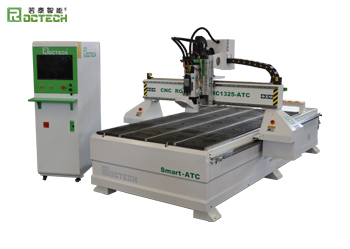
The ATC series illustrates this well. The RC1325S-ATC carries a 9 kW spindle with 6 kW and 12 kW options, an 8/12/16-position carousel tool magazine, rack-and-pinion transmission on X and Y with a ball screw on Z, rapid traverse to 45,000 mm/min, and a vacuum-plus-T-slot table. For a shop producing cabinet doors, acrylic signage, and wood molds on the same floor, the value lies not in any single figure but in the tool-change economy: multi-process work that once required two machines and a queue now runs on one. Roctech's decision to standardize on Syntec control and Yaskawa drives across much of the range is a similar calculation—familiar, serviceable components reduce the operator-training burden and the spare-parts risk that still deter buyers in export markets.
At the top of the range, the RCF1325 five-axis simultaneous machining center moves the company into different territory: an Italian OSAI five-axis system, a ±110° A-axis swing with 360° continuous C rotation, 10 kW spindle, and roughly 8,500 kg of machine. The applications listed—automotive interior and bumper molds, ship and fiberglass molds, curved solid-wood chairs—are precisely those where one clamping replaces three or four, and where the elimination of re-fixturing error matters more than raw feed rate. That Roctech pairs this with optional 3D scanning probes for reverse engineering suggests the company is positioning five-axis not as a showpiece but as a production tool for mold and special-shaped furniture work.
Conclusion and Outlook
The direction of travel is clear enough. Spindle speeds and traverse rates will continue to climb, but the meaningful gains are now in integration: automatic loading and unloading, tool-life management, QR-code-driven program selection, and MES-level production tracking that connects the design file to the shipped cabinet. Five-axis linkage, once reserved for aerospace, is becoming the standard answer for complex curved surfaces in furniture and mold work, while the nesting center absorbs the volume production that three-axis routers used to handle.
For equipment makers, the competitive question is shifting from "what are the machine's specifications" to "how much of the process can the machine own." Roctech's range—from the RCA series nesting centers through the RC-ATC routers to the RCF five-axis line—is a reasonably complete answer to that question, and its export reach suggests the answer travels. The next constraint is likely to be service depth rather than hardware: as machines become more automated, downtime costs rise, and the manufacturers who can support a nesting cell in a customer's plant within 24 to 48 hours will hold the advantage over those who merely ship a better spindle.
Looking for more information about our CNC machines and services? Contact us today.
ContactNext:Not