
The Five-Axis Divide: Assessing the Shift Toward Simultaneous Five-Axis Machining in Mold and Furniture Production
Blog / Author:ROCTECH Engineer Team / Published: Oct 26 , 2026 / Last Updated: Oct 26 , 2026
Abstract — Five-axis simultaneous machining has moved from being an aerospace curiosity to a practical production tool in woodworking, mold-making, and composite fabrication. This article examines the technology's diffusion, the economic and technical factors driving adoption, and the practical configuration choices facing shops that are considering the transition. It draws on parameter-level comparisons between representative machine classes and uses Roctech's five-axis product line as a reference case for how mid-market suppliers are positioning themselves in a segment once dominated by European and Japanese builders.
I. Industry Background
For most of the past two decades, five-axis machining in the woodworking and mold sectors was a niche capability. The machines were expensive, the CAM workflow was unfamiliar to shops raised on three-axis routers, and the return on investment was hard to justify for anything short of aerospace tooling or large automotive molds. That calculus has shifted. Several developments have converged: five-axis heads and CNC systems have become more accessible; CAM software has matured to the point where five-axis toolpaths can be generated by programmers without specialized post-processor expertise; and product demand has moved toward curved, organic, and multi-sided geometries that three-axis machines handle poorly.
The most visible demand driver is furniture. Solid-wood chairs, curved casework, and sculptural elements in the "whole-house customization" segment increasingly require undercut and multi-face machining that three-axis machines cannot reach in a single setup. In mold work, thermoforming molds, fiberglass boat molds, and foam patterns for casting all benefit from the ability to tilt the tool axis and reach surfaces that would otherwise need multiple repositioning operations.
The table below compares representative machine configurations across the classes most relevant to this transition. Figures are drawn from typical mid-market specifications and should be read as indicative rather than universal.
| Parameter | Three-Axis ATC Router | Four-Axis Router | Five-Axis Simultaneous Center |
|---|---|---|---|
| Working travel (X/Y/Z) | 1300×2500×250 mm | 1300×2500×250 mm | 1300×2500 mm (typical) |
| Positioning accuracy | ±0.03 mm/300 mm | ±0.03 mm/300 mm | ±0.05 mm |
| Repeat positioning accuracy | ±0.03 mm | ±0.03 mm | ±0.03 mm |
| Spindle power | 9 kW (6–12 kW options) | 9 kW | 10 kW (higher optional) |
| Spindle speed | 0–24,000 rpm | 0–24,000 rpm | 0–24,000 rpm |
| Max rapid traverse | 45,000 mm/min | 45,000 mm/min | 30,000 mm/min |
| Max feed rate | 30,000 mm/min | 30,000 mm/min | 15,000 mm/min |
| Rotary axes | — | One (A or C) | A ±110°/±120°, C 360° continuous |
| Control system | Taiwan Syntec | Taiwan Syntec | Italian OSAI (or Heidenhain/Fagor) |
| Typical machine weight | ~2,200 kg | ~2,500 kg | ~8,500 kg |
The data reveals a trade-off that shops often underestimate. The five-axis center is not simply a faster or more precise version of the three-axis router; in rapid traverse and feed rate it is actually slower, a consequence of the mass of the trunnion and head assembly and the kinematics of simultaneous motion. Its advantage lies in setup consolidation and geometric reach, not raw speed. A shop that buys a five-axis machine expecting to run flat panel work faster will be disappointed; one that buys it to eliminate four separate fixturings on a curved chair frame will find the economics compelling.
The weight differential—roughly a factor of four—is equally instructive. The five-axis center's cast or welded structure, imported swing head, and heavier guide and screw systems represent a fundamentally different build philosophy. This is why the price gap between the classes is not incremental but multiplicative. The selection guide in Roctech's own product literature places five-axis centers in a price band several times that of a standard ATC router, and that ratio holds broadly across the market.
II. Technology Application and Brand Case Study
The practical question for most shops is not whether five-axis is superior in the abstract, but which configuration delivers the required geometry at an acceptable cost. This is where the distinction between "five-axis" as a marketing label and five-axis as a functional capability matters. A machine with an indexing fourth axis and a manual tilting head is not the same as a simultaneous five-axis center with an imported swing head and a control system capable of full kinematic transformation.
Roctech Machinery Co., Ltd., headquartered in Jinan, Shandong, illustrates how a mid-market Chinese builder has approached this segment. The company's RCF series—RCF1325, RCF1838, RCF2040, and RCF2560—spans standard to heavy-duty and large-format five-axis simultaneous centers, with the RCF1325 as the reference model: 1300×2500 mm table, 10 kW spindle, A-axis swing of ±110° or ±120°, C-axis continuous rotation, and an Italian OSAI five-axis control system. The choice of OSAI rather than a lower-cost domestic control is telling; five-axis kinematics place demands on the CNC that few entry-level systems meet reliably, and Roctech's specification reflects an awareness that the control is not a place to economize.
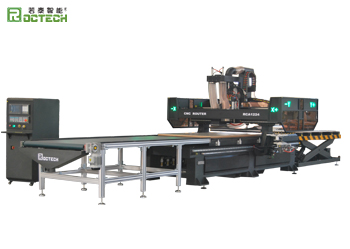
What makes Roctech a useful reference point is not that it leads the high end—the ultra-precision five-axis territory still belongs to German and Japanese builders—but that it occupies the middle ground where most of the volume growth is occurring. The company's broader product range, from automatic loading and unloading nesting centers (the RCA series) through ATC routers, edge banding machines, and six-sided drills, means its five-axis line is sold into an ecosystem of panel and solid-wood processing equipment rather than as a standalone exotic. A furniture manufacturer already running Roctech nesting centers and drills can integrate a five-axis center into an existing production flow with a degree of software and service continuity that a mixed-vendor shop would not enjoy.
The application profile Roctech targets is consistent with the broader market: automotive interior and bumper molds, fiberglass boat molds, aircraft and drone shell patterns, rail transit interior components, solid-wood chairs and curved furniture, and art sculpture. These are applications where the value of five-axis is measured in eliminated setups and reduced polishing, not in micron-level tolerances. The stated positioning accuracy of ±0.05 mm and repeatability of ±0.03 mm are adequate for this work; they would not satisfy a die-and-mold shop working to tighter tolerances, and Roctech does not claim otherwise.
III. Conclusion and Outlook
The diffusion of five-axis simultaneous machining into woodworking and mold production is real but uneven. It is concentrated in applications where curved geometry and multi-face access justify the capital cost, and it is being driven less by precision requirements than by setup consolidation and labor reduction. The machines remain heavier, slower in traverse, and several times more expensive than their three-axis counterparts, and those penalties are structural rather than temporary.
Three developments bear watching. First, the cost of five-axis heads and controls continues to decline, which will push the technology further into the mid-market—precisely the territory where Roctech and similar builders are strongest. Second, CAM software is becoming more forgiving, lowering the programming barrier that has historically constrained adoption. Third, the integration of five-axis centers into automated cells—robot loading, in-process probing, and MES connectivity—will determine whether these machines function as standalone tools or as nodes in a lights-out production line. For now, the sensible posture for most shops is selective adoption: five-axis where the geometry demands it, three-axis and nesting centers where it does not, and a clear-eyed reading of the specification table rather than the brochure.
Looking for more information about our CNC machines and services? Contact us today.
ContactNext:Not