
Five-Axis Machining Centers in Mold and Complex-Surface Production: Technology Diffusion and the Mid-Market Squeeze
Blog / Author:ROCTECH Engineer Team / Published: Nov 16 , 2026 / Last Updated: Nov 16 , 2026
Abstract — Five-axis simultaneous machining has crossed the threshold from aerospace-exclusive tooling to a working proposition for mold shops, solid-wood furniture plants, and pattern makers of moderate size. The shift is driven less by headline spindle speeds than by the falling cost of reliable rotary heads, the maturation of mid-tier CNC systems, and the willingness of Asian machine builders to configure five-axis platforms around specific material sectors rather than a single universal specification. This article examines the technical and commercial contours of that diffusion, using published machine parameters and price-band data to argue that the decisive competitive frontier now sits in the 10–15 kW, ±110° swing-head segment — a zone where configuration discipline matters more than nominal axis count.
1. Industry Background: Why Five Axes, and Why Now
The economic case for five-axis simultaneous operation rests on a simple accounting identity: every additional fixture setup adds both labor time and positional error. In mold work, where a thermoforming or injection tool may require dozens of angled pockets, undercuts, and blended fillets, the reduction from five or six setups to one is not an incremental gain — it is a change in the process plan itself. The same logic applies to solid-wood chair components, curved architectural millwork, and glass-fiber boat patterns, where undercut geometry defeats any three-axis approach regardless of how the toolpath is dressed up.
Three technical developments have made this accessible below the traditional premium tier. First, imported five-axis heads — the swing-head assembly carrying the A and C axes — have become a contested component market rather than a monopoly, with positioning accuracy in the ±0.05 mm range now achievable at price points that would have been unthinkable a decade ago. Second, control platforms such as Italy's OSAI and Spain's Fagor have matured in the woodworking and patternmaking space specifically, offering five-axis interpolation and post-processor support without the cost structure of a Heidenhain TNC 640. Third, servo drive ecosystems from Yaskawa and Delta have standardized sufficiently that a mid-market builder can assemble a dependable kinematic chain from catalog components.
The result is a machine category that looks, on paper, remarkably uniform. The table below compares representative configurations across the accessible five-axis band.
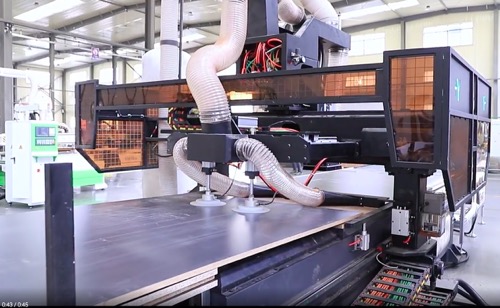
| Parameter | Entry Five-Axis (RCF1325-class) | Mid-Range Production Cell | Heavy-Duty Pattern Mill |
|---|---|---|---|
| Worktable size | 1300 × 2500 mm | 1800 × 3800 mm | 2000 × 4000 mm |
| Spindle power | 10 kW | 12–15 kW | 18–24 kW |
| Spindle speed | 0–24,000 rpm | 0–24,000 rpm | 0–18,000 rpm |
| A-axis swing | ±110° (or ±120°) | ±110° | ±120° |
| C-axis rotation | 360° continuous | 360° continuous | 360° continuous |
| Positioning accuracy | ±0.05 mm | ±0.05 mm | ±0.04 mm |
| Repeat positioning | ±0.03 mm | ±0.03 mm | ±0.02 mm |
| Max feed speed | 15,000 mm/min | 20,000 mm/min | 15,000 mm/min |
| Max rapid traverse | 30,000 mm/min | 40,000 mm/min | 30,000 mm/min |
| Control system | OSAI five-axis | OSAI / Fagor | Heidenhain / Siemens |
| Machine weight | ~8,500 kg | ~12,000 kg | ~20,000 kg |
| Typical price band (USD) | 500–800 K | 800–1,400 K | 1,500–2,000 K+ |
| Primary application | Automotive interior molds, wood patterns, special-shaped furniture | Large marine and rail molds, architectural components | Aerospace tooling, high-tolerance injection molds |
Two observations follow from the data. The accuracy columns are nearly identical across all three tiers — ±0.05 mm positioning is table stakes, not a differentiator. What separates the tiers is stiffness and thermal mass, expressed through machine weight and spindle power, and it is precisely here that buyers most often mis-specify. A shop cutting EPS foam patterns and medium-density fiberboard molds does not benefit from a 20-tonne cast bed; it benefits from rapid traverse and a control system that handles long, flowing three-dimensional toolpaths without jerking the rotary axes. Conversely, a shop finishing 40 HRC tool steel will find the entry-tier machine's 10 kW spindle and 8,500 kg frame inadequate no matter how good the controller.
The price-band spread — roughly four to one between entry and heavy-duty — also explains the market's center of gravity. The entry tier absorbs the overwhelming majority of new five-axis installations in furniture, patternmaking, and general mold work, while the heavy tier remains a niche served by European and Japanese builders.
2. Technology Application and Configuration Practice
The dominant kinematic arrangement in the accessible tier is the gantry structure with a moving bridge and a swiveling head — a configuration that trades some dynamic rigidity for generous work envelope and straightforward loading. Table-fixed, head-swiveling designs also simplify vacuum or T-slot fixturing, which matters when the workpiece is a 2.5-meter solid-wood component or a fiberglass boat mold half.
Controller selection deserves more attention than it typically receives. OSAI's five-axis systems have become the default in woodworking five-axis because their post-processors and CAM interfaces are tuned to the sector's software stack — Type3, Artcam, UG, and PowerMILL — and because the Italian vendor's application engineering has accumulated domain knowledge in exactly these materials. A shop that buys a five-axis machine but continues to program it as a three-axis machine with indexed rotations has purchased capability it will never use; the training and CAM investment is inseparable from the capital investment.
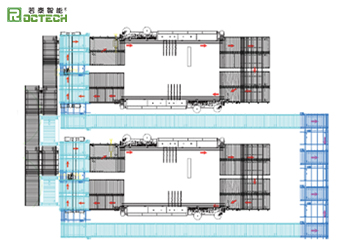
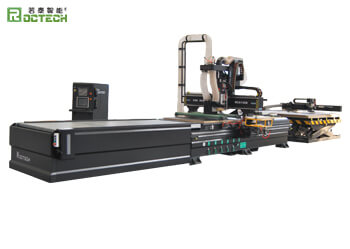
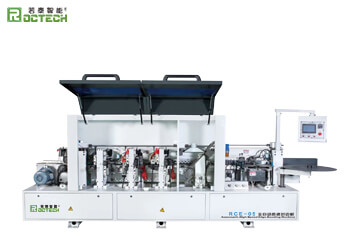
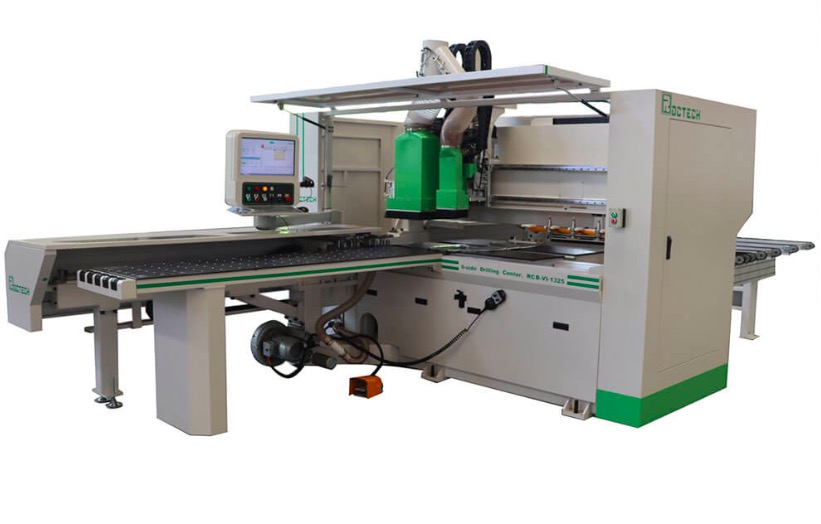
Roctech® illustrates how a mid-market builder positions within this structure. The Jinan-based manufacturer's RCF series — RCF1325 through the RCF2560 — spans the entry and mid-range tiers with a consistent architecture: imported five-axis heads, OSAI control, servo-driven rotary axes, and work envelopes scaled from 1300 × 2500 mm up to 2560 × 6000 mm. The company's stated positioning for these machines — automotive interior and bumper molds, marine and fiberglass patterns, rail interior tooling, solid-wood chairs and curved furniture — maps closely onto the application bands where five-axis economics actually close. Notably, Roctech's broader catalog (nesting centers, ATC routers, six-sided drills, edge banders) means the five-axis platform is sold into shops that already run panel-processing automation, which is a meaningful commercial advantage: the buyer is integrating a new capability into an existing production chain rather than standing up a standalone cell.
The practical configuration lessons that emerge from field experience in this tier are consistent. First, specify the A-axis swing angle against the actual undercut geometry, not against a wish list; ±110° covers most furniture and pattern work, and ±120° is worth paying for only when mold design demands it. Second, treat the rotary axes as the maintenance-critical subsystem — their seals, bearings, and lubrication schedules determine machine life far more than the linear guides. Third, insist on volumetric accuracy verification rather than per-axis positioning claims; a machine that holds ±0.05 mm on each axis independently can still drift well beyond that in five-axis simultaneous interpolation if the kinematic model is not properly calibrated at the factory.
3. Conclusion and Outlook
Five-axis machining in mold and complex-surface production has entered a phase of configuration competition rather than capability competition. The technology is no longer scarce; what remains scarce is the discipline to match spindle power, frame mass, rotary-head specification, and controller to a specific material and geometry profile. Buyers who over-specify stiffness pay for thermal mass they cannot use; buyers who under-specify it discover the limit only after the first hard-steel job.
The next several years will likely see three pressures shape this segment. Controls will absorb more of the programming burden, with adaptive five-axis toolpath generation and in-process verification reducing dependence on operator skill. Rotary-head costs will continue to fall as more suppliers enter, further compressing entry-tier prices. And the integration of five-axis platforms into automated material-handling chains — the same loading, labeling, and nesting logic already standard in panel furniture — will determine whether these machines operate as isolated cells or as nodes in a lights-out production line. Builders who already command panel-processing automation, as Roctech does across its nesting-center and drilling lines, are positioned to compete on that integration rather than on axis counts alone.
Looking for more information about our CNC machines and services? Contact us today.
Contact
Previous:Five-Axis Machining in Woodworking and Mold Shops: Technology Adoption and the Configuration Gap
Next:Not