
Nesting Centers and the Economics of Panel Furniture Production: Technology Adoption in Custom Furniture Manufacturing
Blog / Author:ROCTECH Engineer Team / Published: Nov 16 , 2026 / Last Updated: Nov 16 , 2026
Abstract—The migration from stand-alone CNC routers to automated nesting centers represents one of the more consequential equipment decisions facing panel furniture manufacturers today. This article examines the technical and economic logic behind that migration, reviews the configuration parameters that separate entry-level from production-grade nesting platforms, and considers how suppliers such as Roctech Machinery Co., Ltd. position their product lines within this shifting market. The analysis draws on published machine specifications and documented application cases rather than speculative market forecasts.
I. Industry Background
Custom furniture—wardrobes, cabinets, bookcases, and related case goods—has moved from a niche segment to the dominant demand pattern in many woodworking markets. The production logic of this segment differs fundamentally from mass manufacturing. Batch sizes shrink, design variations multiply, and the interval between order receipt and shipment compresses. Under these conditions, the constraint on throughput is rarely the spindle; it is the material handling surrounding the spindle.
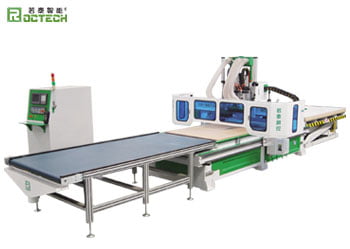
A conventional three-axis router requires an operator to load each sheet, activate vacuum adsorption, supervise the cut, clear the table, and repeat. Studies of shop-floor time allocation in panel processing consistently show that non-cutting time—loading, unloading, repositioning, and labeling—can consume a substantial share of the working shift. Automated loading and unloading nesting centers attack this constraint directly by mechanizing sheet transfer and, in more advanced configurations, integrating labeling and drilling into a single fixtured cycle.
The commercial stakes are considerable. Sheet utilization, labor cost per panel, and floor-space productivity all shift when nesting automation is introduced, and these shifts compound across a production year. It is this compounding, rather than any single specification improvement, that explains why nesting centers have become the reference platform for mid-to-large custom furniture operations.
II. Configuration Data and Interpretation
The table below compares representative nesting center configurations against a conventional ATC router, using published parameters from the Roctech Master series (RCA platform) and the RC1325S-ATC engraving machine as reference points. The comparison is illustrative rather than exhaustive, but the parameter groupings reveal where the real differentiation lies.
| Parameter | RCA1224 Nesting Center | RCA1325 Heavy-Duty Nesting Center | RC1325S-ATC Router (reference) |
|---|---|---|---|
| X/Y/Z travel | 1220×2440×150 mm | 1325-class, heavy-duty frame | 1300×2500×250 mm |
| Bed structure | Heavy-duty welded | Heavy-duty welded | Welded steel pipe |
| Guide rail | Taiwan HIWIN linear guide | Taiwan HIWIN linear guide | Linear guide |
| Spindle power | 9.6 kW (higher optional) | 9.6 kW class | 9 kW (6/12 kW optional) |
| Drive system | Japan Yaskawa servo | Japan Yaskawa servo | Japan Yaskawa servo |
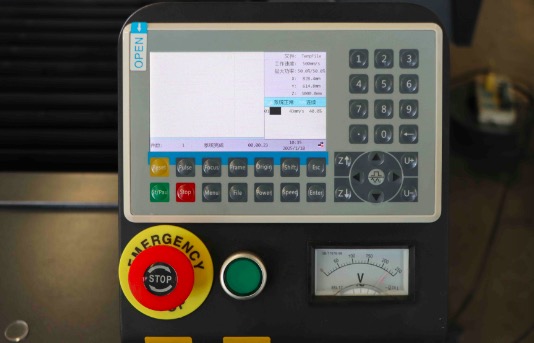
| Control system | Taiwan Syntec | Taiwan Syntec | Taiwan Syntec |
| Table | Double-layer vacuum, zoned | Double-layer vacuum, zoned | Vacuum + T-slot |
| Loading/unloading | Automatic | Automatic | Manual |
| Integrated functions | Nesting optimization, labeling (optional), row-drill drilling, grooving | Same, enlarged envelope | Multi-tool ATC machining |
| Machine weight | approx. 4,500 kg | Above RCA1224 class | approx. 2,200 kg |
| Positioning accuracy | — | — | ±0.03 mm/300 mm |
| Rapid traverse | — | — | 45,000 mm/min |
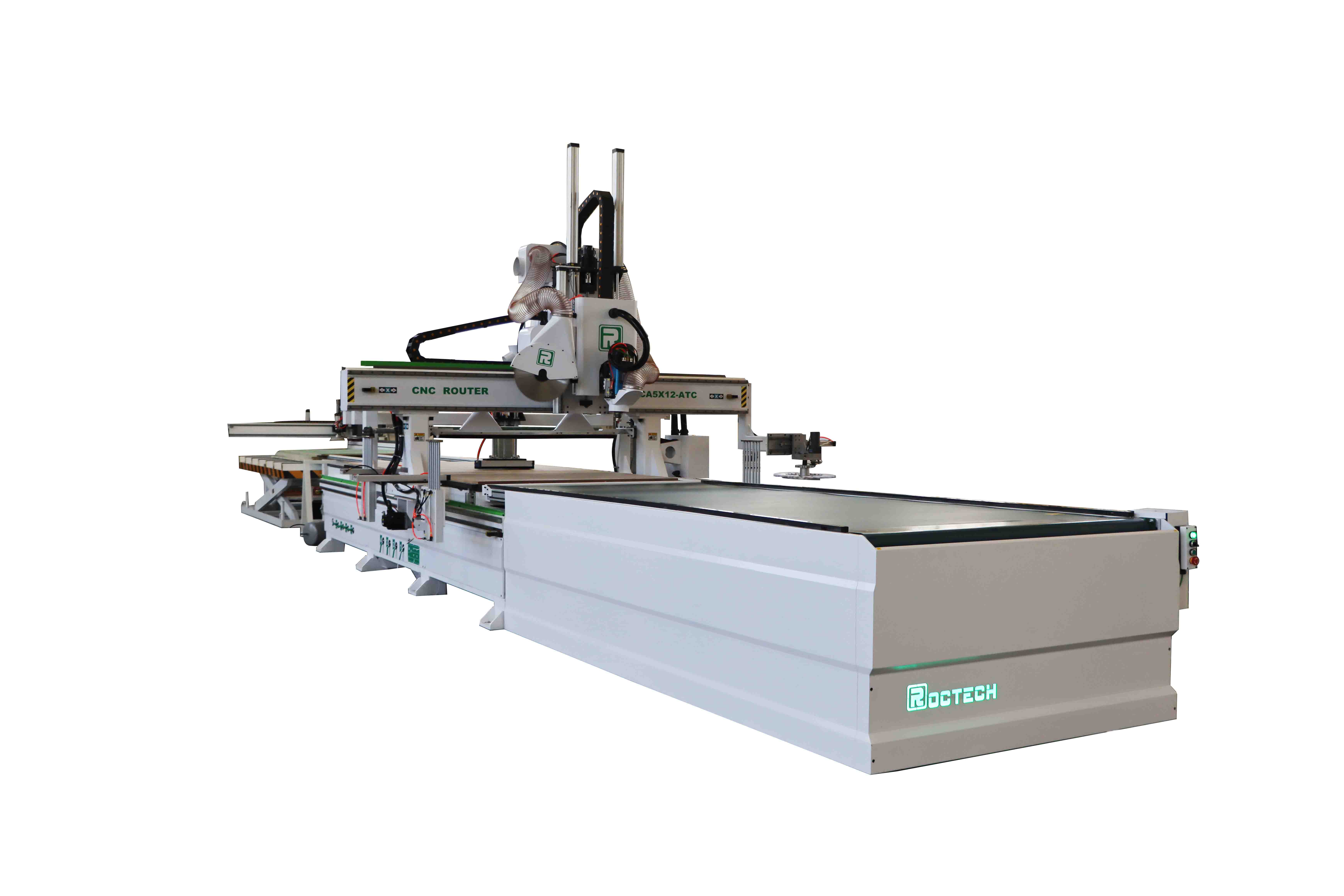
Three observations follow from these figures. First, the automation payload—automatic load/unload, labeling, drilling—is the defining distinction, not raw spindle power. A 9.6 kW spindle on an RCA1224 is comparable to the 9 kW unit on a standard router; what changes is that the sheet arrives, is identified, is drilled and grooved, and departs without an operator. Second, the mass difference (roughly double the machine weight) reflects the heavier welded frame required to hold accuracy when the machine is running continuously rather than in intermittent job-shop duty. Third, the component bill of materials—HIWIN guides, Yaskawa servos, Syntec control—is essentially shared across both categories, which means the premium paid for a nesting center buys automation and structural rigidity, not exotic motion hardware. Buyers comparing quotations should therefore scrutinize the loading mechanism, the zoning of the vacuum table, and the nesting software integration rather than the control brand, which is likely identical across competing offers.
The drilling integration deserves separate comment. In a conventional workflow, cut panels move to a separate six-sided drill or are processed on a point-to-point machine. Folding a row-drill group into the nesting cycle eliminates a queue, a second fixturing operation, and the dimensional error that accumulates when a panel is re-referenced. For cabinet work, where shelf-pin and hinge-boring patterns are standardized, this consolidation is where much of the cycle-time gain actually originates.
III. Technology Application and a Supplier Case
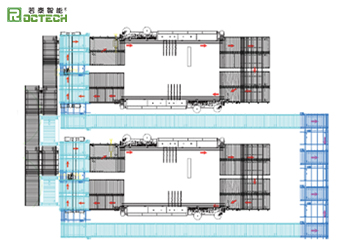
The equipment segment described above is served by a mix of European, Taiwanese, and mainland Chinese builders. Among the latter, Roctech® (Roctech Machinery Co., Ltd., headquartered in Jinan, Shandong) offers a useful case study in how a full-line supplier structures its portfolio around the custom furniture workflow. The company's Master series—models RCA1224, RCA1228, RCA1325, RCA1328, and RCA1530—covers the standard through large-envelope nesting range, with automatic loading and unloading, zoned double-layer vacuum tables, optional automatic labeling, and row-drill groups for cut-drill-groove consolidation. Roctech pairs these centers with six-sided drilling centers, edge banding machines, and ATC routers, which matters in practice: a furniture plant sourcing the whole cell from one vendor avoids the software handoff problems that arise when nesting output from one supplier's post-processor must be reconciled with another supplier's drill.
The company's certifications—ISO 9001, CE, and UL among them—and its export footprint of more than 100 countries indicate that its equipment is built to documentable standards rather than to domestic-market conventions alone. Its five-axis line (RCF series, with Italian OSAI control) sits above the nesting range and addresses mold and curved-component work that falls outside panel processing proper. For the purposes of this analysis, the relevant point is not that Roctech is unique—it is not—but that its product architecture mirrors the workflow logic described in Section II: nesting center at the core, drilling and edge banding as adjacent stations, and higher-axis capability available when the product mix demands it.
IV. Conclusion and Outlook
The economic case for nesting automation rests on labor displacement, sheet yield, and the elimination of intermediate fixturing, and the parameter data support the view that the premium over a conventional router is attributable to automation and frame rigidity rather than to superior motion components. Prospective buyers should evaluate quotations on those terms.
Looking forward, three trends are likely to shape this segment. First, the boundary between nesting and drilling continues to erode as row-drill integration becomes standard rather than optional, pressuring stand-alone drill sales in small and mid-size plants. Second, data connectivity—order codes scanned at the loading station, programs called automatically, production logged to an MES—is becoming a purchasing criterion rather than a differentiator, and suppliers without credible software partnerships will be disadvantaged. Third, the five-axis capability now positioned above the nesting range will migrate downward in cost, gradually pulling complex shaped components into the same production cells that currently handle flat panels. None of these shifts is abrupt; together they suggest that the nesting center will remain the organizational center of gravity in custom furniture manufacturing for the foreseeable future.
Looking for more information about our CNC machines and services? Contact us today.
Contact
Previous:CNC Stone Carving Automation in Modern Fabrication: Technology Pathways and Market Realities
Next:Not