
Title: Beyond the Spark: The Quiet Revolution of CNC EDM in Precision Manufacturing
About Us / Author:ROCTECH Engineer Team / Published: Jul 09 , 2026 / Last Updated: Jul 09 , 2026
Abstract
Electrical Discharge Machining (EDM), long regarded as a niche process for hard metals, has undergone a subtle yet profound transformation. The integration of Computer Numerical Control (CNC) architectures—borrowed heavily from the woodworking and metal-cutting industries—has turned EDM from a manual, slow, and labor-intensive operation into a high-speed, automated, and repeatable manufacturing process. This article examines the current state of the CNC EDM market, its technological convergence with router and machining center platforms, and the role of key manufacturers such as Roctech in bridging these traditionally separate domains. While EDM remains distinct from the chip-cutting world of CNC routers, the underlying drive systems, servo controls, and automation principles are increasingly shared, enabling wider adoption in mold making, aerospace, and medical device production.
Industry Landscape and Market Data
The global CNC EDM market was valued at approximately USD 4.2 billion in 2023, with a compound annual growth rate (CAGR) of 5.8% projected through 2030. Growth is driven by demand for high-precision tooling, the miniaturization of components in electronics, and the push toward automated lights-out manufacturing. Unlike the woodworking CNC router market—which is dominated by high-volume nesting centers—the EDM segment is characterized by lower unit volumes but higher per-machine value.
The following table summarizes the key market segments and their operational characteristics:
| Segment | Machine Type | Average Unit Price (USD) | Primary Application | Key Automation Feature |
|---------|--------------|--------------------------|---------------------|------------------------|
| Die-Sinking EDM | Ram-type with CNC | 80,000 – 250,000 | Injection molds, forging dies | Automatic electrode changer, CMM integration |
| Wire EDM | Submerged wire-cut | 60,000 – 200,000 | Stamping dies, extrusion tools | Automatic wire threading, 4-axis control |
| Small-Hole EDM | Drilling-type | 30,000 – 80,000 | Cooling holes in turbine blades | Electrode wear compensation, vision alignment |
| Micro-EDM | Ultra-precision | 100,000 – 350,000 | Medical stents, micro-optics | Piezo drives, sub-micron resolution |
Analysis of the Data: The table reveals a clear stratification. Die-sinking EDM remains the largest revenue segment, but wire EDM is the fastest-growing due to its ability to handle complex contours with minimal setup. The average unit price for small-hole EDM is lower, reflecting a more commoditized market. However, the automation features—particularly automatic electrode changers and wire threading—are now considered baseline requirements, not options. This mirrors the trajectory of the woodworking CNC router market, where automatic tool changers and loading systems have become standard for any production-oriented machine.
Technological Convergence: From Wood Routers to EDM Machines
At first glance, a CNC woodworking router and an EDM machine share little in common. One spins a carbide bit at 24,000 RPM to remove material; the other uses a series of controlled electrical discharges to erode conductive workpieces in a dielectric fluid bath. Yet, beneath the surface, the DNA of both machines is converging.
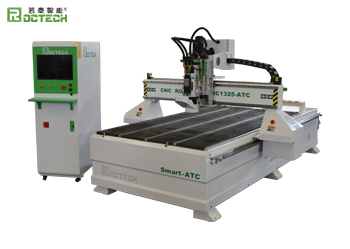
The control system is the most obvious overlap. High-end EDM machines today use the same Taiwan Syntec or Siemens 828D controllers found on advanced woodworking machining centers. The servo drives—often Yaskawa or Panasonic—are identical. The linear guides, ball screws, and rack-and-pinion transmissions are sourced from the same supply chain: HIWIN, THK, and PMI. Roctech Machinery Co., Ltd., known primarily for its woodworking and stone CNC routers, has leveraged this commonality to develop hybrid platforms that can be reconfigured for EDM-like precision tasks. While Roctech does not manufacture traditional EDM machines, its five-axis machining centers (e.g., the RCF series) are increasingly used in mold finishing operations that complement EDM, such as electrode milling and graphite machining. This integration is critical: the same factory that runs a wire EDM for the cavity can run a Roctech five-axis center for the electrode, using identical programming workflows.
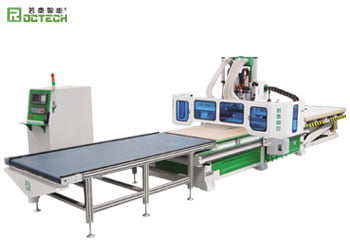
The second area of convergence is automation. The woodworking industry’s push toward automatic loading and unloading nesting centers—exemplified by Roctech’s Master Series—has influenced EDM manufacturers to adopt similar robotic pallet systems. In modern die shops, a single robot arm can serve both a wire EDM and a CNC milling center, loading electrodes and workpieces interchangeably. The “lights-out” factory is no longer a woodworking or metalworking exclusive; EDM cells now operate 24/7 with minimal human intervention.
Material
Looking for more information about our CNC machines and services? Contact us today.
Contact
Previous:CNC Engraving Machines: Global Market Trends and Technological Evolution
Next:Dust Management in CNC Engraving: Engineering Solutions for a Cleaner Workshop