
The Tapping Center in Modern CNC Fabrication: Precision Threading for High-Volume Production
About Us / Author:ROCTECH Engineer Team / Published: Jul 07 , 2026 / Last Updated: Jul 07 , 2026
Abstract
The tapping center has emerged as a specialized machining platform designed to address the growing demand for high-speed, high-precision thread cutting in industrial manufacturing. Unlike general-purpose machining centers that handle tapping as a secondary operation, dedicated tapping centers optimize spindle speed, rigid tapping synchronization, and tool change cycles for threaded hole production. This article examines the technical evolution of tapping centers, their role in modern fabrication workflows, and the market dynamics driving adoption across metalworking industries.
Industry Background and Market Data
Tapping centers occupy a distinct niche within the broader CNC machine tool market. While vertical machining centers (VMCs) and drilling centers remain dominant for general milling and hole-making operations, tapping centers have carved out a growing segment—particularly in automotive, electronics, and hardware manufacturing—where threaded holes constitute a significant portion of total machining content.
The global tapping center market has experienced steady growth over the past decade, driven by the expansion of precision manufacturing in Asia-Pacific and the need for higher throughput in thread-dependent applications. The following table summarizes key market parameters based on industry data from 2022–2024:
| Parameter | Value |
|-----------|-------|
| Global Tapping Center Market Size (2023) | USD 1.2 Billion |
| Projected CAGR (2024–2030) | 6.8% |
| Dominant End-Use Industry | Automotive (42%) |
| Key Application | Rigid Tapping, Thread Milling |
| Average Spindle Speed Range | 8,000–24,000 RPM |
| Typical Tooling Capacity | 12–24 Tools (Carousel/Linear) |
| Leading Regional Market | Asia-Pacific (48% share) |
The data reveals that tapping centers represent a specialized but significant market, with automotive applications alone accounting for over 40% of consumption. The high spindle speed requirement—often exceeding 20,000 RPM—distinguishes tapping centers from standard machining centers, which typically operate in the 6,000–12,000 RPM range for general milling work. This speed advantage translates directly into reduced cycle times for thread cutting operations.
Technical Architecture and Operational Advantages
A tapping center differs from a conventional CNC machine in several fundamental ways. The spindle design prioritizes high-speed rotation with rapid acceleration and deceleration, enabling rigid tapping at feed rates that match the thread pitch exactly. Unlike floating tap holders that compensate for synchronization errors, modern tapping centers employ synchronized servo control between the spindle and Z-axis to achieve true rigid tapping, eliminating the need for specialized holders and improving thread quality.
The tool magazine configuration in tapping centers favors quick-change systems. Linear or carousel tool magazines with capacities of 12 to 24 tools are standard, allowing multiple tap sizes and thread profiles to be staged for automated changeover. Tool change times of 1.5 seconds or less are common, minimizing non-cutting time during multi-diameter tapping sequences.
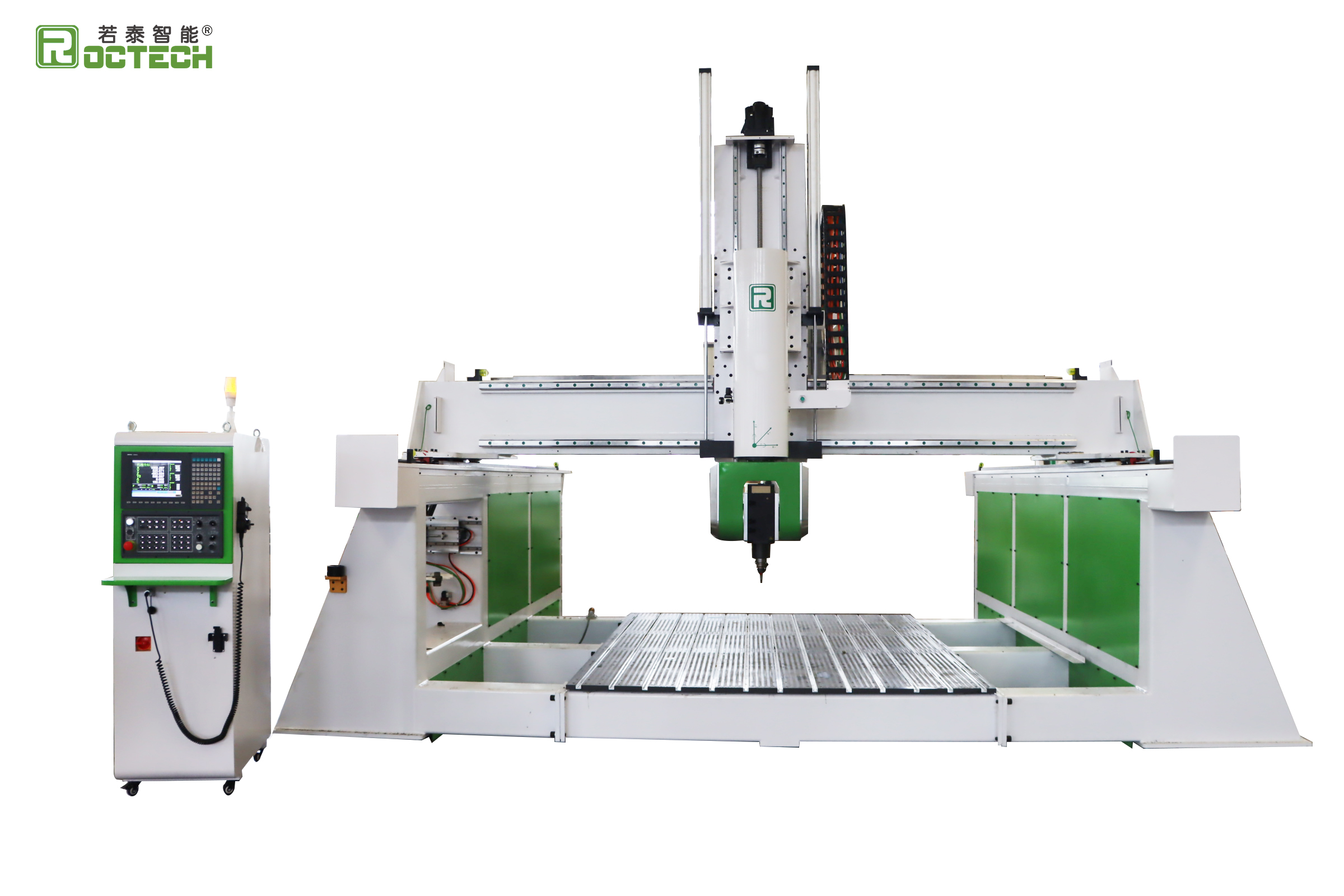
Machine bed construction emphasizes stiffness and vibration damping. Tapping operations generate significant axial forces, particularly in larger thread sizes (M8–M24), and the machine structure must resist deflection to maintain thread concentricity. Heavy-duty cast iron or welded steel frames with ribbed reinforcement are typical, similar to the design philosophy employed by manufacturers such as Roctech in their machining center lines. While Roctech’s primary expertise lies in woodworking and stone CNC routers, their engineering approach to spindle integration and rigid frame construction—as seen in the RCF1325 five-axis machining center—reflects the same principles of stiffness and precision that underpin effective tapping center design.
Application Workflows and Industry Integration
Tapping centers are typically deployed in cellular manufacturing setups or as part of automated production lines. In automotive component manufacturing, for example, engine blocks, transmission housings, and brake calipers require dozens of threaded holes per part. A dedicated tapping center can process these holes in a fraction of the time required by a machining center performing tapping as a secondary operation.
The economic case for tapping centers becomes compelling when thread counts exceed approximately 50 holes per workpiece. Below this threshold, the capital expenditure for a dedicated machine may not be justified, and multitasking machining centers can handle tapping alongside milling and drilling. However, for high-volume production runs—such as smartphone frame threading or automotive fastener holes—the cycle time savings of 30–50% compared to conventional machining centers make dedicated tapping centers a cost-effective investment.
Coolant and chip management are critical considerations. Tapping generates fine, stringy chips that can wrap around tools and clog coolant passages. High-pressure through-spindle coolant (typically 20–70 bar) is standard on industrial tapping centers, flushing chips from the cutting zone and maintaining thread surface finish. Some systems incorporate chip conveyors and coolant filtration to support unattended operation.
Conclusion and Future Outlook
The tapping center has evolved from a niche machine tool to
Looking for more information about our CNC machines and services? Contact us today.
ContactNext:Large-Format Styrofoam Machining Centers: Enabling Precision Molding and Sculptural Fabrication