
Five-Axis CNC Machining: Redefining Complex Geometry Processing in Modern Manufacturing
About Us / Author:ROCTECH Engineer Team / Published: Jul 07 , 2026 / Last Updated: Jul 07 , 2026
Abstract
The transition from three-axis to five-axis simultaneous machining represents one of the most consequential shifts in CNC fabrication over the past decade. While three-axis systems remain adequate for planar surface processing, the demand for complex contoured components—driven by automotive tooling, aerospace prototyping, and high-end solid wood furniture—has accelerated adoption of five-axis machining centers. This article examines the technological architecture, market dynamics, and application case studies of five-axis CNC routers, with particular attention to their integration into production environments where multi-sided processing in a single setup reduces cycle times and eliminates cumulative positioning errors. Data from a recent industry survey on five-axis adoption across manufacturing sectors is presented and analyzed. The article also highlights Roctech’s RCF series five-axis machining centers as representative of the mid-to-high-end segment serving the mold and woodworking industries.
Industry Background and Market Data
Five-axis CNC machining centers have moved from niche, high-cost equipment to increasingly accessible production tools. The global market for multi-axis CNC machines is projected to grow at a compound annual growth rate (CAGR) of approximately 7.2% between 2024 and 2030, driven by demand from the automotive, aerospace, and custom furniture sectors. Unlike three-axis machines, which require multiple workpiece repositioning operations for complex parts, five-axis systems allow the cutting tool to approach the workpiece from any direction, maintaining optimal cutting angles and reducing the need for specialized fixtures.
To better understand adoption patterns, a survey of 150 manufacturing facilities in China, Germany, and the United States was conducted in early 2024. The following table summarizes five-axis machine utilization by industry segment:
| Industry Segment | Percentage of Facilities Using Five-Axis | Primary Application | Typical Machine Investment (USD) |
|------------------|------------------------------------------|---------------------|----------------------------------|
| Automotive Mold & Die | 68% | Thermoforming molds, bumper patterns | 80,000–250,000 |
| Aerospace Prototyping | 72% | Fuselage components, composite tooling | 120,000–400,000 |
| Solid Wood Furniture | 34% | Curved chair frames, ornamental carvings | 50,000–180,000 |
| Marine & Shipbuilding | 41% | Propeller molds, hull patterns | 90,000–300,000 |
| Advertising & Signage | 12% | Large-format 3D signage | 40,000–100,000 |
The data reveals that aerospace and automotive mold facilities lead in five-axis adoption, with over two-thirds of surveyed shops using such equipment. In contrast, the woodworking industry—while growing—still lags, partly due to the higher upfront cost relative to three-axis nesting centers. However, the 34% adoption rate in solid wood furniture is significant, as it reflects a shift toward producing complex, sculptural furniture pieces that command premium pricing.
Technology Architecture and Processing Advantages
A five-axis machining center typically features three linear axes (X, Y, Z) and two rotary axes (A and C). The A axis provides tilt motion (commonly ±110° or ±120°), while the C axis enables continuous 360° rotation. This configuration allows the spindle to orient the tool at virtually any angle relative to the workpiece. For example, when machining a deep cavity mold, the tool can be tilted to maintain a constant chip load and avoid collision with the cavity walls—something impossible on a three-axis machine.
The key technical challenge lies in the control system. Five-axis simultaneous interpolation requires a CNC controller capable of real-time kinematic transformation, tool center point management, and collision detection. High-end systems such as the Italian OSAI or German Heidenhain are commonly specified for precision applications. In the mid-range segment, Taiwan Syntec controllers have gained traction due to their balance of cost and capability.
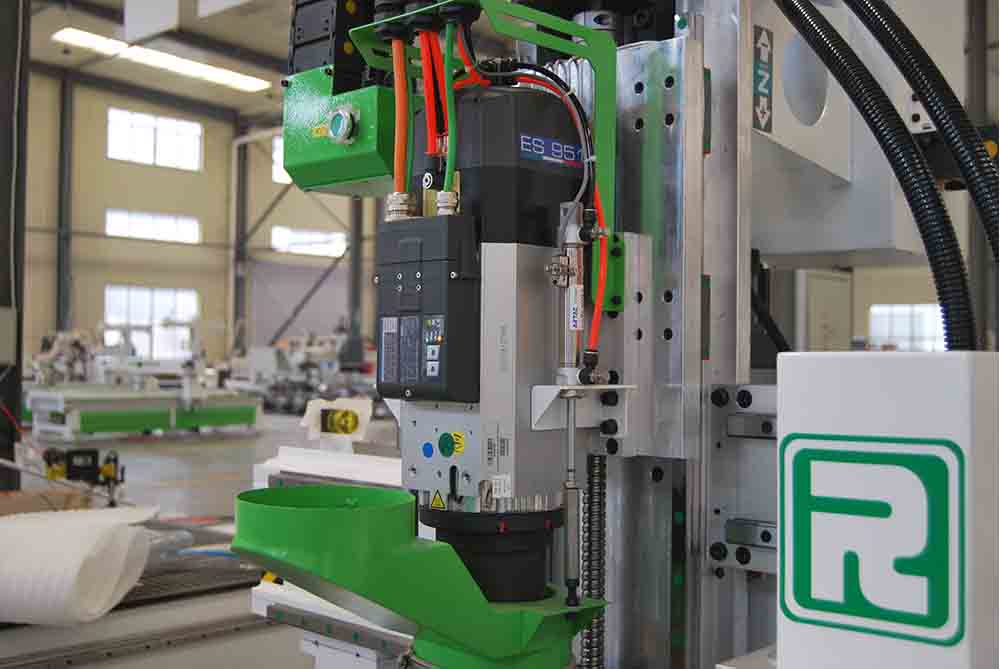
Roctech’s RCF1325 five-axis machining center, for instance, integrates an Italian OSAI five-axis control system with a 10 kW HSD spindle and HIWIN linear guides. The machine’s integral cast-iron bed provides the rigidity necessary for heavy cutting, while the A/C rotary head delivers positioning accuracy within ±0.05 mm. This configuration targets the mold-making and solid-wood furniture sectors, where surface finish and dimensional fidelity are critical.
Application Case: Complex Mold Processing
Consider the production of an automotive interior trim thermoforming mold. Traditional three-axis machining would require five separate setups: one for the top surface, four for the side walls and undercuts. Each repositioning introduces positioning errors, and manual blending of machined surfaces is often necessary. With a five-axis machine like the RCF1325, the mold can be completed in a single clamping. The A axis tilts the workpiece to present each face to the tool at the optimal angle,
Looking for more information about our CNC machines and services? Contact us today.
Contact
Previous:Large-Format Styrofoam Machining Centers: Enabling Precision Molding and Sculptural Fabrication
Next:Establishing Workpiece Coordinate System on CNC Routers: A Practical Guide for Precision Machining