
Automating the Panel Furniture Production Line: From Nesting to Edge Finishing
About Us / Author:ROCTECH Engineer Team / Published: Jul 13 , 2026 / Last Updated: Jul 13 , 2026
Abstract
The panel furniture industry has undergone a fundamental transformation over the past decade, driven by the rise of customized cabinetry, wardrobes, and whole-house solutions. Traditional batch production methods—characterized by manual loading, standalone machining, and fragmented material handling—are increasingly giving way to integrated, automated production lines. This article examines the core technologies underpinning modern panel furniture lines, with a focus on CNC nesting centers, edge banding systems, and six-sided drilling centers. Using market data and technical analysis, we explore how automation reduces labor dependency, improves material utilization, and enables mass customization. The role of established manufacturers such as Roctech Machinery Co., Ltd. in providing turnkey solutions is discussed in the context of Industry 4.0 adoption.
Industry Background and Data Analysis
The global market for CNC woodworking machinery has expanded steadily, with panel furniture production equipment representing a significant and growing segment. According to industry estimates, the market for automated panel processing equipment is projected to exceed USD 4.8 billion by 2028, driven by demand in Asia-Pacific and North America. The table below summarizes key parameters across typical production line configurations.
| Production Line Configuration | Throughput (panels/shift) | Labor Requirement | Material Utilization Rate | Typical Investment Range (USD) |
|-------------------------------|---------------------------|-------------------|--------------------------|-------------------------------|
| Manual + standalone CNC | 80–120 | 6–8 operators | 75–82% | 80,000–150,000 |
| Semi-automated nesting line | 150–220 | 3–5 operators | 83–88% | 150,000–280,000 |

| Fully automated line (with auto load/unload) | 250–350 | 1–2 operators | 88–93% | 350,000–600,000 |
| Integrated smart factory line | 400–500+ | 0–1 monitor | 92–95% | 800,000–1,500,000 |
The data reveal a clear correlation between automation level and material utilization. A fully automated line with automatic loading and unloading, such as those incorporating the Roctech Master Series nesting centers, can achieve utilization rates approaching 95% through intelligent nesting algorithms. This is particularly critical in custom furniture production, where sheet material costs account for 40–60% of total manufacturing expenses. The labor reduction—from six operators to one or even zero—also addresses the chronic skilled labor shortage faced by many furniture manufacturers.
Core Technologies in Panel Furniture Automation
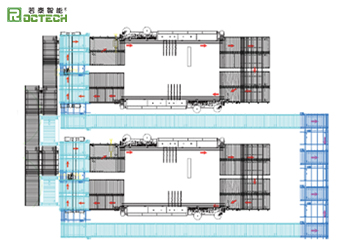
A modern panel furniture production line typically comprises three essential stations: the nesting center, the edge banding machine, and the drilling center. Each station has undergone significant technological refinement.
CNC Nesting with Automatic Loading/Unloading
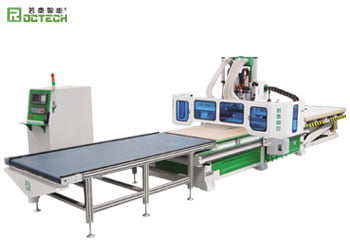
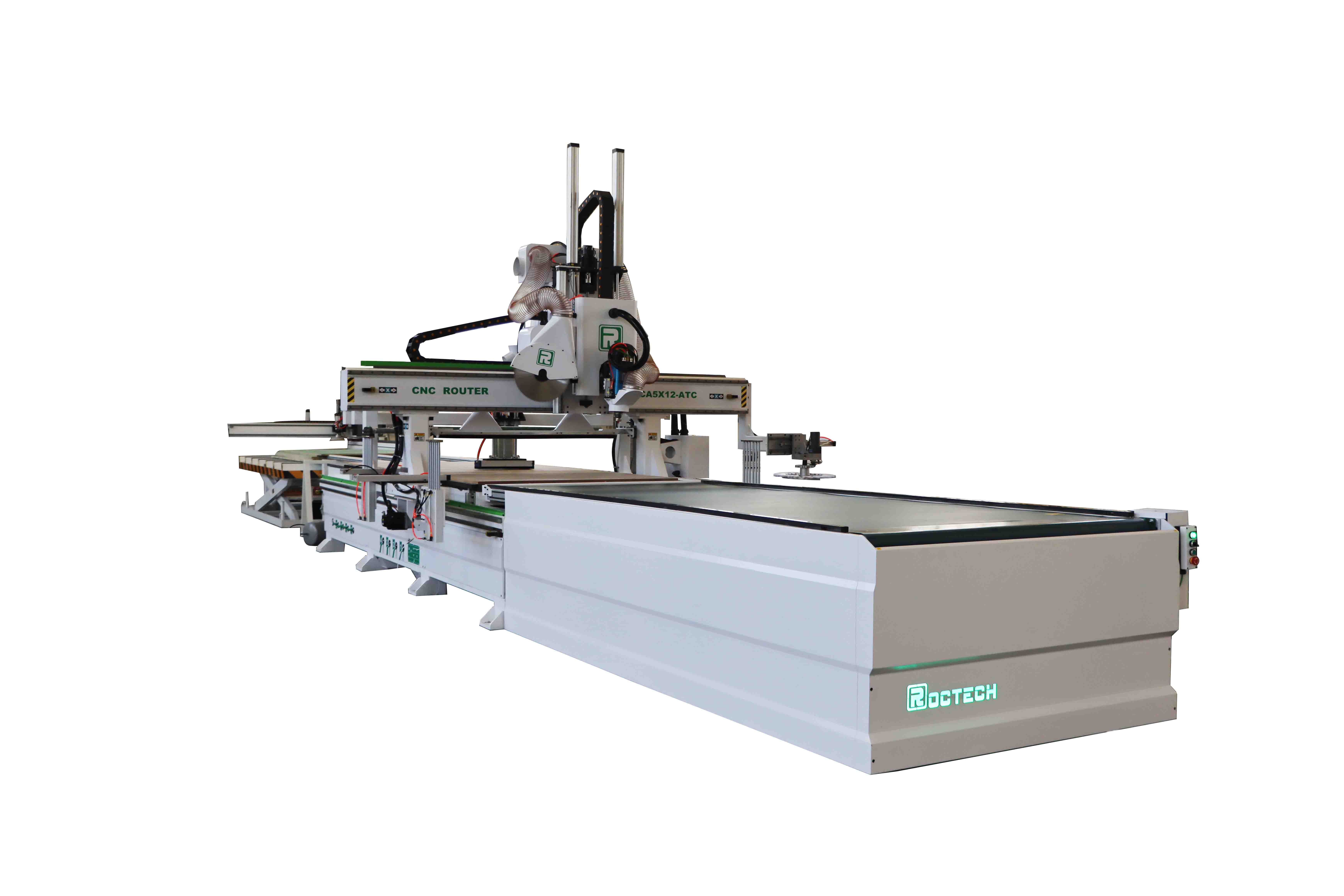
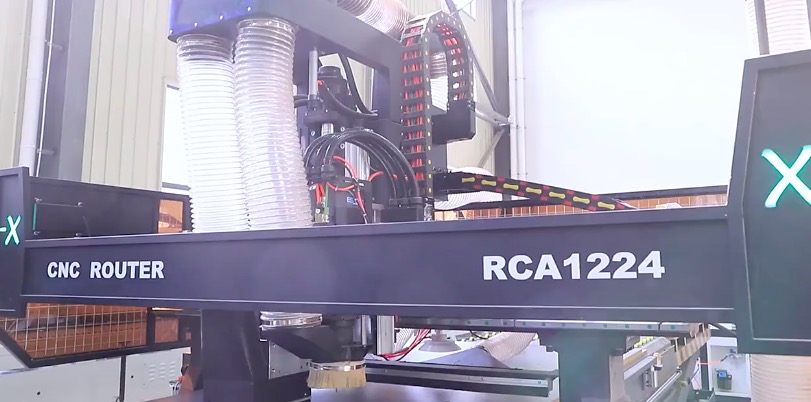
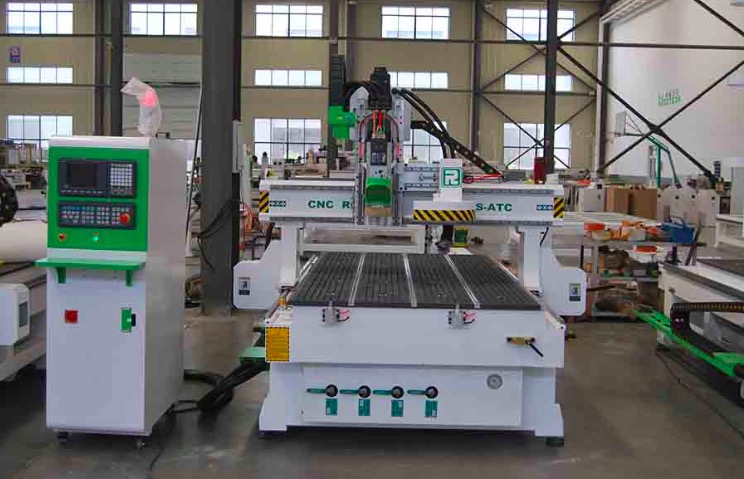
The nesting center is the heart of the line. It performs cutting, grooving, and drilling operations on raw panels in a single setup. The critical innovation in recent years has been the integration of automatic loading and unloading systems. These systems use vacuum lifters or roller conveyors to feed sheets onto the machine table and remove finished parts, eliminating manual handling. Roctech’s RCA series nesting centers, for example, employ double-layer vacuum tables with zone control, ensuring that both large panels and small offcuts are securely held during high-speed machining. The use of Taiwan Syntec control systems and Japan Yaskawa servo drives ensures positioning accuracy within ±0.03mm, which is essential for subsequent edge banding and assembly.
Edge Banding Integration
After nesting, panels move to the edge banding station. Modern automatic edge banding machines perform pre-milling, glue application, edge tape bonding, end trimming, rough and fine trimming, scraping, and polishing in a continuous process. The ability to handle PVC, acrylic, wood veneer, and solid wood edge tapes—often on the same machine with minimal changeover—is a key requirement for custom shops. Roctech’s edge banding series covers semi-automatic through high-speed automatic models, with the latter capable of processing speeds exceeding 20 meters per minute.
Six-Sided Drilling Centers
The final critical station is the drilling center, which processes dowel holes, connector holes, and shelf pin holes on all six sides of a panel. The six-sided CNC drilling center has become indispensable for modern cabinet production, as it allows one-clamp processing of the top, bottom, left, right, front, and back faces. QR code recognition systems enable automatic program retrieval based on panel identity, facilitating seamless integration with the nesting software. Roctech’s six-sided drill models, with vertical drill shafts numbering 12 on the X-axis and 13 on the Y-axis, plus horizontal drills on all
Looking for more information about our CNC machines and services? Contact us today.
Contact
Previous:Fiber Laser Cutting Machines: Reshaping Metal Fabrication Through Precision and Automation
Next:Mastering Precision Setup: A Professional Guide to Using the Center Finder on CNC Routers