

Engraving Machine Noise: Sources, Diagnosis, and Practical Mitigation Strategies
Blog / Author:ROCTECH Engineer Team / Published: Oct 08 , 2026 / Last Updated: Oct 08 , 2026
Abstract—Noise emission from CNC engraving machines is frequently treated as an unavoidable by-product of high-speed material removal. In practice, however, excessive noise is a diagnostic signal of mechanical degradation, aerodynamic inefficiency, or inadequate system integration. This article examines the principal noise sources in engraving machines and nesting centers, quantifies their relative contribution, and evaluates mitigation measures ranging from spindle selection to structural damping. Reference is made to equipment architectures such as those produced by Roctech Machinery Co., Ltd., whose ATC engraving machines and nesting centers illustrate how component-level choices influence acoustic behavior in production environments.
I. Introduction
In furniture manufacturing, advertising fabrication, and mold processing, the engraving machine operates for extended duty cycles, often in workshops where multiple units run concurrently. Operators frequently report that noise becomes a limiting factor in shift length, communication, and compliance with occupational health regulations. A typical woodworking engraving machine can produce sound pressure levels between 75 and 95 dB(A) depending on spindle speed, material, and tool engagement. Understanding where that energy originates is the first step toward controlling it.
II. Principal Noise Sources
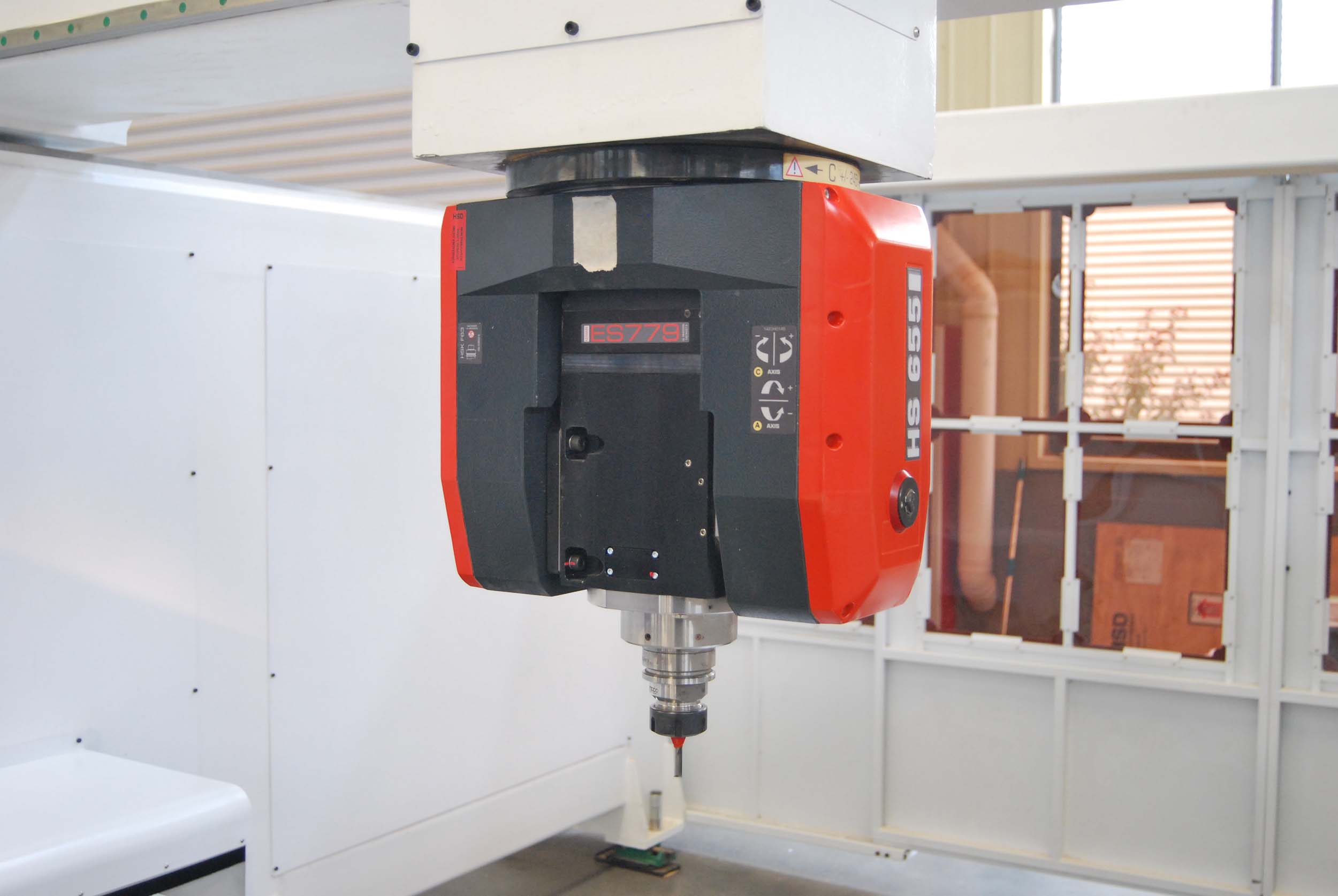
Noise in a CNC router is not monolithic. It arises from several subsystems, each with distinct spectral characteristics.
| Noise Source | Typical Frequency Range | Relative Contribution | Primary Cause |
|---|---|---|---|
| Spindle rotation | 200–2000 Hz | 25–35% | Bearing imperfection, unbalanced tool holder |
| Cutting engagement | 500–8000 Hz | 30–40% | Tool impact, chip formation, tool wear |
| Vacuum pump | 100–1000 Hz | 15–25% | Air pulsation, water ring turbulence |
| Dust collector | 200–4000 Hz | 10–20% | Impeller imbalance, airflow turbulence |
| Axis motion (rack/screw) | 50–500 Hz | 5–10% | Gear mesh, guide rail friction, servo resonance |
| Structural resonance | 20–300 Hz | Variable | Bed stiffness, panel vibration |
The data indicate that cutting engagement and spindle rotation together account for more than half of total acoustic output. This distribution matters: treating only the vacuum pump, a common but misdirected practice, yields limited improvement.
III. Spindle-Related Noise
The spindle is the most concentrated rotating assembly. Roctech's ATC series, for example, offers spindles from 6 kW to 12 kW operating at up to 24,000 RPM, with Italian HSD units specified on higher-end configurations. At 24,000 RPM, a spindle with a fundamental rotational frequency of 400 Hz can generate harmonics extending well into the kHz range if bearings are worn or if the tool holder is not properly seated.
Diagnostic indicators include a rise in high-frequency content, intermittent squeal at specific speeds, and temperature elevation. Bearing replacement intervals and correct grease quantity are decisive. Operators should note that a spindle which is quiet at 12,000 RPM but noisy at 18,000 RPM is usually exhibiting a resonance condition rather than simple wear.
IV. Cutting Process Noise
Tool geometry and cutting parameters dominate the mid-to-high frequency band. A dull tool increases contact friction and excites higher-order vibration modes in the workpiece and bed. Feed rates that are too low relative to spindle speed produce rubbing rather than shearing, raising noise without improving surface finish.
Practical adjustments include selecting tools with appropriate helix angles for the material, maintaining sharp edges, and increasing feed per tooth to promote clean chip formation. For MDF and hardwood, up-cut and compression spirals behave differently; the compression bit often reduces edge chipping and, by extension, impulsive noise at the panel surface.
V. Ancillary Equipment
Vacuum pumps used for workpiece hold-down are a persistent complaint. Water ring pumps, common on woodworking machines, produce broadband noise from water turbulence and cavitation. Rotary vane pumps are quieter but demand cleaner gas. Enclosing the pump in a ventilated acoustic cabinet, or relocating it outside the immediate work zone, is often more cost-effective than pump replacement.
Dust collectors present a similar case. A cartridge collector with an unbalanced impeller can emit a tonal hum that propagates through ductwork. Flexible duct sections and vibration isolation mounts at the collector inlet reduce transmission into the machine frame.
VI. Structural and Installation Factors
A machine that is not leveled or that sits on a resonant floor will amplify low-frequency vibration. Heavy-duty welded beds, such as those used in Roctech's RCA1224 nesting center with its approximately 4,500 kg total mass, provide inherent damping compared with lighter frames. Nonetheless, anchor bolts, leveling pads, and separation from adjacent equipment remain necessary.
VII. Mitigation Hierarchy
Effective noise control follows a hierarchy: eliminate at source, isolate the path, protect the receiver.
1. Source control: Replace worn bearings, balance tool holders, sharpen or replace tooling, tune servo gains to avoid oscillation.
2. Path control: Enclose the spindle zone with acoustic panels, isolate pumps and collectors, use flexible couplings in ductwork.
3. Receiver protection: Provide hearing protection, rotate operators between noisy and quiet stations, and schedule high-speed operations during periods of lower staffing.
VIII. Conclusion
Noise from an engraving machine is rarely a single fault. It is the sum of spindle condition, tooling practice, ancillary equipment, and installation quality. Systematic attention to these factors can reduce measured levels by 8–15 dB(A), improving operator comfort and extending equipment life. Manufacturers continue to address the issue through spindle design, structural mass, and enclosure options, but the operator's daily maintenance regime remains the most immediate and least expensive lever.
Looking for more information about our CNC machines and services? Contact us today.
Contact
Previous:CNC折弯机:钣金加工智能化的关键装备