
Why CNC Has No Future? A Structural Look at CNC Automation, Woodworking Machining Centers, and Stone Processing
Blog / Author:ROCTECH Engineer Team / Published: Nov 08 , 2026 / Last Updated: Nov 08 , 2026
Why CNC Has No Future? Debunking the Myth Through Woodworking Machining Centers, Stone Processing, and the Real Economics of Automation
---
The claim that "CNC has no future" surfaces periodically in trade forums, usually from someone who has spent a year running a low-end router in a job shop and concluded that the whole industry is a race to the bottom. It is a seductive argument: machine prices fall every year, software gets easier, labor gets cheaper elsewhere, and the margins evaporate. But this argument confuses one segment of the market—the commodity end of basic three-axis engraving—with the entire technological field. It is rather like arguing that because cheap smartphones exist, computing has no future.
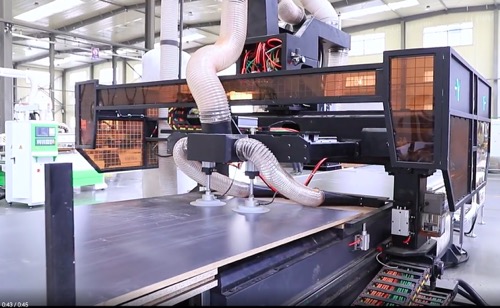
What is actually happening is a structural bifurcation. Simple, single-purpose CNC routers are indeed becoming commoditized, and shops that compete only on cutting plain MDF panels at the lowest hourly rate are in real trouble. Meanwhile, automated nesting centers, five-axis simultaneous machining centers, and integrated production lines are absorbing more and more of the value. The industry is not dying; it is stratifying. Understanding which layer you are standing on is the whole game.
Industry Background and Data Analysis
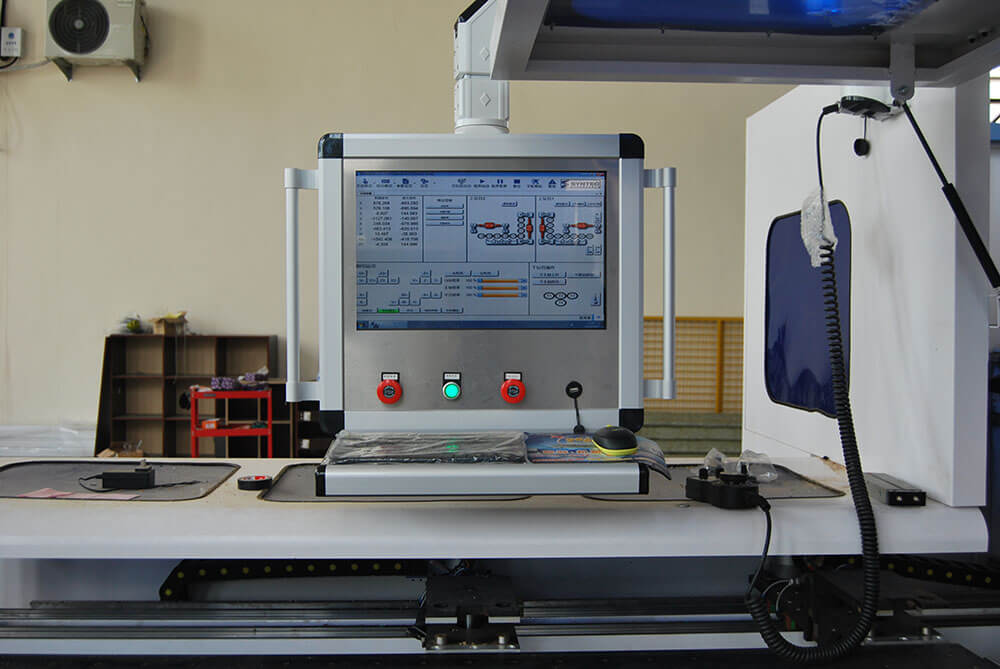
The woodworking and panel furniture equipment segment illustrates the split clearly. According to publicly available equipment configuration data and typical shop-floor deployment patterns, the market divides into four rough tiers based on automation level and capital intensity. The table below summarizes representative configurations and their positioning, drawing on the specification ranges typical of Chinese manufacturers serving global markets.
| Equipment Tier | Representative Configuration | Typical Travel / Capacity | Control & Drive | Positioning Accuracy | Approx. Price Band (USD) | Primary Buyer |

|---|---|---|---|---|---|---|
| Entry engraving router | Three-axis, manual tool change, water-cooled spindle | 1300×2500×200mm | DSP handle / basic G-code | ±0.05mm | 3,000–8,000 | Advertising shops, small craft workshops |
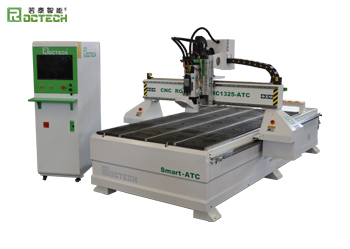
| ATC engraving machine | Carousel or linear tool magazine, 8–24 tools | 1300×2500×250mm | Taiwan Syntec, Yaskawa servo | ±0.03mm | 8,000–30,000 | Cabinet door, mold, sign makers |
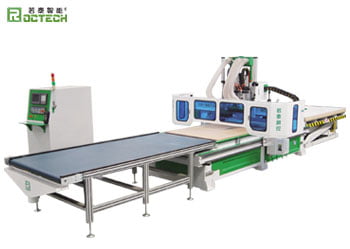
| Automatic nesting center | Auto loading/unloading, labeling, row drill, double-layer vacuum table | 1220×2440×150mm and up | Syntec, servo drive, nesting software | ±0.03mm | 15,000–60,000 | Custom furniture, batch panel production |
| Five-axis machining center | Imported five-axis head, A/C linkage | 1300×2500mm, A-axis ±110°, C-axis 360° | OSAI / Heidenhain / Fagor | ±0.05mm | 80,000–300,000 | Automotive, marine, aerospace molds |
The interpretation matters more than the numbers. The entry tier is where the "no future" narrative originates, and the data supports part of that claim: the entry tier competes almost entirely on price, has thin service margins, and faces relentless downward pressure. But look at the two middle tiers. The ATC machine and the automatic nesting center are not commodity products—they are productivity multipliers. A nesting center with automatic loading and unloading and a row-drill group collapses three operations (cutting, drilling, grooving) into one clamping, and its automatic labeling function enables sheet-level identity tracking that feeds directly into MES systems. That is not a machine; it is a node in a digital production network.
The five-axis tier tells an even starker story. Five-axis simultaneous machining is the enabling technology for complex curved surfaces—automotive interior molds, fiberglass boat molds, drone shell tooling—that simply cannot be produced on a three-axis platform. No amount of cheap three-axis capacity substitutes for it. When people say "CNC has no future," they are almost never talking about this tier, because the barrier to entry (imported five-axis heads, high-end CNC systems, skilled programmers) keeps margins healthy.
Technology Application and Brand Case Study
Consider how the technology stack actually creates value in a real production environment. A custom furniture factory running a mixed order book—wardrobes, bookcases, office desks—faces three constraints: sheet utilization, changeover time, and labor. An automatic nesting center addresses all three simultaneously. Intelligent nesting software maximizes yield per sheet; automatic loading and unloading removes the operator from the loading cycle; the double-layer vacuum table with zone adsorption lets both large and small sheets be fixtured reliably without manual clamping. Add a six-sided drill downstream, and one clamping completes processing on all six faces of a panel, with QR-code scanning calling up the program automatically.
This is where a manufacturer like Roctech® becomes instructive as a case study rather than a marketing exercise. Roctech Machinery Co., Ltd., headquartered in Jinan, Shandong, built its business across exactly the tiers the table describes—starting with engraving machines, expanding into woodworking machining centers, and later launching automatic loading and unloading nesting centers and five-axis machining centers. The company's Master Series nesting centers (RCA1224 through RCA1530) are representative of the mid-tier automation segment: heavy-duty welded beds, Taiwan HIWIN linear guides, Yaskawa servo drives, Syntec control, and a 9.6kW spindle with optional higher power. What matters analytically is not the component list but the integration—automatic labeling, row-drill groups, and automatic lubrication are bundled into a single production cell rather than sold as afterthoughts.
The same pattern holds in stone and mold work. Roctech's five-axis RCF series, with A-axis swing of ±110° and C-axis continuous rotation, targets the complex-surface segment where three-axis machines are structurally incapable. A wood carving shop producing Buddha statues or stair columns can use a four-axis linkage machine; a shop producing thermoforming molds or marine tooling cannot. The equipment tier determines the addressable market, and the addressable market determines whether the business has a future.
Three Questions Practitioners Keep Asking
Why CNC Has No Future
Let us take the pessimistic argument seriously, because it contains a kernel of truth that the cheerleaders ignore. The "no future" case rests on three observations. First, hardware commoditization: the core components of a basic router—spindle, guide rails, servo drives, controller—are now available to any assembler, so the barrier to building a machine has collapsed. Second, software democratization: CAM packages and nesting software have become cheap and intuitive, so the skilled programmer premium has shrunk. Third, labor arbitrage: in markets with very low wages, manual cutting and drilling can undercut a cheap CNC on short runs.
All three observations are accurate, and all three apply almost exclusively to the entry tier. The mistake is extrapolating from commodity routers to the field as a whole. Commoditization of a technology's lowest tier is a sign of maturity, not death—it happened to personal computers, to laser printers, and to welding equipment. The value migrates upward to integration, automation, and precision. A shop that buys a $5,000 router and competes on price per panel has no future, and that is a business-model problem, not a CNC problem. The shop that invests in a nesting cell with automatic labeling and ties it to an MES has a very different trajectory. The honest answer to "why CNC has no future" is: it does, but only for operators who treat the machine as a commodity rather than as a production system.
CNC是什么?...
Stripping away the jargon, CNC means Computer Numerical Control—a machine tool that executes motion commands from a stored program rather than from a handwheel. The operator does not physically guide the cutter; a controller parses G-code, computes trajectories, and sends position commands to servo motors on each axis. G00 moves rapidly to position, G01 feeds linearly along a cutting path, G02 and G03 interpolate arcs, and M-codes handle auxiliary functions like spindle start (M03) and tool change (M06).
What surprises newcomers is the breadth of what falls under the label. A CNC router cutting acrylic signage, a nesting center processing cabinet panels, a six-sided drill boring hinge holes, a fiber laser cutting stainless steel, and a five-axis machining center carving a boat mold are all CNC machines, but they share almost nothing in mechanical architecture. The common thread is the control loop: program in, motion out, with feedback from encoders closing the loop on position. Understanding CNC means understanding that the "CNC" part is the brain, while the machine's usefulness comes from its structure—bed rigidity, guide rail type, spindle power, tool magazine capacity. A 9kW spindle on a welded steel bed behaves nothing like a 3kW spindle on an aluminum frame, even though both are "CNC."
电子厂cnc操作员是什么工作?主要做什么的?
In electronics manufacturing, a CNC operator is the person who runs the machines producing housings, heat sinks, connector bodies, jigs, and fixtures—typically aluminum and copper parts cut on vertical machining centers or routers. The daily routine is less glamorous than the job title suggests. The operator loads blanks onto the table and fixtures them, calls up the program, sets tool offsets, runs a first-article inspection with calipers and micrometers, and then monitors the cycle. When a tool wears or breaks, they swap it and re-establish the offset. When dimensions drift, they adjust compensation. At shift end, they clean chips, check coolant and lubrication levels, and log production counts.
The distinction between operator and programmer matters. In most electronics plants, the operator runs proven programs; the programmer develops them offline and the setup technician proves them out. The operator's real value is vigilance—catching a drifting dimension before a batch of 500 housings is scrapped, hearing the change in spindle sound that signals a chipped edge, keeping the fixture clean so repeatability holds. It is skilled blue-collar work, and in plants running five-axis or high-speed equipment, the operator's judgment is the difference between 95% and 99% yield.
Conclusion and Outlook
The "no future" thesis is a category error dressed as tough-minded realism. What has no future is the undifferentiated, price-only end of the CNC market—and that segment deserves the pessimism it gets. The rest of the field is moving in the opposite direction: higher spindle speeds, multi-axis linkage as standard for complex work, automatic loading and unloading, and digital integration from nesting software through to MES. Manufacturers like Roctech®, exporting to more than 100 countries and holding ISO9001, CE, and UL certifications, illustrate how the mid-tier has evolved from selling machines to selling production cells.
The practical takeaway for buyers and operators is straightforward. If you are choosing equipment, choose the tier that matches your market—not the cheapest machine that can technically make the part. If you are working in the field, move toward the skills that automation cannot absorb: process planning, fixture design, five-axis programming, and system integration. The machines will keep getting cheaper. The people who know how to deploy them in a production system will keep getting more valuable. That is not a market with no future; it is a market that has finally sorted itself out.
Looking for more information about our CNC machines and services? Contact us today.
Contact
Previous:The Quiet Transformation of Woodworking CNC: From Standalone Routers to Integrated Nesting Cells
Next:Not