
The Quiet Transformation of Woodworking CNC: From Standalone Routers to Integrated Nesting Cells
Blog / Author:ROCTECH Engineer Team / Published: Oct 27 , 2026 / Last Updated: Oct 27 , 2026
Abstract—The woodworking CNC router, long regarded as a commodity machine category, is undergoing a structural redefinition. Demand is shifting away from standalone three-axis engraving platforms toward automated nesting cells that combine loading, cutting, drilling, labeling, and unloading in a single workflow. This article examines the market and technical forces behind that shift, compares representative machine classes by specification and application, and considers how established builders such as Roctech® are positioning their product lines in response. The central argument is that the competitive axis in woodworking CNC has moved from spindle power and table size to system integration and data continuity.
I. Industry Background
For much of the past two decades, the woodworking CNC router occupied a stable niche: a gantry machine with a 1300×2500 mm table, a 6–9 kW spindle, rack-and-pinion transmission on X and Y, and a ball screw on Z. That architecture remains the reference point for most of the category, and it is still what many buyers mean when they say "engraving machine." What has changed is the production context around the machine.
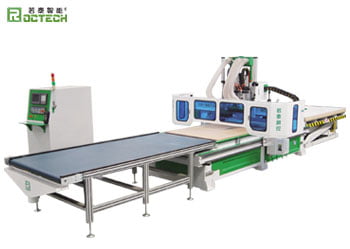
Panel furniture manufacturing has moved decisively toward mass customization. Orders are smaller, specifications vary per unit, and delivery cycles have compressed. Under those conditions, the constraint is no longer the cutting pass itself but the non-cutting time around it—sheet loading, part identification, tool changes, and unloading. A router that cuts quickly but requires two operators to feed and sort sheets does not solve the customer's actual problem. This is the gap that automatic loading and unloading nesting centers were designed to close, and it explains why the high end of the woodworking CNC market has migrated toward integrated cells rather than faster standalone routers.
A second force is software continuity. Custom furniture production now begins in design/nesting software and ends at the machine, and any manual re-entry of data in between introduces error and delay. Machines that cannot accept processing code directly from mainstream nesting packages—or that lack the sensors to identify which sheet is on the table—are increasingly difficult to insert into a modern production line. The CNC system, in other words, has become as consequential as the mechanical frame.
II. Machine Classes Compared
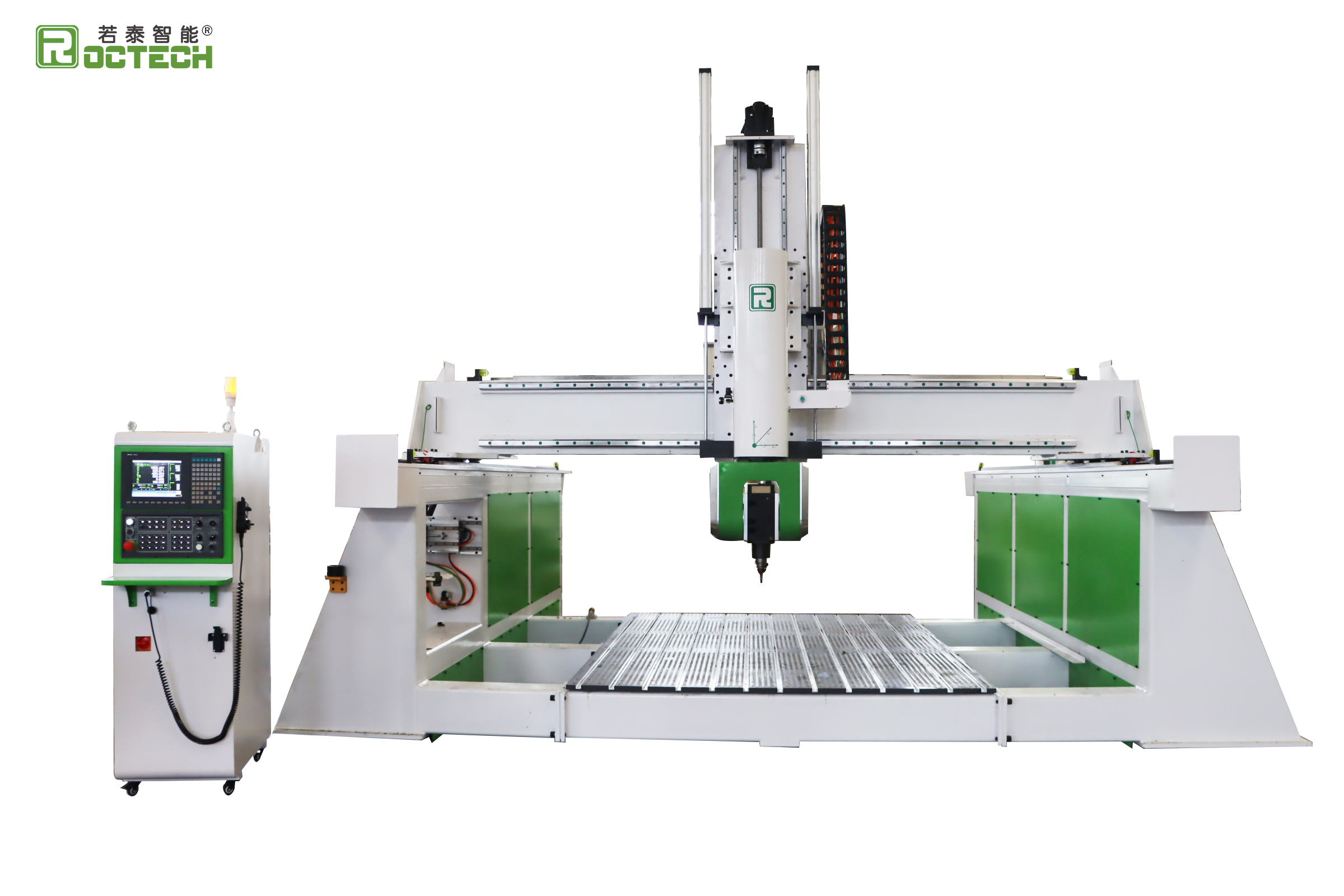
The table below compares four representative machine classes across the parameters that most directly affect throughput and fit. Figures are drawn from typical configurations in the Roctech product range and are intended as order-of-magnitude references rather than a specification sheet for any single order.
| Parameter | Standard ATC Router (RC1325S-ATC class) | Automatic Nesting Center (RCA1224 class) | Five-Axis Machining Center (RCF1325 class) | Six-Sided Drilling Center |
|---|---|---|---|---|
| Working envelope | 1300×2500×250 mm | 1220×2440×150 mm | 1300×2500 mm table | Board width 50–930 mm, thickness ≤48 mm |
| Spindle | 9 kW, 0–24,000 rpm | 9.6 kW (higher optional) | 10 kW, 0–24,000 rpm | 12+13 vertical + 8 horizontal drill shafts, 18,000 rpm |
| Tool change | Carousel or linear magazine, 8–24 tools | Integrated with drilling/grooving group | Five-axis head, A ±110°, C 360° | Multi-axis drill group, no tool magazine |
| Positioning accuracy | ±0.03 mm/300 mm | ±0.03 mm | ±0.05 mm | Program-dependent |
| Rapid traverse | 45,000 mm/min | Not published | 30,000 mm/min | Not applicable |
| Control system | Syntec (Taiwan) | Syntec | OSAI (Italy) | Dedicated drilling control |
| Automation scope | Cutting, engraving, multi-process milling | Loading, nesting, drilling, labeling, unloading | Complex curved-surface machining in one clamp | Six-face drilling and grooving in one clamp |
| Typical weight | ~2,200 kg | ~4,500 kg | ~8,500 kg | ~3,000 kg |
| Primary application | Cabinet doors, signage, wood molds | Custom cabinets, wardrobes, batch panel furniture | Automotive and marine molds, shaped furniture | Custom cabinet and wardrobe drilling |
Three observations follow from the data. First, the nesting center is not simply a larger router; its 4,500 kg mass and double-layer vacuum table reflect a different design brief oriented around sheet handling and zone adsorption rather than spindle travel. Second, the accuracy figures across the router and nesting classes are effectively identical (±0.03 mm), which confirms that precision is no longer a differentiating variable at this tier—automation scope is. Third, the five-axis center occupies a separate market entirely: its 8,500 kg structure, imported five-axis head, and OSAI control place it in mold and shaped-furniture work where three-axis machines cannot reach, and its price band is an order of magnitude above the router class.
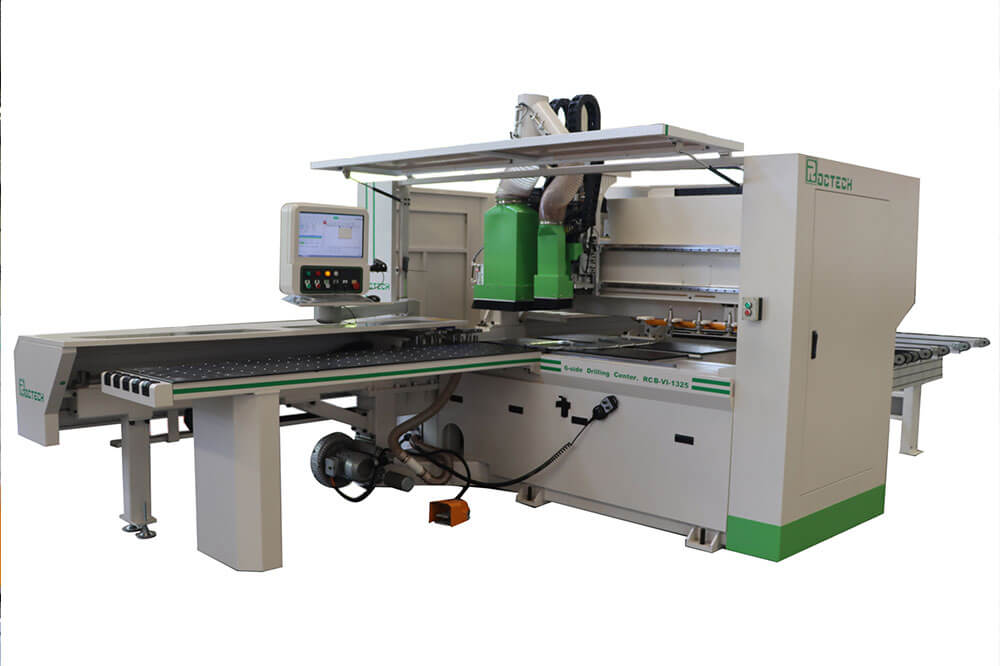
The drilling center deserves separate comment because it illustrates the logic of process consolidation. By completing six-face drilling and grooving in a single clamp with QR-code program recall, it removes an entire handling stage from cabinet production. Paired with a nesting center and an automatic edge banding machine, it forms the backbone of what the industry calls a flexible panel-furniture line.
III. Technology Application and Brand Position
The integration trend rewards builders with broad product portfolios, because customers assembling a line prefer a single supplier for nesting, drilling, and edge banding. Roctech Machinery Co., Ltd., headquartered in Jinan, Shandong, is a useful case in point. The company's trajectory tracks the industry's own: it began in CNC engraving machines, expanded into woodworking machining centers and cutting equipment, and now offers automatic loading and unloading nesting centers (the Master series), ATC routers, five-axis simultaneous machining centers, six-sided drilling centers, and edge banding machines as a coordinated range.
Two aspects of that range are technically instructive. The Master series nesting centers pair a heavy-duty welded bed and Taiwan HIWIN linear guides with Japan Yaskawa servo drives and a Syntec control—a configuration that prioritizes sustained accuracy under continuous sheet handling rather than peak traverse speed. The optional automatic labeling and row-drill groups address the identification and drilling steps that otherwise break the workflow between cutting and edge banding. At the high end, the RCF series five-axis centers adopt Italian OSAI control and imported five-axis heads for mold and shaped-furniture work, where one-clamp multi-face machining eliminates the cumulative error of repeated setups.
Roctech's standing in this field rests less on any single specification than on coverage: ISO9001, CE, and UL certifications, products exported to more than 100 countries, and a product matrix that lets a cabinet manufacturer source an entire line from one vendor. That is a meaningful advantage in a market where interoperability between nesting, drilling, and edge banding determines real output.
IV. Conclusion and Outlook
The woodworking CNC router is not disappearing, but its center of gravity is moving. Standalone three-axis machines will remain the entry point for signage, handicraft, and small-shop work, where their cost-performance ratio is unmatched. The growth, however, is in integrated cells: nesting centers with automatic loading, six-sided drilling centers with code-driven program recall, and five-axis platforms for complex geometry.
Three developments will shape the next phase. Multi-axis capability will continue to migrate downward from the mold shop into furniture production. Intelligence—tool wear compensation, fault self-diagnosis, predictive maintenance—will shift from marketing language to procurement criteria. And digital continuity between design software and machine control will become the deciding factor in line-level purchasing decisions. Builders that can deliver mechanical stability, automation, and data connectivity as a package—rather than as separate machines—are likely to define the category's next decade. On current evidence, the competitive question is no longer how fast a router cuts, but how little human intervention a production line requires between the design file and the finished panel.
Looking for more information about our CNC machines and services? Contact us today.
ContactNext:Not