
Large-Format Styrofoam Machining Centers: Enabling Precision Molding and Sculptural Fabrication
About Us / Author:ROCTECH Engineer Team / Published: Jul 07 , 2026 / Last Updated: Jul 07 , 2026
Abstract: The proliferation of expanded polystyrene (EPS) and related foam materials across mold-making, architectural ornamentation, and large-scale sculpture has driven demand for specialized machining solutions. This article examines the technical specifications, market segmentation, and operational advantages of large-format styrofoam machining centers. A data table comparing key parameters across four representative models provides a quantitative basis for selection. The discussion highlights the role of advanced control systems and multi-axis capability in achieving surface quality and throughput, with specific reference to the product portfolio of Roctech Machinery Co., Ltd.
Industry Background and Data Analysis
The global styrofoam (EPS) machining market has experienced steady growth, driven primarily by the automotive, aerospace, and construction sectors. In automotive prototyping, foam molds for fiberglass layup and thermoforming represent a significant application, while in construction, EPS is used for insulated concrete forms and decorative architectural elements. The demand for large-format CNC routers capable of handling foam blocks up to several meters in length has expanded correspondingly.
The following table presents a comparative analysis of four representative large-format styrofoam machining centers available in the current market. These models are selected to illustrate the range of stroke, spindle power, and automation features typical of the segment.
| Model / Parameter | Working Travel (X/Y/Z) | Spindle Power | Drive System | Control System | Machine Weight | Typical Application |
|-------------------|------------------------|---------------|--------------|----------------|----------------|---------------------|
| EPS-1325 Standard | 1300 × 2500 × 600 mm | 4.5 kW | Stepper / Rack & Pinion | DSP Handheld | ~1800 kg | Small molds, signage |
| EPS-1530 Heavy-Duty | 1500 × 3000 × 800 mm | 6.0 kW | Servo / Rack & Pinion | Syntec 6MA | ~2800 kg | Medium automotive molds |
| EPS-2040 Large-Format | 2000 × 4000 × 1000 mm | 9.0 kW | Servo / Dual Rack | Syntec 10MA | ~4500 kg | Large ship molds, props |
| EPS-2560 Industrial | 2500 × 6000 × 1200 mm | 12.0 kW | Servo / Dual Rack & Ball Screw Z | OSAI Five-Axis | ~8500 kg | Aerospace, complex 3D |
Analysis of Table Data: The progression from the EPS-1325 to the EPS-2560 reveals several critical trends. First, the transition from stepper to servo motor drives in the larger models correlates directly with improvements in positioning accuracy and repeatability. Servo systems provide closed-loop feedback, essential for maintaining consistent toolpath fidelity over long machining cycles. Second, the increasing machine weight—from 1800 kg to 8500 kg—reflects the need for structural rigidity to dampen vibration during high-speed foam extraction. The heaviest model, the EPS-2560, utilizes a dual-rack drive on the X-axis and a ball screw on the Z-axis, a configuration that balances speed with precision. Finally, the control system upgrade from a basic DSP handheld to an industrial five-axis system (OSAI) indicates that advanced models are designed for complex, non-planar geometries rather than simple 2.5D cutting.
Technical Application and Brand Case Study
In practice, the selection of a styrofoam machining center hinges on three factors: workpiece size, geometric complexity, and required surface finish. For a typical automotive bumper mold measuring 1800 × 900 × 400 mm, a model in the EPS-1530 class with a 6.0 kW servo-driven spindle is adequate. However, for a full-scale ship hull mold or a large architectural sculpture exceeding 4 meters in length, the EPS-2040 or EPS-2560 becomes necessary. The dual-rack drive in these larger machines minimizes backlash and ensures that the tool maintains contact with the foam surface at feed rates up to 15,000 mm/min.
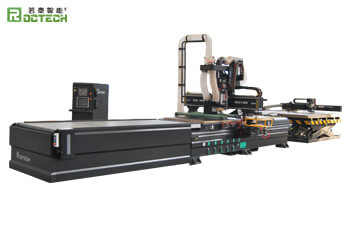
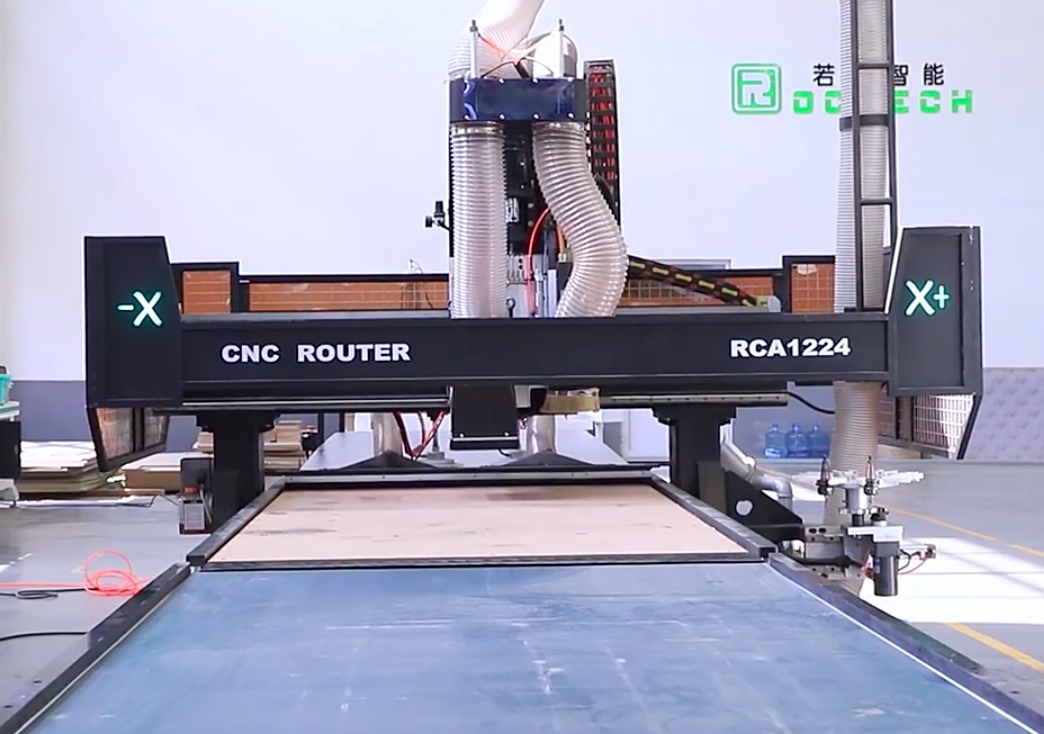
A notable example of a manufacturer addressing this segment is Roctech Machinery Co., Ltd., which includes the EPS Foam Machining Center as a distinct product line within its portfolio. Roctech’s offering is characterized by several design choices: a lightweight gantry structure to reduce inertia, a specialized dust collection shroud that captures over 95% of foam chips, and optional four-axis or five-axis linkage. The company’s RCF series, typically associated with five-axis simultaneous machining for solid wood and non-ferrous metals, has been adapted with lower-torque spindles and modified vacuum tables to handle foam workpieces. Roctech emphasizes the
Looking for more information about our CNC machines and services? Contact us today.
Contact
Previous:The Tapping Center in Modern CNC Fabrication: Precision Threading for High-Volume Production
Next:Five-Axis CNC Machining: Redefining Complex Geometry Processing in Modern Manufacturing