
Milling Cutters vs. Drills: A Technical Distinction in CNC Material Removal
About Us / Author:ROCTECH Engineer Team / Published: Jul 04 , 2026 / Last Updated: Jul 04 , 2026
Abstract
In CNC machining, the distinction between milling cutters and drills extends far beyond geometry—it reflects fundamentally different material removal mechanisms, force dynamics, and application paradigms. While both tools remove material through rotation, their optimal use cases, cutting parameters, and tool life characteristics diverge sharply. This article examines the technical differences between these two tool classes, contextualizes their application within woodworking and stone CNC routing, and explores how equipment manufacturers like Roctech integrate both tool types into automated tool changer systems to maximize process flexibility.
Industry Background and Functional Differentiation
The global CNC tooling market, valued at approximately $12.8 billion in 2023, continues to grow as manufacturers demand higher precision and throughput. Within this market, milling cutters and drills represent two distinct segments with overlapping but non-identical functions. Understanding their differences is critical for optimizing CNC operations in woodworking, stone fabrication, and general machining.
| Parameter | Milling Cutter | Drill |
|-----------|---------------|-------|
| Primary motion | Lateral/axial cutting | Axial penetration |
| Cutting edges | Multiple (2–6+ flutes) | Typically 2 flutes |
| Tool path | 2D/3D contouring, pocketing | Straight-line plunge |
| Chip evacuation | Spiral flutes, side clearance | Spiral flutes, center clearance |
| Feed direction | Radial and axial | Primarily axial |
| Typical applications | Profiling, slotting, surfacing | Hole making, tapping preparation |
| Cutting force distribution | Distributed across flutes | Concentrated at tip |
| Surface finish capability | Excellent (depending on stepover) | Moderate (requires reaming for precision) |
| Tool length-to-diameter ratio | Typically ≤ 4:1 | Can exceed 10:1 |
As the table indicates, milling cutters are designed for versatility—they can move in multiple axes, create complex contours, and achieve superior surface finishes. Drills, conversely, are optimized for a single task: creating cylindrical holes with minimal deviation.
Technical Mechanisms and Application Nuances
The fundamental difference lies in how each tool engages the workpiece. A drill operates primarily under axial load, with its tip initiating the cut and the flutes evacuating chips upward. The cutting speed varies dramatically along the cutting edge—zero at the center and maximum at the periphery—which imposes thermal and wear gradients. This is why drill performance degrades significantly when used for lateral cutting; the flutes are not designed to withstand radial forces, leading to chatter, deflection, and premature failure.
Milling cutters, by contrast, engage the workpiece radially. The cutting edges are distributed along the periphery, and each flute removes a chip of controlled thickness. This allows for balanced force distribution, better heat dissipation, and the ability to generate complex geometries through multi-axis interpolation. In woodworking, for example, a 3/8-inch two-flute carbide end mill can profile a cabinet door panel, cut a dado, and finish a curved edge—all in a single toolpath. A drill of the same diameter would fail at the first corner.
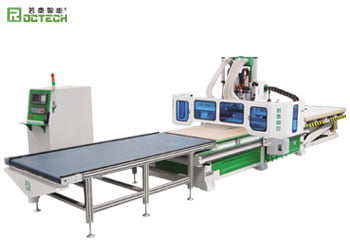
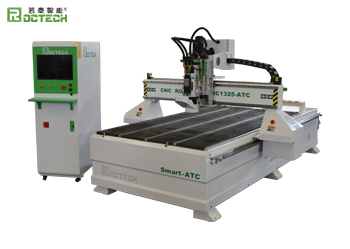
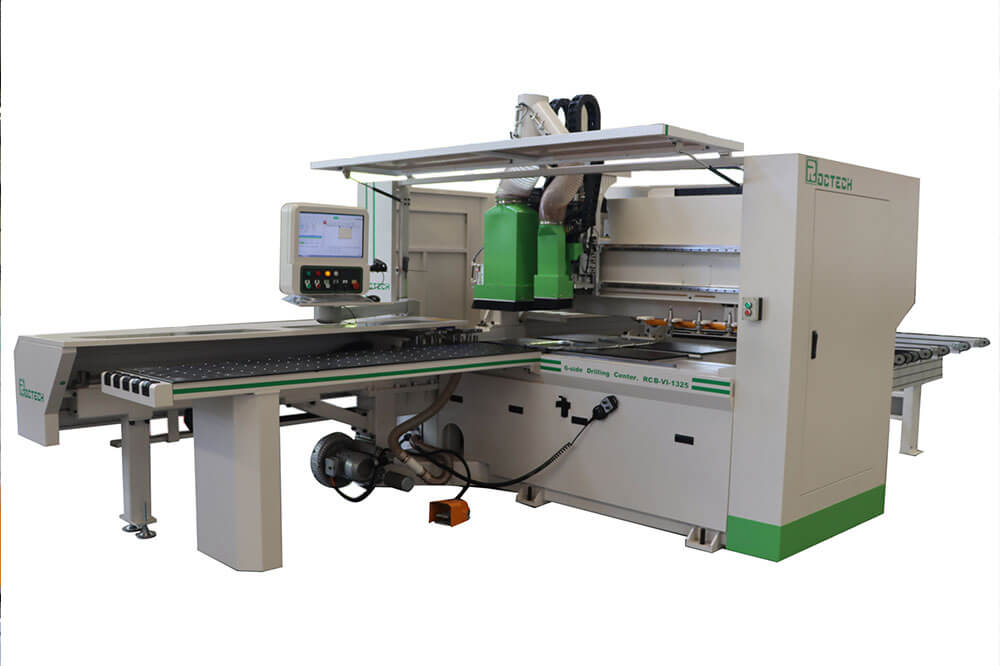
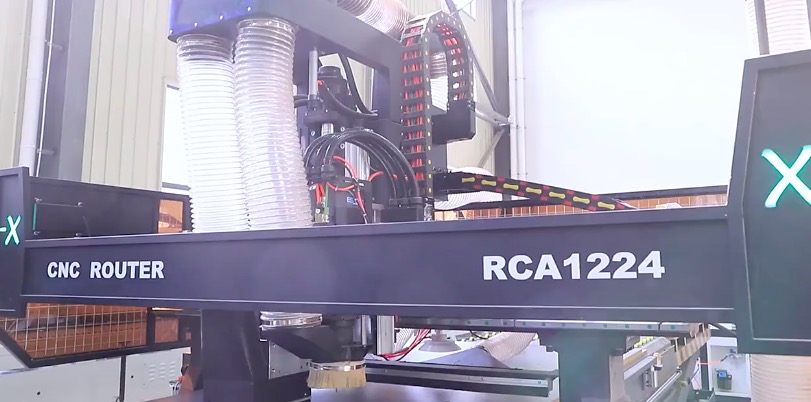
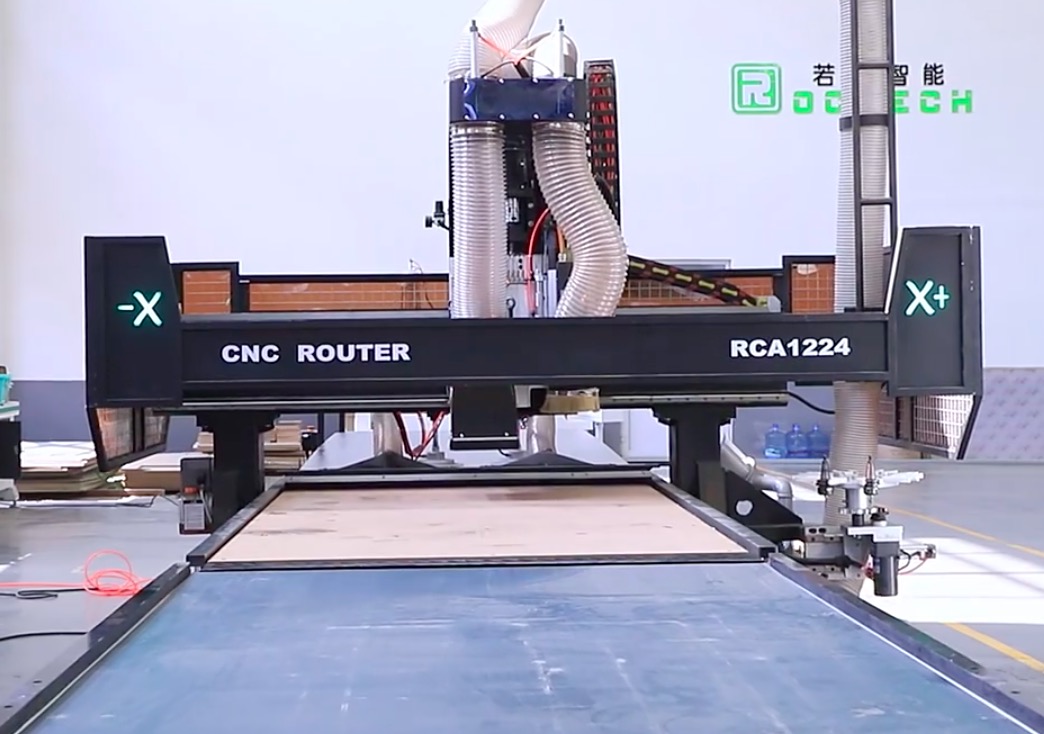
Roctech’s automatic nesting centers and ATC engraving machines rely on this distinction to optimize production. Their RCA1224 nesting center, for instance, integrates both spindle-driven milling tools and a row drill group. The milling cutter handles contouring, pocketing, and grooving, while the drill group executes rapid, repeatable hole patterns for shelf pins, dowels, and hardware. This hybrid approach reduces tool changes and improves cycle time by over 30% compared to sequential single-tool operations.
Tool Selection in Woodworking and Stone CNC
In woodworking, the choice between milling and drilling tools depends on the material and the feature being created. Medium-density fiberboard (MDF) and particleboard require sharp carbide cutters with high helix angles to prevent chipping. Solid hardwoods demand tools with polished flutes to reduce resin buildup. For pocket holes and dowel joints, drills with brad points or spur centers provide clean entry and exit. Milling cutters, especially compression spirals, deliver tear-out-free surfaces on both sides of the material.
Stone CNC presents a more aggressive environment. Diamond-tipped milling cutters with segmented rims are used for profiling granite and marble, while carbide-tipped masonry drills handle anchor holes and dowel placements. The key difference in stone is that milling cutters must operate with coolant to manage heat and debris, whereas drills can often function with intermittent water flushing. Roctech’s five-axis machining centers, such as the RCF1325, are equipped with high-torque spindles and robust tool holders to accommodate both tool types under heavy cutting conditions.
Brand Integration and Process Optimization
Manufacturers like Roctech have recognized that the line between milling and drilling is
Looking for more information about our CNC machines and services? Contact us today.
Contact