
Title: The Underappreciated Utility of Low-Power Laser Cutters in Modern Fabrication Workflows
About Us / Author:ROCTECH Engineer Team / Published: Jul 10 , 2026 / Last Updated: Jul 10 , 2026
Article Content:
In the broader conversation surrounding industrial laser cutting, the market focus has shifted decisively toward high-wattage fiber lasers—machines capable of slicing through 20-millimeter carbon steel with surgical precision. However, this emphasis on brute force often obscures the persistent, and arguably more versatile, role of low-power laser cutting machines (typically in the 500W to 1500W range). These systems, while limited in their maximum depth of cut, occupy a critical niche in the fabrication ecosystem, particularly in light-gauge sheet metal processing, signage, and prototyping. The data below, drawn from recent industry analysis, illustrates their current market distribution.
Table 1: Global Low-Power Fiber Laser (500W–2000W) Shipment Share by Application Sector (2024)
| Application Sector | Percentage of Shipments | Typical Material Thickness (Carbon Steel) | Key Driver |
| :--- | :--- | :--- | :--- |
| Advertising & Signage | 32% | 0.5 – 2.0 mm | Demand for intricate, burr-free cuts on stainless steel and aluminum. |
| Sheet Metal Fabrication | 28% | 1.0 – 3.0 mm | High speed and low operating costs for enclosures and brackets. |
| Prototyping & Education | 18% | 0.8 – 2.5 mm | Low upfront investment and minimal safety infrastructure. |
| Hardware & Furniture | 15% | 1.0 – 2.0 mm | Decorative cutting and hole patterns. |
| Other (Repair, Medical) | 7% | Variable | Flexibility for small-batch, high-mix production. |
Data sourced from industry white papers and manufacturer shipment reports.
Analysis of the Data: The table reveals a clear dichotomy. Over 60% of shipments are concentrated in the advertising and general sheet metal segments. This is not an accident. Low-power lasers, such as Roctech’s 1000W and 1500W fiber models, excel in these environments because they offer a “sweet spot” of speed and edge quality. For a 1.5mm stainless steel sign, a 1000W machine can achieve a cutting speed comparable to a 3000W unit but with significantly lower electrical consumption and a smaller heat-affected zone (HAZ). The high-speed cutting capability, often exceeding 120 meters per minute in rapid traverse, translates directly to throughput for high-volume sign shops. Furthermore, the lower power reduces the risk of material warpage, a critical factor when processing thin-gauge galvanized sheets for electrical cabinets.
Technology and Brand Application
The viability of these machines rests on engineering refinements that go beyond raw wattage. A low-power system must optimize its beam delivery, focusing head, and motion control to compensate for its reduced energy density. For example, a well-designed 500W machine can cut 1mm stainless steel as cleanly as a 6000W machine running at a reduced power setting, provided the cutting head features a high-quality collimation lens and an automatic focusing system to adapt to slight material inconsistencies.
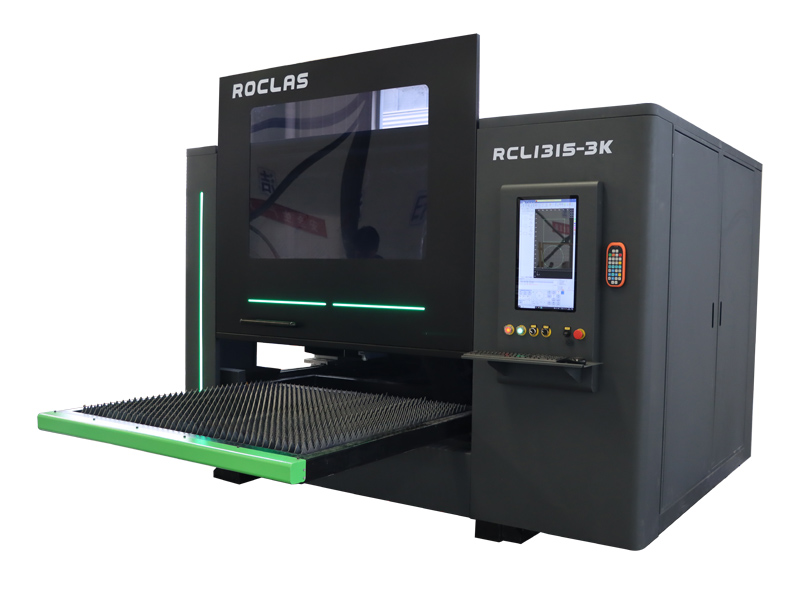
Companies like Roctech Machinery Co., Ltd. have recognized this need and offer a range of low-to-mid power fiber laser cutters. Their 3015 model (3000x1500mm cutting area), typically configured with a 1000W to 1500W source, is a prime example. It integrates a high-precision rack-and-pinion transmission system and a rigid, welded bed to ensure that the machine’s dynamic response does not introduce micro-jitter, which could ruin the cut quality on thin materials. The inclusion of a capacitive follow-up system on the cutting head ensures the nozzle gap remains constant, a detail that becomes paramount when the laser’s power is just enough to penetrate the material. Any deviation would result in non-through cuts or excessive dross.
Conclusion and Outlook
The narrative that “bigger is better” in laser cutting is incomplete. For a vast number of workshops handling sheet metal under 3mm thick—a majority of the custom fabrication and signage market—a low-power laser cutting machine is not a compromise, but an optimized tool. Its lower capital expenditure, reduced electrical infrastructure requirements (often single-phase or standard three-phase without high-power transformers), and inherently safer operation make it the most logical entry point into digital sheet metal processing.
Looking forward, the trend toward “ultra-thin” processing in consumer electronics and medical devices will only reinforce the relevance of these machines. The ability to cut 0.4mm stainless steel with no thermal distortion is a higher-order problem for a 6000W
Looking for more information about our CNC machines and services? Contact us today.
Contact