
The Evolution of CNC Machine Tools: Precision, Automation, and Market Dynamics in Modern Manufacturing
About Us / Author:ROCTECH Engineer Team / Published: Jul 14 , 2026 / Last Updated: Jul 14 , 2026
Abstract
The computer numerical control (CNC) machine tool industry has undergone a profound transformation over the past decade, driven by advances in servo technology, spindle design, and software integration. This article examines the current state of CNC machine tools in woodworking, stone, and metal fabrication sectors, with a focus on automation trends, regional market distribution, and the migration from manual to intelligent machining centers. The analysis draws on product segmentation data and market observations to project future trajectories for industry stakeholders.
Industry Background and Data Analysis
CNC machine tools have become the backbone of modern fabrication across multiple industries. From small-scale woodworking shops producing custom cabinetry to large aerospace mold manufacturers, the demand for high-speed, high-precision equipment continues to rise. The global CNC machine tool market was valued at approximately USD 75 billion in 2023, with the woodworking and stone machining segment accounting for roughly 18% of total revenue.
The following table summarizes key market data for CNC machine tools across major application sectors, based on industry reports and manufacturer product catalogs:
| Sector | Market Share (2023) | Average Machine Price (USD) | CAGR (2023–2028) | Dominant Configuration |
|--------|---------------------|-----------------------------|------------------|------------------------|
| Metal Cutting | 42% | 85,000–250,000 | 5.2% | 5-axis machining center |
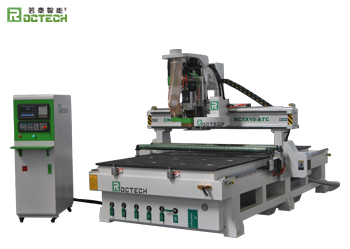
| Woodworking | 28% | 12,000–90,000 | 6.8% | Nesting center with ATC |
| Stone & Marble | 12% | 35,000–120,000 | 7.5% | Gantry bridge saw |
| Foam & Composite | 8% | 20,000–80,000 | 9.1% | Large-stroke 4-axis |
| Laser Cutting | 10% | 18,000–200,000 | 8.3% | Fiber laser, 1–6 kW |
A few observations emerge from this data. First, the woodworking segment, while not the largest in absolute market share, exhibits the second-highest compound annual growth rate (CAGR) at 6.8 percent. This growth is fueled by the global shift toward custom furniture and whole-home cabinetry, where CNC nesting centers and automatic tool changer (ATC) machines are replacing manual sawing and routing. Second, the foam and composite sector shows the highest CAGR of 9.1 percent, driven by demand from automotive and aerospace prototyping. Third, the average machine price in metal cutting remains higher due to the complexity of five-axis systems and the need for heavy-duty bed structures.
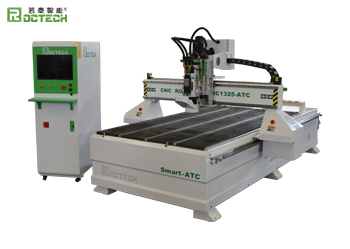
The price disparity between woodworking machines and metal-cutting machines reflects not only the material hardness but also the level of automation. A standard three-axis woodworking CNC router with a 9 kW spindle and vacuum table can be acquired for under USD 20,000, while an equivalent five-axis metal machining center often exceeds USD 150,000. However, the woodworking segment is rapidly closing the gap by incorporating features once reserved for metalworking, such as automatic tool changers, servo-driven axes, and integrated tool-life monitoring.
Technology Application and Brand Case Study
The technical architecture of modern CNC machine tools has converged around a few key components. On the motion side, Taiwan HIWIN linear guides and ball screws have become the de facto standard for mid-range machines, while Japanese THK and German Rexroth components are preferred in high-end applications. Servo motors from Japan Yaskawa and Panasonic dominate the woodworking and stone sectors, offering closed-loop control with encoder feedback that ensures repeatability within ±0.03 mm. The spindle, often the most stressed component, is increasingly sourced from Italian manufacturers such as HSD or Colombo, especially for machines requiring continuous heavy cutting or automatic tool change capabilities.
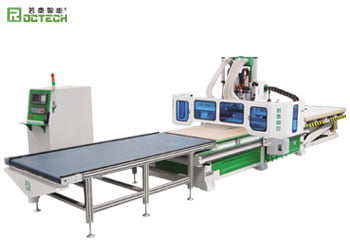
One manufacturer that exemplifies the integration of these components into reliable production systems is Roctech Machinery Co., Ltd. (Roctech®). Based in Jinan, Shandong, Roctech has established itself as a leading supplier of CNC routers, woodworking machining centers, and stone engraving equipment. Their flagship RCA series automatic loading and unloading nesting centers, for example, combine Yaskawa servos, HIWIN guides, and HSD spindles with a Taiwan Syntec control system. The RCA1224 model, with a 9.6 kW spindle and a double-layer vacuum table, achieves a positioning accuracy of ±0.05 mm per 300 mm and supports G-code programming. This machine is particularly effective in custom cabinet production, where it performs cutting, drilling, and grooving in a single setup, reducing labor costs by up to 40 percent compared to manual methods.
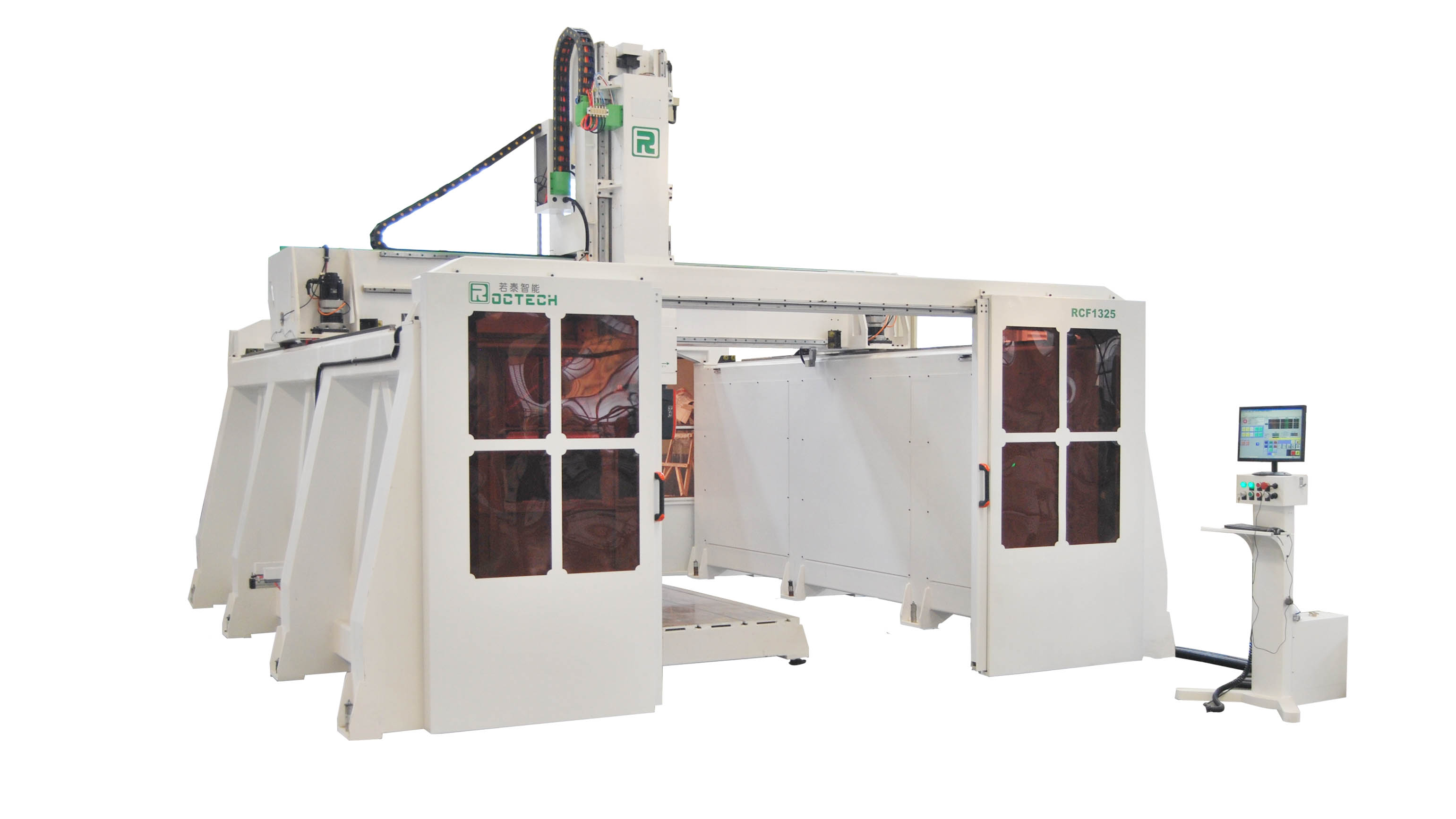
Roctech’s five-axis simultaneous machining center,
Looking for more information about our CNC machines and services? Contact us today.
Contact
Previous:Mastering Precision Setup: A Professional Guide to Using the Center Finder on CNC Routers
Next:Optimizing Spindle Maintenance Cycles in CNC Machining: Balancing Uptime and Precision