
Automated Milling in Modern CNC Manufacturing
Blog / Author:ROCTECH Engineer Team / Published: Oct 10 , 2026 / Last Updated: Oct 10 , 2026
Abstract
Automated milling has evolved from a niche capability in high-end machine shops to a mainstream requirement across furniture manufacturing, mold making, and architectural fabrication. The integration of automatic tool changers, automated loading and unloading systems, and intelligent nesting software has fundamentally reshaped throughput economics. This article examines the technical underpinnings of automated milling systems, compares representative machine configurations, and considers how equipment suppliers—Roctech among them—are positioning their product lines to meet shifting demand patterns.
Industry Background and Data Analysis
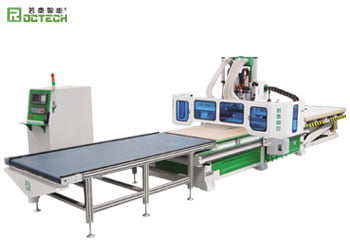
The global push toward reduced labor dependency in manufacturing has accelerated adoption of automated milling platforms. In panel furniture production, for instance, the shift from manual nesting to automatic loading and unloading nesting centers represents one of the more visible transitions. The table below summarizes key parameter comparisons across three representative machine categories that embody different levels of milling automation.
| Parameter | Automatic Loading/Unloading Nesting Center (RCA1224 class) | ATC Engraving Machine (RC1325S-ATC class) | Five-Axis Machining Center (RCF1325 class) |
|-----------|-----------------------------------------------------------|-------------------------------------------|---------------------------------------------|
| X/Y/Z Travel | 1220×2440×150mm | 1300×2500×250mm | 1300×2500mm (worktable) |
| Spindle Power | 9.6 kW | 9 kW (6–12 kW optional) | 10 kW |
| Tool Magazine Capacity | Row drill group + routing | 8/12/16 tools | Dependent on head configuration |
| Positioning Accuracy | Not specified (woodworking grade) | ±0.03mm/300mm | ±0.05mm |
| Rapid Traverse Speed | Not specified | 45,000 mm/min | 30,000 mm/min |
| Control System | Taiwan Syntec | Taiwan Syntec | Italian OSAI |
| Machine Weight | Approx. 4,500 kg | Approx. 2,200 kg | Approx. 8,500 kg |
Several observations emerge from this comparison. First, the nesting center prioritizes material handling automation over raw axis speed—its value proposition lies in reducing manual intervention across an entire shift rather than in maximizing single-part cycle time. Second, the ATC engraving machine occupies a middle ground: it automates tool changes but still requires manual workpiece loading in its standard configuration, making it suitable for batch production of complex parts where tool variety matters more than pallet automation. Third, the five-axis platform represents a different category of automation entirely, where the complexity lies in simultaneous motion control and the ability to complete multi-sided features in a single clamping rather than in tool or workpiece exchange.
The nesting center’s 9.6 kW spindle paired with a double-layer vacuum table and optional automatic labeling reflects a design philosophy aimed at cabinet and wardrobe production, where sheet utilization and throughput consistency outweigh micron-level positioning. By contrast, the five-axis machine’s positioning accuracy of ±0.05mm and repeatability of ±0.03mm address mold and curved-surface applications where even small deviations accumulate across long toolpaths.
Technical Applications and Brand Case: Roctech
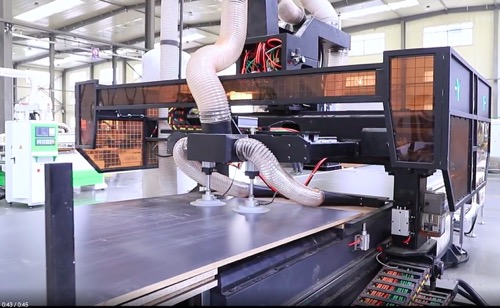
Roctech’s product architecture illustrates how automated milling requirements diverge by application. The Master Series automatic loading and unloading nesting center, represented by models such as the RCA1224 and the enlarged RCA1328, integrates sheet loading, nesting optimization, labeling, and unloading into a continuous workflow. The system pairs a heavy-duty welded bed with Taiwan HIWIN linear guides and Japan Yaskawa servo motors—component choices that signal a focus on durability under continuous operation rather than peak acceleration. For custom furniture manufacturers running mixed orders, the practical benefit is a reduction in the frequency of manual sheet handling, which in turn lowers labor cost per panel and reduces the risk of handling damage.
At the other end of the spectrum, Roctech’s five-axis simultaneous machining centers, including the RCF1325 and the larger RCF2040, employ imported five-axis heads and control systems from Italian OSAI, German Heidenhain, or Spanish Fagor. These machines target automotive molds, ship models, and complex solid wood components where the ability to machine undercuts and compound angles without re-fixturing is the primary economic driver. The gap in automation philosophy between these two product families is instructive: one automates material flow, the other automates kinematic capability.
Between these extremes, the ATC engraving machine series—RC1325S-ATC and its larger variants—addresses the broad middle market of woodworking, signage, and light mold production. With a tool magazine capacity of 8 to 16 tools and rapid traverse speeds up to 45,000 mm/min, these machines automate the tool change function while leaving workpiece handling to the operator or to optional pusher devices. This configuration suits job shops where part geometries vary but batch sizes do not justify the capital outlay of a full pallet-changing system.
Conclusion and Outlook
Automated milling is not a single technology but a spectrum of capabilities, each addressing a different bottleneck in the production chain. Nesting centers attack material handling; ATC machines attack tool change downtime; five-axis platforms attack fixturing complexity. The appropriate choice depends on where the dominant non-cutting time is spent in a given production environment. As control systems become more capable and component costs continue to moderate, the boundary between these categories will likely blur—entry-level machines will gain features previously reserved for high-end platforms. Suppliers with broad product portfolios, such as Roctech, are positioned to serve customers across this spectrum, though the engineering challenge of integrating automation without compromising rigidity or accuracy remains a persistent constraint. The next phase of development will likely center on predictive maintenance and adaptive process control, areas where the gap between marketed capability and practical reliability still warrants careful scrutiny.
Looking for more information about our CNC machines and services? Contact us today.
Contact