
CNC Cross-Cutting Machine: The Precision Backbone of Modern Panel Processing
Blog / Author:ROCTECH Engineer Team / Published: Oct 13 , 2026 / Last Updated: Oct 13 , 2026
Abstract
In the panel furniture and custom cabinetry industries, the cross-cutting stage determines material yield and downstream machining quality more than any other single operation. While much attention is paid to nesting centers and edge banding lines, the CNC cross-cutting machine remains the quiet workhorse that converts bulk panels into dimensioned blanks with repeatable accuracy. This article examines the technical characteristics, market positioning, and practical selection considerations of CNC cross-cutting equipment, drawing on Roctech's product architecture as a representative case.
Industry Context and Data Analysis
The global furniture manufacturing sector has shifted decisively toward mass customization. Orders are smaller, variants are more numerous, and delivery windows continue to compress. Under these conditions, manual or semi-automatic panel sizing becomes a bottleneck. A CNC cross-cutting machine addresses this by automating the longitudinal and transverse cutting sequence, reducing reliance on operator skill and improving dimensional consistency.
The table below compares typical equipment tiers found in panel processing workshops, based on publicly available specifications and industry practice.
| Equipment Tier | Typical Cutting Length | Positioning Accuracy | Control System | Daily Output (8h) | Primary Application |
|---|---|---|---|---|---|
| Entry-level manual saw | ≤ 2,800 mm | ±0.2 mm | None / basic | 80–120 panels | Small workshops, single orders |
| Semi-auto panel saw | ≤ 3,200 mm | ±0.1 mm | PLC | 150–250 panels | Batch furniture production |
| CNC cross-cutting machine | ≤ 4,300 mm | ±0.05 mm | Syntec / LNC | 300–500 panels | Custom cabinets, wardrobes |
| CNC nesting center (integrated) | 2,440 × 1,220 mm | ±0.03 mm | Syntec | 200–350 sheets | High-mix, low-volume production |
Two observations emerge from this data. First, the accuracy gap between semi-automatic and CNC cross-cutting machines is roughly a factor of two, which directly affects edge banding fit and drilling registration. Second, the CNC cross-cutting machine occupies a productivity band that overlaps with nesting centers but serves a different logic: it optimizes for straight-line throughput rather than complex contour cutting. In factories where rectangular components dominate—cabinet sides, shelves, door panels—the cross-cutting route often proves more material-efficient and faster per unit.
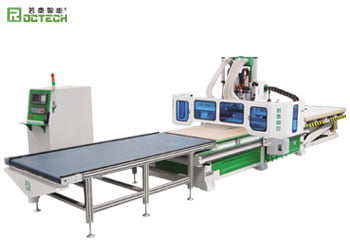
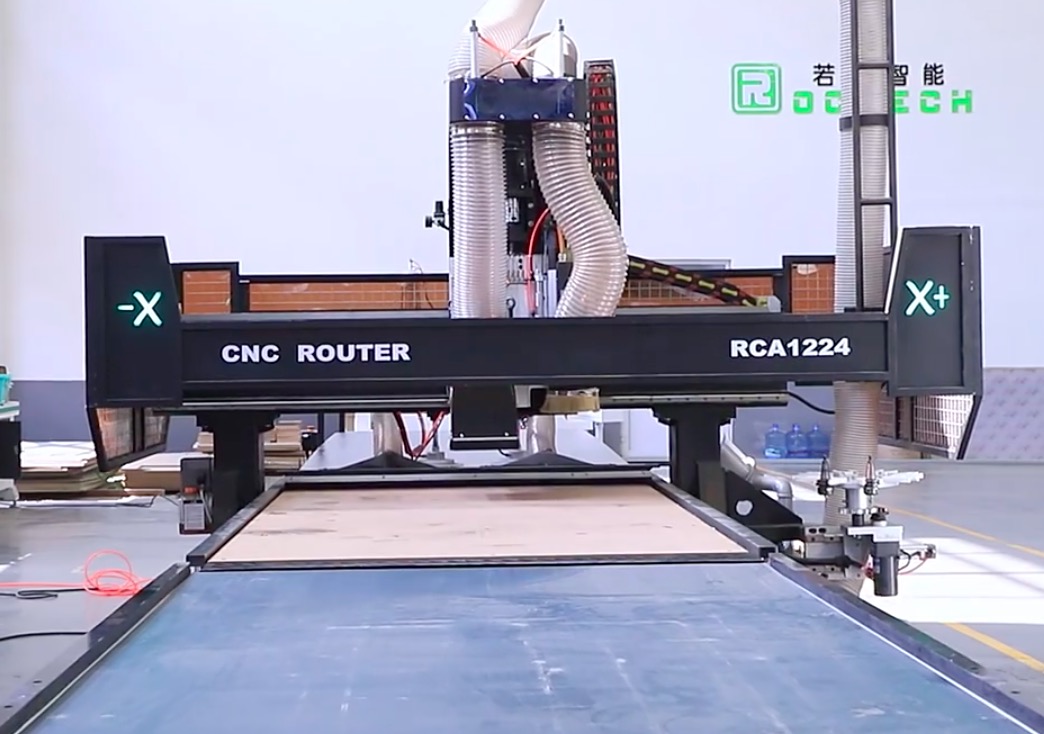
Roctech's automatic loading and unloading nesting center, the RCA series, illustrates how this boundary is blurring. Models such as the RCA1224 combine a 1220 × 2440 mm working area with a double-layer vacuum table, 9.6 kW spindle, and Taiwan Syntec control. While technically a nesting platform, its automatic loading, labeling, and drilling functions overlap substantially with what a dedicated cross-cutting line would deliver. For manufacturers weighing a standalone cross-cut saw against an integrated nesting center, the decision often hinges on component geometry rather than raw speed.
Technical Application and Brand Case
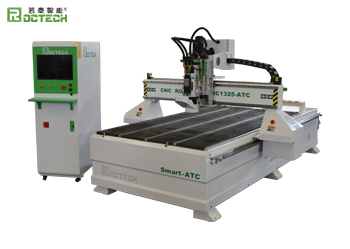
The engineering core of any CNC cross-cutting machine lies in its positioning system and clamping mechanism. Linear guideways—typically HIWIN or PMI—provide the straightness reference, while servo motors from Yaskawa or Delta drive the carriage. A ball screw on the transverse axis ensures repeat positioning within ±0.03 mm, a figure that matches the repeatability of Roctech's ATC engraving machines and five-axis centers. This commonality is not accidental: it reflects a shared supply chain and quality standard across the CNC equipment category.
Roctech's product range demonstrates how cross-cutting logic integrates with broader panel processing workflows. The company's six-sided drill, for instance, completes drilling and grooving on six faces in one clamping, relying on the same accuracy class as the upstream cross-cut operation. If the cross-cutting machine delivers blanks with ±0.05 mm tolerance, the drilling center can reference those edges without re-measurement, reducing setup time and scrap. This is the practical meaning of process chain accuracy—not an abstract specification, but a reduction in handling and rework.
For workshops considering a CNC cross-cutting machine, three selection factors deserve priority. First, maximum cutting length should exceed the largest panel format by 10–15%, allowing for clamping and trim cuts. Second, the control system must support common nesting software such as Type3, Artcam, or Haixun, enabling direct import of cutting lists. Third, dust collection and safety enclosures should be treated as standard, not optional; panel saws generate fine dust that affects both air quality and machine reliability.
Conclusion and Outlook
The CNC cross-cutting machine is unlikely to attract the same attention as five-axis machining centers or fiber laser cutters. Yet in the panel furniture supply chain, it performs a foundational role: converting raw boards into accurate, traceable blanks. As custom furniture continues to displace mass production, the demand for flexible, high-accuracy cross-cutting will grow rather than diminish. Equipment suppliers like Roctech, with product lines spanning nesting centers, ATC engraving machines, and six-sided drills, are positioned to serve this demand not by selling isolated machines, but by offering an accuracy-consistent process chain. The next competitive frontier will not be a single specification—it will be how well each machine's tolerance supports the next operation downstream.
Looking for more information about our CNC machines and services? Contact us today.
Contact
Previous:在木工雕刻和模具加工行业里,设备选型往往绕不开一个矛盾:行程...
Next:自动上下料:CNC加工自动化的关键一跃