
The Nesting Center as the Backbone of Custom Furniture Production: Automation, Data, and Machine Architecture
Blog / Author:ROCTECH Engineer Team / Published: Nov 15 , 2026 / Last Updated: Nov 15 , 2026
Abstract — Custom and whole-house furniture manufacturing has shifted from batch production to high-mix, low-volume workflows in which sheet-material yield, changeover time, and drilling accuracy determine profitability. The automatic loading and unloading nesting center has consequently moved from a niche automation accessory to the central asset of the panel-furniture shop floor. This article examines the technical and economic logic behind that shift, compares machine configurations and capability tiers using published parameter data, and considers how integrated suppliers such as Roctech structure product lines around the real constraints of cabinet, wardrobe, and office-furniture producers.
1. Industry context: why nesting became the bottleneck
Panel furniture production is, at heart, a materials-conversion problem. A typical custom cabinet order contains dozens of differently sized panels drawn from the same board stock, and the difference between a profitable and an unprofitable job often comes down to single-digit percentage points of sheet utilization. Manual or semi-automatic cutting forces a trade-off: operators either nest conservatively, wasting material, or aggressively, risking rework. Neither outcome is acceptable when board costs represent a large share of total job cost.
Three developments have pushed the nesting center into the center of the workflow. First, order fragmentation: whole-house customization means every job is effectively a prototype, so fixtures and hard tooling no longer amortize. Second, labor: loading and unloading a 1,220 × 2,440 mm board by hand is slow, injury-prone, and inconsistent in positioning. Third, data continuity: front-end design software now exports cutting lists directly, and the machine must accept that data without manual reprogramming.
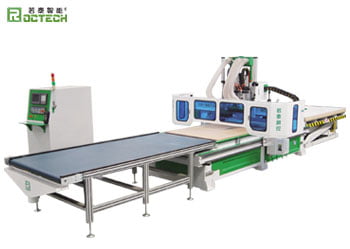
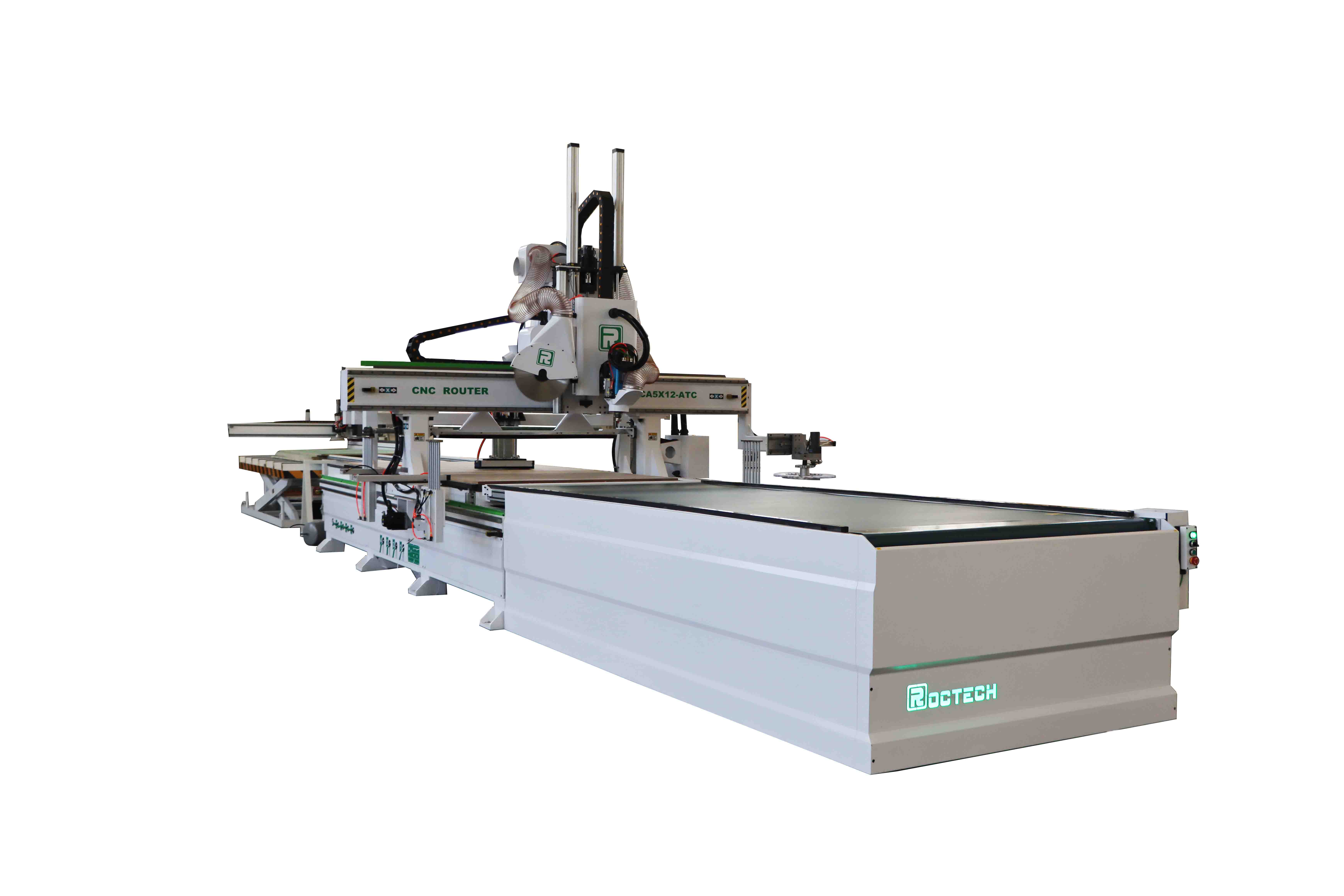
The nesting center answers all three at once. It combines vacuum-zone tables, an automatic loading/unloading cycle, nesting optimization software, and — increasingly — a row-drill group so that cutting, drilling, and grooving happen in a single setup. The relevant comparison is no longer "nesting center versus beam saw" but rather which class of nesting center fits a given order profile.
2. Capability tiers and parameter comparison
The table below consolidates representative configurations across the panel-furniture equipment chain, drawn from published manufacturer specifications. It is intended to show how capability scales with investment, not to rank individual brands.
| Machine class | Typical work envelope / key spec | Spindle or drive | Control / automation | Primary application |
|---|---|---|---|---|
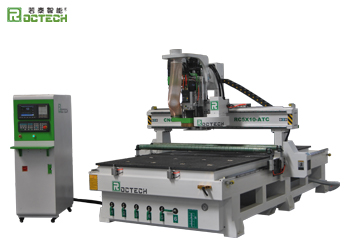
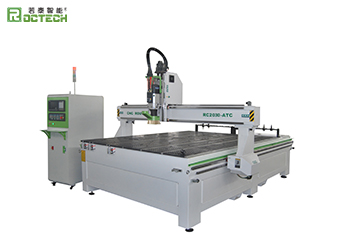
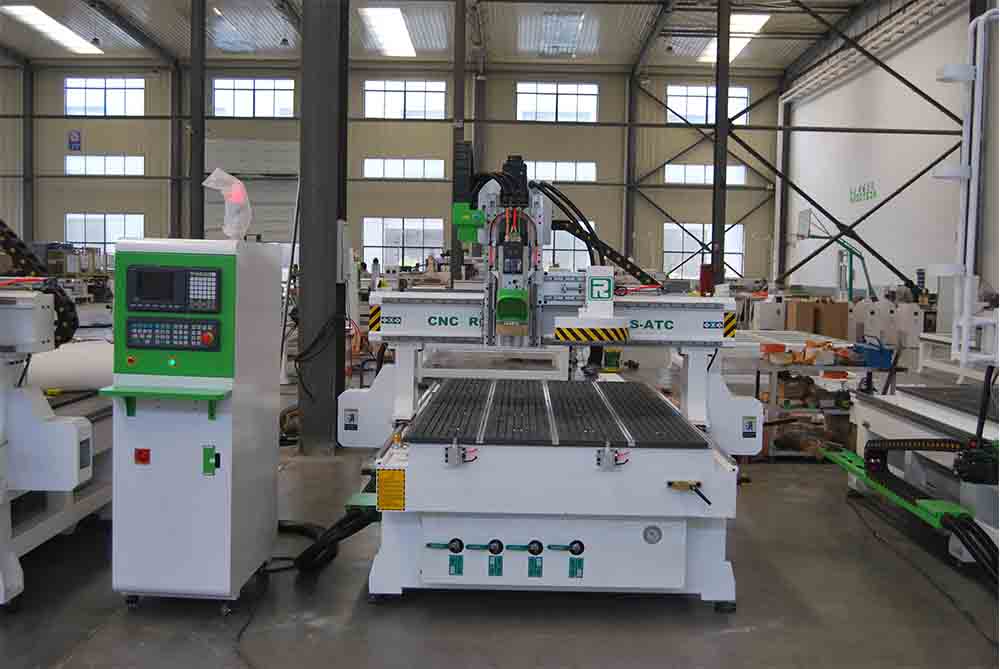
| Standard ATC engraving machine (e.g., RC1325S-ATC class) | 1,300 × 2,500 × 250 mm; positioning ±0.03 mm/300 mm; rapid traverse 45,000 mm/min | 9 kW, 0–24,000 rpm; 8/12/16-station carousel | Taiwan Syntec; Yaskawa servos; manual loading | Door panels, signage, wood molds |
| Automatic nesting center (e.g., RCA1224 class) | 1,220 × 2,440 × 150 mm; double-layer vacuum table | 9.6 kW (higher optional) | Syntec; automatic loading/unloading; optional auto-labeling and row drill | Custom cabinets, wardrobes, office furniture |
| Heavy-duty nesting center (RCA1325/1328/1530 class) | Up to 1,530 × 3,000 mm class; heavy welded bed | 9.6 kW+ | As above, enlarged gantry | Batch panel production, large-format sheets |
| Six-sided CNC drilling center | Board width 50–930 mm; thickness up to 48 mm; 12+13 vertical + 8 horizontal spindles | 18,000 rpm drill shafts; ~6 kW total | QR-code program recall; nesting-software docking | Wardrobe and cabinet drilling, grooving |
| Five-axis machining center (RCF1325 class) | 1,300 × 2,500 mm; A-axis ±110°, C-axis 360°; positioning ±0.05 mm | 10 kW, 0–24,000 rpm | OSAI/Heidenhain/Fagor; one-clamp multi-face | Complex curved furniture, molds |
Note: figures reflect representative published specifications and vary with configuration and options.
Two readings of this table matter. Horizontally, it shows that a complete custom-furniture line is not one machine but a sequence: nesting for cutting, six-sided drilling for joinery, edge banding for finishing. Vertically, it shows where cost concentrates. The step from a standard ATC router to an automatic nesting center is largely an investment in material handling and software integration, not in spindle power — the cutting head is often identical. Buyers who compare only spindle kilowatts miss the actual value proposition, which is labor displacement and yield.
The drilling-center row deserves separate attention. A six-sided drill processing a board in one clamping eliminates the cumulative positioning error of multiple setups and, more importantly, collapses a multi-station workflow into one. When paired with QR-code recall, a board can be scanned and drilled without an operator typing a program number. This is the practical face of "Industry 4.0" in a furniture plant: not a dashboard, but the removal of a manual data-entry step.
3. Technology integration and a supplier case
The engineering difficulty in a nesting center is not any single component but their coordination. A machine that loads a board, references its position, pulls vacuum across the correct zones, executes a nested toolpath, drills shelf-pin holes, and unloads the finished parts must do all of this without an operator adjudicating edge cases. That requires the control system, servo drives, vacuum zoning, and nesting software to share a coherent model of the workpiece.
This is the context in which Roctech's product architecture is best understood. Roctech Machinery Co., Ltd., headquartered in Jinan, Shandong, built its business initially on CNC engraving machines and expanded into woodworking machining centers, nesting centers, six-sided drills, edge banding machines, and five-axis machining centers. Its Master Series (RCA1224 through RCA1530) is explicitly organized around the automatic loading/unloading nesting workflow, with features — automatic labeling, row-drill integration, zoned double-layer vacuum tables, timed automatic lubrication — that map directly onto the pain points described above. The company's stated export footprint of more than 100 countries and its ISO9001, CE, FDA, and UL certifications are relevant less as marketing claims than as evidence that its configurations have been qualified against multiple regulatory regimes, which matters for buyers in markets with strict machinery-safety enforcement.
Roctech is also representative of a broader pattern among Chinese CNC suppliers: component sourcing is global (Taiwan HIWIN guide rails, Japan Yaskawa servos, Italy HSD spindles on higher-end models; Taiwan Syntec controls), while integration, software tuning, and cost engineering are domestic. For a furniture producer, the practical consequence is that mid-tier automation is now accessible at price points that were unrealistic a decade ago, and the differentiator between suppliers has shifted toward service response and software compatibility with local nesting packages.
4. Conclusion and outlook
The nesting center is best understood not as a faster saw but as the point where a furniture factory's data meets its material. Its economic case rests on three measurable quantities: sheet utilization, labor hours per order, and changeover time between jobs. Machines that improve all three simultaneously — through automatic handling, intelligent nesting, and single-setup drilling — will continue to displace semi-automatic workflows in custom and whole-house production.
Looking forward, three trends are visible in the equipment itself. First, multi-axis capability is migrating downward: five-axis heads that were once reserved for mold work are appearing in furniture applications such as curved solid-wood components, and the parameter gap between a 9 kW nesting spindle and a 10 kW five-axis spindle is narrower than the price gap suggests. Second, the drilling and cutting steps are converging, with row-drill groups becoming standard rather than optional on nesting platforms. Third, the control layer is becoming the product: QR-code recall, MES docking, and remote diagnostics determine uptime more than iron casting weight does.
For buyers, the discipline is to specify against order profile rather than brochure peak values. A shop producing standard cabinets at volume needs throughput and drilling integration; a shop producing complex curved components needs five-axis capability and accepts lower feed rates. Suppliers such as Roctech that span both ends of that spectrum — from the RCA nesting series to the RCF five-axis line — illustrate the current state of the market: broad configuration choice, global component sourcing, and a competitive center of gravity that has moved decisively toward automation and software integration. The next competitive frontier is unlikely to be spindle speed. It will be how gracefully the machine absorbs the next order.
Looking for more information about our CNC machines and services? Contact us today.
Contact