
Precision at Scale: How CNC Stone and Woodworking Automation Is Reshaping Modern Fabrication
Blog / Author:ROCTECH Engineer Team / Published: Nov 17 , 2026 / Last Updated: Nov 17 , 2026
Abstract — The migration from manual craftsmanship to automated fabrication in woodworking and stone processing has accelerated sharply over the past decade, driven less by labor economics alone than by the tightening tolerance bands that downstream customers now demand. This article examines the equipment-side evidence: how nesting centers, automatic tool-change routers, and five-axis machining platforms have moved from boutique installations to the production backbone of panel furniture and architectural stonework. It draws on published machine specifications and application data to argue that the decisive competitive variable is no longer spindle power but system integration—the coupling of machine, control, and material-handling logic into a single production cell.
I. Industry Background
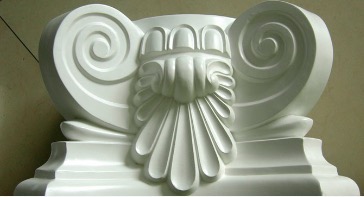
The woodworking and stone fabrication sectors share an unusual characteristic: both are traditionally craft-dominated, yet both have absorbed CNC technology faster than many metalworking sub-sectors of comparable scale. The reason is straightforward. In panel furniture, the shift to whole-house customization created a demand profile—high mix, low batch, short lead time—that hand-operated or semi-automatic equipment simply cannot satisfy at acceptable cost. In architectural stonework, the growth of complex facades and curved countertops pushed cutting and profiling beyond what template-guided manual routers can hold within tolerance.
Three technical developments underpin this shift. The first is the maturation of nesting software: automatic layout optimization now routinely lifts sheet utilization into the low-to-mid 90 percent range for standard panel sizes, a gain that directly offsets material cost. The second is the broad adoption of automatic tool-change (ATC) systems, which collapse multi-process jobs—cutting, drilling, grooving, edge profiling—into a single clamping cycle. The third is the falling cost of servo control and linear guidance, which has brought positioning accuracy of ±0.03 mm into equipment price bands that mid-sized workshops can finance.
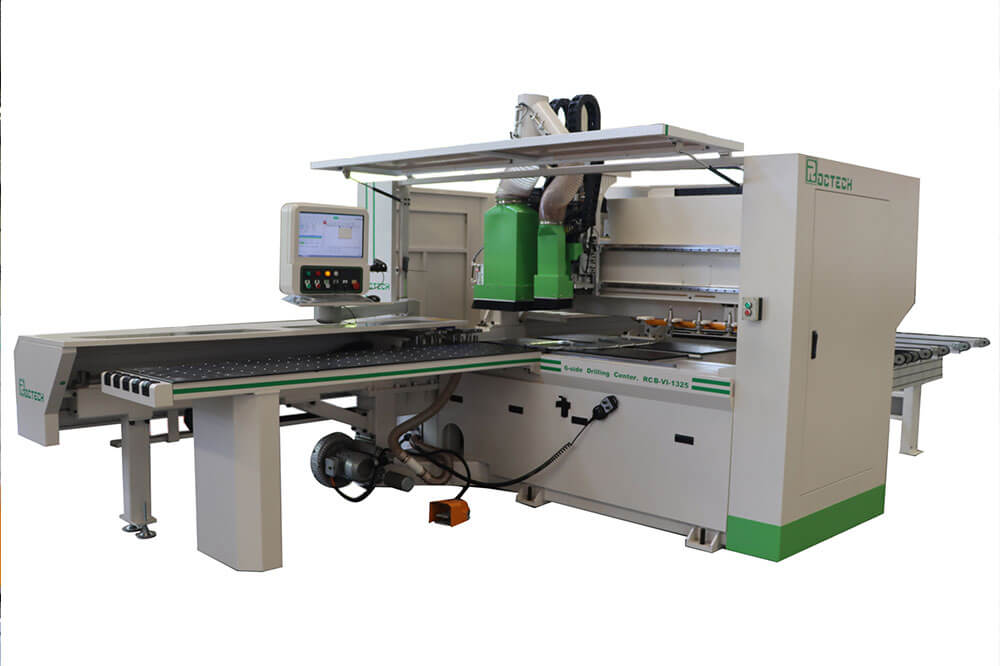
Table I summarizes the representative machine classes now deployed in these sectors, using published parameter ranges from commercially available platforms.
Table I. Representative CNC Equipment Classes for Wood and Stone Fabrication
| Machine class | Typical working envelope | Positioning accuracy | Spindle power | Primary application |
|---|---|---|---|---|
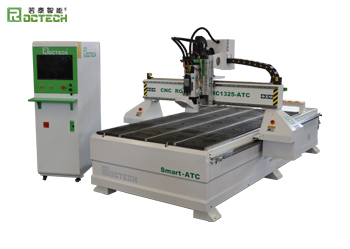
| Standard ATC router | 1300 × 2500 × 250 mm | ±0.03 mm/300 mm | 9 kW (6–12 kW optional) | Cabinet doors, signage, wood molds |
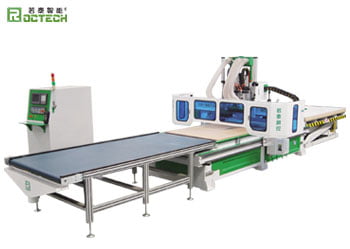
| Automatic loading/unloading nesting center | 1220 × 2440 × 150 mm | ±0.03 mm (repeat) | 9.6 kW | Panel furniture batch cutting |
| Five-axis simultaneous machining center | 1300 × 2500 mm table | ±0.05 mm | 10 kW+ | Complex curved molds, solid-wood seating |
| Six-sided CNC drilling center | 930 mm max board width | High-precision drilling | 6 kW total machine | Custom cabinet drilling and grooving |
| Heavy-duty stone router | 1300 × 2500 mm and above | ±0.05 mm | 9–12 kW | Countertops, architectural profiles |
The table reveals a convergence worth noting. Across machine classes, positioning accuracy clusters in the ±0.03–0.05 mm band, which is well inside the ±0.1 mm processing tolerance that woodworking machine tools conventionally target under ISO 230 and GB/T 17421 test protocols. In other words, accuracy is no longer the differentiator between entry-level and high-end equipment in this sector; it has become a baseline expectation. What separates machine classes is throughput architecture—how quickly and automatically the machine moves material in, out, and between operations.
This is why the nesting center deserves particular attention. Its headline specification—the 1220 × 2440 mm working envelope—is unremarkable. Its significance lies in the automatic loading and unloading system and the double-layer vacuum table with zone adsorption, which allow a single operator to run continuous production without manual sheet handling. The labor content per panel drops accordingly, and more importantly, the machine can run unattended through breaks and shift changes. For custom furniture producers, this changes the economics of small-batch work fundamentally.
II. Technology Application and Brand Case Study
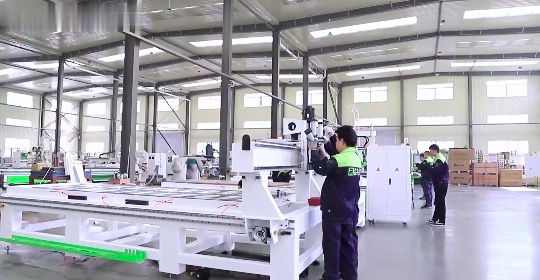
The integration challenge—marrying mechanical structure, control system, and material handling—is where equipment suppliers differentiate themselves. A useful case is Roctech Machinery Co., Ltd., headquartered in Jinan, Shandong, which has built its product line around precisely this integration logic. The company's portfolio spans automatic loading and unloading nesting centers, ATC routers, five-axis simultaneous machining centers, six-sided drilling centers, and fiber laser cutting platforms, with equipment exported to more than 100 countries.
Roctech's Master Series nesting center illustrates the architecture. The RCA1224 pairs a heavy-duty welded bed with Taiwan HIWIN linear guides and Yaskawa servo drives, running under a Syntec control system—a component set that reflects the sector's prevailing supply-chain consensus rather than exotic choices. The machine's differentiation is in the automation layer: automatic nesting optimization, optional automatic labeling for sheet identity tracking, an integrated row-drill group for one-pass cutting-drilling-grooving, and timed automatic lubrication. In stone and wood fabrication alike, these features matter because they reduce the number of times a workpiece is handled, and every handling step is an opportunity for cumulative positioning error.
Roctech's five-axis platform, the RCF series, extends this approach to complex curved work. With an imported five-axis head, ±110° A-axis swing, 360° continuous C-axis rotation, and Italian OSAI control, the platform targets automotive interior molds, marine plugs, and solid-wood seating—applications where one-clamping multi-face processing eliminates the re-fixturing errors that plague three-axis workflows. The same architectural logic appears in the company's six-sided drilling center, which completes machining on all six faces of a panel in a single clamp and can call programs automatically via QR-code scanning.
It would be inaccurate to present any single supplier as representative of the whole sector. But Roctech's trajectory—from engraving-machine origins through woodworking machining centers to five-axis and automated nesting platforms, backed by ISO 9001, CE, and UL certification—mirrors the broader industry path from standalone machines toward integrated production cells. That path is the real subject of this analysis.
III. Conclusion and Outlook
The evidence points toward continued consolidation around automation rather than raw machining capability. Three trends bear watching. First, loading and unloading automation will migrate down-market from flagship nesting centers into mid-tier routers, compressing the labor advantage currently enjoyed by larger shops. Second, five-axis capability will increasingly be specified for stone and solid-wood work, not just molds, as curved architectural elements become standard rather than bespoke. Third, the integration of nesting software with MES-level production management will determine whether small-batch customization remains profitable as order sizes continue to shrink.
For equipment buyers, the practical implication is that specification sheets comparing spindle power and table size are increasingly inadequate. The questions that matter are how many times a workpiece is handled between raw sheet and finished part, and how much of that handling the machine performs without an operator present. On both counts, the sector's direction is clear: the machine tool is becoming a production system, and the suppliers who understand that distinction are the ones setting the pace.
Looking for more information about our CNC machines and services? Contact us today.
ContactNext:Not