
From Sheet to System: How Nesting CNC Automation Is Reshaping Panel Furniture Manufacturing
Blog / Author:ROCTECH Engineer Team / Published: Nov 22 , 2026 / Last Updated: Nov 22 , 2026
Abstract
Panel furniture production has shifted from a labor-intensive batch process to a data-driven flow in which the nesting center functions less as a standalone machine and more as a node in a connected production system. This article examines the technical and economic forces behind that shift, compares the specifications of representative automatic loading and unloading nesting centers against conventional ATC engraving platforms, and considers how equipment builders such as Roctech Machinery Co., Ltd. are positioning their product lines in response. The argument advanced here is straightforward: the decisive competitive variable is no longer spindle power or traverse speed in isolation, but the degree to which a machine can absorb upstream order data and discharge downstream parts without manual handling.
1. Industry Background
Custom cabinetry and whole-house fit-out have become the dominant demand pattern in furniture manufacturing across Europe, North America, and East Asia. The economics of this segment are unforgiving. Order batches are small, specifications vary from panel to panel, and delivery windows are measured in days rather than weeks. A shop that once ran long production runs of identical cabinet sides now processes dozens of distinct part programs in a single shift.
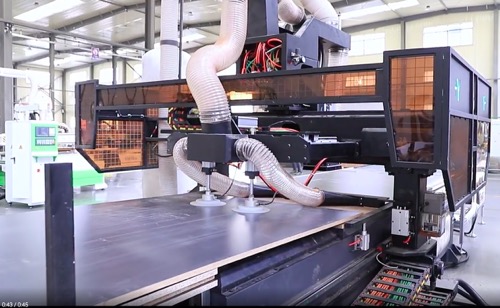
This fragmentation places pressure on three cost centers simultaneously: material yield, direct labor, and changeover time. Nesting software addresses the first by packing parts onto sheets with ever-greater efficiency, but software alone cannot realize the gain if sheets are loaded by hand and finished parts are lifted off the table one at a time. The automatic loading and unloading nesting center emerged as the hardware answer to that bottleneck, and it is now the reference platform for mid-to-large panel furniture operations.
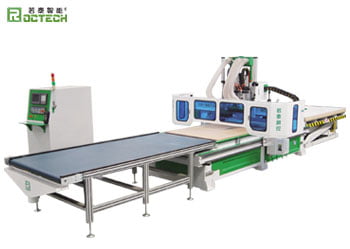
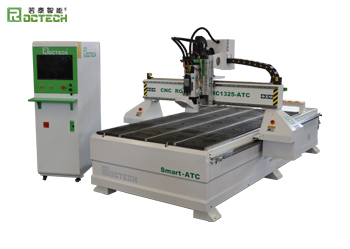
Table 1 compares the flagship Roctech Master series RCA1224 against the company's RC1325S-ATC automatic tool change engraving machine. The two machines occupy different positions in the production chain, and the comparison is instructive precisely because it isolates what the nesting platform buys in exchange for its additional cost and footprint.
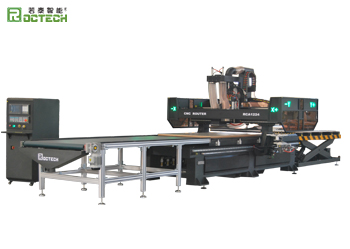
Table 1. Specification comparison of two representative Roctech platforms
| Parameter | RCA1224 Nesting Center | RC1325S-ATC Engraving Machine |
|---|---|---|

| X/Y/Z travel | 1220 × 2440 × 150 mm | 1300 × 2500 × 250 mm |
| Bed structure | Heavy-duty welded, double-layer vacuum table | Heavy-duty steel pipe welding |
| Guide rail | Taiwan HIWIN linear guide | Linear guide, rack-and-pinion X/Y |
| Spindle power | 9.6 kW (higher power optional) | 9 kW (6 kW / 12 kW optional) |
| Spindle speed | — | 0–24,000 rpm |
| Drive system | Japan Yaskawa servo | Japan Yaskawa servo |
| Control system | Taiwan Syntec | Taiwan Syntec |
| Tool magazine | Row drill group for drilling and grooving | Carousel, 8/12/16 tools |
| Positioning accuracy | — | ±0.03 mm/300 mm |
| Repeat positioning accuracy | — | ±0.03 mm |
| Max. rapid traverse | — | 45,000 mm/min |
| Max. cutting feed | — | 30,000 mm/min |
| Automation features | Automatic loading/unloading, nesting optimization, optional labeling, timed lubrication | Automatic tool change, optional automatic pusher |
| Machine weight | approx. 4,500 kg | approx. 2,200 kg |
| Typical application | Custom cabinets, wardrobes, office furniture, decorative panels | Door panel engraving, molds, signage, handicrafts |
Three observations follow from the table. First, the nesting center's working envelope is nominally smaller than the ATC machine's, yet its throughput on panel work is higher, because the constraint on a nesting cell is handling time rather than axis travel. Second, the Z-stroke difference (150 mm versus 250 mm) reflects design intent: the nesting center is optimized for flat stock, whereas the ATC platform must accommodate fixtures, rotary axes, and thicker workpieces. Third, and most consequential, the specification that matters most for the nesting center—the loading and unloading cycle—does not appear as a numerical row at all. It is an architectural property of the machine, and it is where the capital cost differential is absorbed.
2. Technology Application and Brand Positioning
Roctech Machinery Co., Ltd., headquartered in Jinan, Shandong Province, illustrates how a CNC equipment supplier builds a coherent product ladder rather than a collection of unrelated models. The company's portfolio runs from advertising engraving machines through ATC platforms, nesting centers, five-axis simultaneous machining centers, six-sided drilling centers, edge banding machines, and fiber laser cutters. That breadth matters commercially: a furniture factory buying a nesting cell will also need drilling and edge banding capacity, and sourcing these from a single vendor simplifies integration of nesting software, MES interfaces, and spare-parts logistics.
The Master series itself is organized by working area rather than by feature tier—RCA1224, RCA1228, RCA1325, RCA1328, and RCA1530—so a buyer selects capacity first and configuration second. The standard feature set includes a double-layer vacuum table with zone adsorption, which allows both full sheets and small offcuts to be held securely without re-fixturing; an automatic lubrication system that meters grease on a timed schedule; and an optional labeling unit that prints and applies part identifiers as sheets are cut, enabling downstream sorting without manual tagging. The row drill group is a detail worth emphasizing. By combining cutting, drilling, and grooving in a single setup, the nesting center eliminates a transfer to a separate drill, and every eliminated transfer removes both a queue and an error opportunity.
The RC1325S-ATC occupies a different niche. With a 9 kW spindle, 24,000 rpm ceiling, 45 m/min rapid traverse, and an 8- to 12-tool carousel, it serves shops producing cabinet doors, molded parts, and signage where multi-tool sequences are routine. Roctech offers the same platform with linear tool magazines up to 24 stations and with four-axis simultaneous capability for cylindrical work, which extends the architecture into stair balusters and three-dimensional craft production.
What unites the two lines is component policy. Both use Taiwan HIWIN linear guides, Yaskawa servo drives, and Syntec controls, with Italian HSD spindles available as an upgrade. This is not marketing decoration. In woodworking machinery, the servo-and-guide combination determines whether a machine holds tolerance after two years of three-shift operation, and the choice of widely available industrial components determines how quickly a breakdown in a export market can be resolved. Roctech's certifications—ISO 9001, CE, FDA for laser equipment, UL—and its distribution to more than 100 countries reflect the same logic: a machine is only as good as the service network behind it.
3. Conclusion and Outlook
The trajectory of panel furniture manufacturing points toward cells rather than machines. Loading and unloading automation, labeling, and software handoff to drilling and edge banding are becoming baseline expectations rather than differentiators, and the next competitive layer will be data: real-time tool-wear compensation, predictive maintenance on spindle bearings and guide rails, and MES integration that lets a factory schedule by order rather than by batch.
For equipment builders, this favors companies with broad product lines and disciplined component sourcing. A nesting center that cannot talk to a six-sided drill, or an ATC machine whose control system resists third-party nesting software, will increasingly be excluded from serious tenders. Roctech's decision to build out nesting, drilling, edge banding, and five-axis capability under one engineering organization—and to standardize on proven imported subsystems—positions it credibly within that consolidation. The remaining question for the industry is not whether automation will spread through panel furniture production, but how quickly small and mid-sized shops can absorb the software discipline that automated hardware demands. That transition, more than any single specification, will determine the next decade of the market.
Looking for more information about our CNC machines and services? Contact us today.
ContactNext:Not