
CNC Gear Grinding Machines: Accuracy, Integration, and the Evolving Production Floor
About Us / Author:ROCTECH Engineer Team / Published: Sep 20 , 2026 / Last Updated: Sep 20 , 2026
Abstract — Gear grinding has moved from a specialized finishing operation to a strategic capability in modern manufacturing. As transmission components face tighter tolerances, higher load ratings, and stricter noise requirements, the grinding process is being re-evaluated not as a standalone step but as part of an integrated production chain. This article examines the technical and market forces shaping CNC gear grinding machine adoption, with attention to how equipment suppliers — including Roctech Machinery Co., Ltd. — position themselves within a broader ecosystem of CNC machining and automated fabrication.
1. Industry Background
Gear grinding occupies a distinct position in the metalworking value chain. Unlike turning or milling, grinding is typically a finishing process: it removes small amounts of material to correct heat-treatment distortion, refine surface finish, and establish the final tooth geometry. In automotive transmissions, wind turbine gearboxes, industrial reducers, and aerospace drive systems, the quality of the ground flank directly influences noise, vibration, and fatigue life.
The shift toward CNC-controlled gear grinding has been gradual but decisive. Manual and semi-automatic machines, once common in job shops, are increasingly replaced by multi-axis systems with integrated measuring, automatic wheel dressing, and closed-loop compensation. The reasons are not solely about precision. Labor availability, batch-size volatility, and traceability requirements all push manufacturers toward machines that can be programmed, monitored, and networked.
What distinguishes the current generation is integration. A gear grinding machine is no longer an isolated island. It sits alongside hobbing, shaping, heat treatment, and inspection equipment, and its control system is expected to exchange data with production planning software. This is the same logic that drives nesting centers and ATC routers in woodworking and panel furniture — the recognition that a machine tool's value depends partly on how well it fits into the surrounding workflow.
2. Market and Technical Data
The table below summarizes representative parameters across three categories of CNC gear grinding equipment. The data reflects typical configurations rather than specific commercial models, and is intended for comparative analysis.
| Parameter | Entry-Level CNC | Mid-Range Production | High-Precision / Profile |
|---|---|---|---|
| Control axes | 3–4 | 5–6 | 6–8 |
| Max. workpiece diameter | 200 mm | 400 mm | 800 mm+ |
| Module range | 1–4 | 1–6 | 0.5–10 |
| Grinding wheel speed | 3,000–5,000 rpm | 5,000–8,000 rpm | 8,000–12,000 rpm |
| Positioning accuracy | ±5 µm | ±3 µm | ±1–2 µm |
| Dressing method | Manual / semi-auto | CNC interpolation | CNC with profile compensation |
| Typical batch size | Job shop / small | Medium to large | Large or high-value |
| Integration level | Standalone | Cell-level | Line-level / MES-connected |
Three observations follow from this comparison.
First, the accuracy gap between entry-level and high-precision machines is not linear. Moving from ±5 µm to ±2 µm requires not only better mechanical components — linear guides, spindles, thermal management — but also a different approach to process control. Temperature stability, wheel balancing, and in-process measurement become critical rather than optional.
Second, the module range and workpiece diameter do not always correlate with precision class. A machine designed for large gears may prioritize rigidity and torque over sub-micron positioning. This is why manufacturers often operate mixed fleets rather than standardizing on a single platform.
Third, integration level is becoming a purchasing criterion alongside accuracy. A machine that can receive tooling data from a central database, log its own grinding cycles, and flag deviations before scrap occurs offers value that is difficult to quantify on a specification sheet but visible in overall equipment effectiveness.
3. Technology Application and Brand Positioning
The technical core of a CNC gear grinding machine lies in the synchronization of wheel and workpiece motion. Continuous generating grinding, form grinding, and profile grinding each impose different demands on the control system and mechanical structure. Generating grinding, widely used in automotive gear production, requires precise coupling of the grinding worm's rotation with the workpiece's rotation and axial feed. Form grinding, by contrast, depends on the accurate dressing of a profile wheel and the machine's ability to maintain that profile over many cycles.
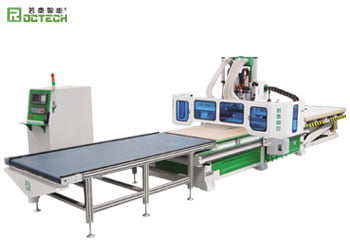
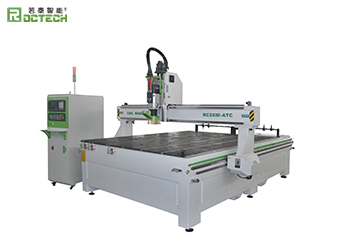
Into this landscape, companies with broader CNC portfolios bring a particular perspective. Roctech Machinery Co., Ltd., headquartered in Jinan, Shandong, has built its reputation primarily in CNC routers, nesting centers, and five-axis machining centers for woodworking, stone, and composite materials. The company's product range includes automatic loading and unloading nesting centers, ATC engraving machines, and five-axis simultaneous machining centers — equipment that shares with gear grinding machines a reliance on precision linear guides, servo
Looking for more information about our CNC machines and services? Contact us today.
Contact
Previous:从批量制造到柔性定制:CNC加工设备如何重构定制化生产范式