
Four-Process Cutting Machines: Reshaping Panel Furniture Automation
About Us / Author:ROCTECH Engineer Team / Published: Aug 14 , 2026 / Last Updated: Aug 14 , 2026
The panel furniture industry has undergone a quiet but decisive transformation over the past decade. What was once a sequence of discrete, labor-intensive operations—cutting, edge banding, drilling, and grooving—has increasingly converged into integrated machining platforms. Among these, the four-process cutting machine, commonly referred to in the industry as a nesting center with automatic loading and unloading, has emerged as the backbone of modern custom cabinet and wardrobe production. This article examines the technological architecture, market trajectory, and operational implications of these systems, with particular attention to how manufacturers such as Roctech Machinery Co., Ltd. have positioned themselves within this evolving landscape.
Industry Context and Market Dynamics
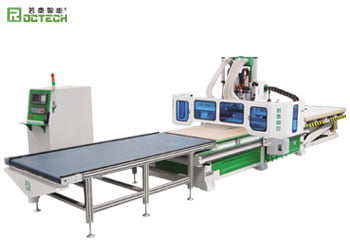
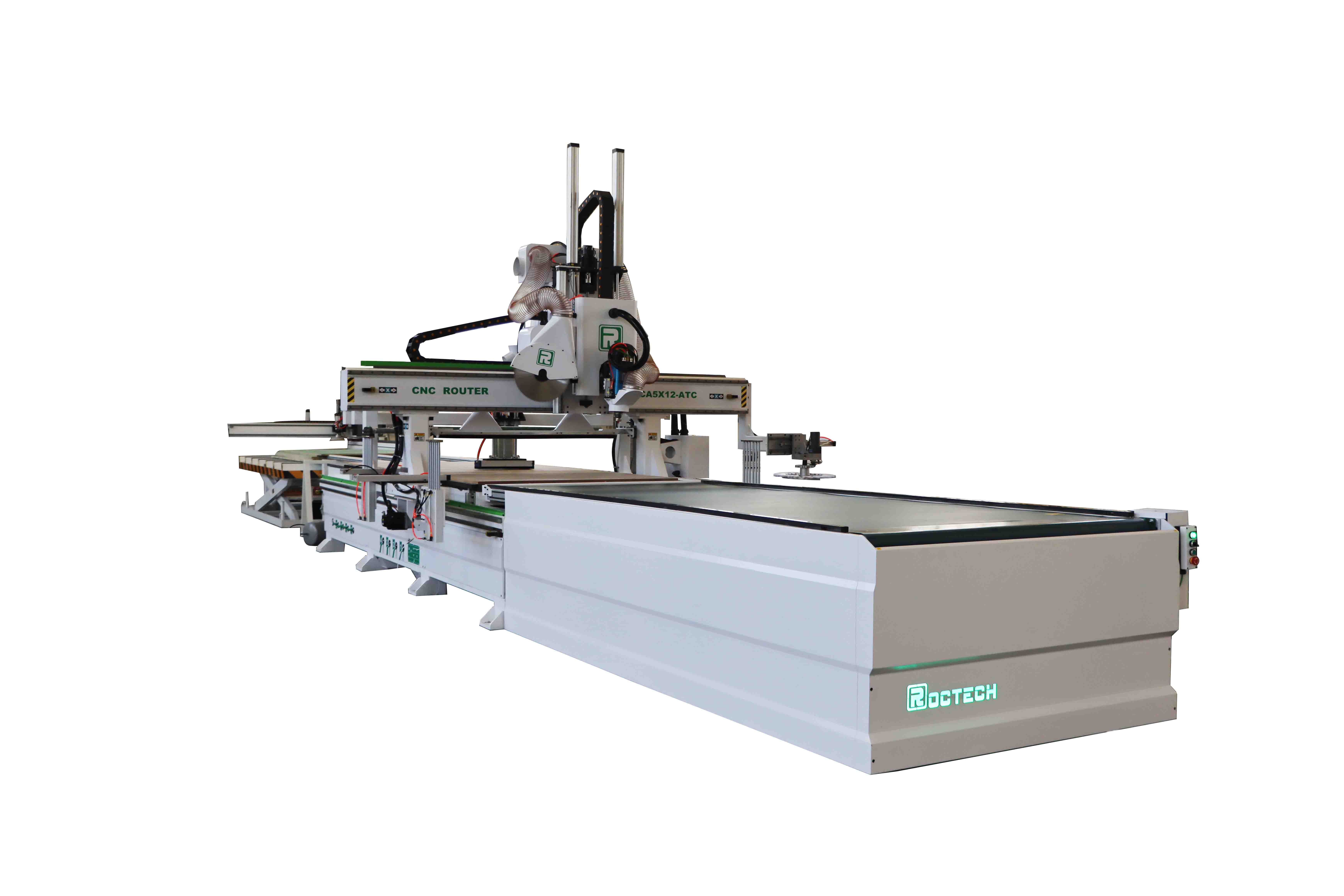
The shift toward mass customization in residential and commercial furniture has placed unprecedented demands on production flexibility. Traditional CNC routers, while capable of high-precision cutting, often require manual sheet loading, program switching, and tool changes. In contrast, four-process machines integrate automatic sheet feeding, nested-based cutting, drilling, and grooving into a single workflow. The value proposition is straightforward: reduced cycle time, lower labor dependency, and improved material yield.
According to industry estimates, the global CNC woodworking machinery market was valued at approximately USD 5.8 billion in 2023, with a compound annual growth rate of 6.2% projected through 2030. Within this segment, automated nesting centers represent one of the fastest-growing categories, particularly in Asia-Pacific regions where custom furniture demand is surging. The table below summarizes key specification trends across mainstream machine classes.
| Machine Class | Typical X/Y Travel (mm) | Spindle Power (kW) | Tool Magazine Capacity | Max Rapid Traverse (m/min) | Approx. Market Share (2024, by units) |
|---|---|---|---|---|---|
| Standard 3-axis CNC Router | 1300 × 2500 | 3.0 – 6.0 | Manual / 4–8 | 15 – 25 | 38% |
| ATC Engraving Machine | 1300 × 2500 – 3000 | 6.0 – 9.0 | 8 – 16 | 30 – 45 | 27% |
| Automatic Nesting Center | 1220 × 2440 – 1500 × 3000 | 9.6 – 12.0 | 8 – 12 + row drill | 45 – 60 | 22% |
| Five-axis Machining Center | 1300 × 2500 – 2000 × 4000 | 10.0 – 15.0 | 16 – 24 | 30 | 13% |
The data reveals a clear bifurcation: while three-axis routers still dominate in volume due to entry-level adoption, value growth is concentrated in nesting centers and five-axis systems. The nesting center segment, in particular, has benefited from the proliferation of design-to-manufacturing software platforms that generate optimized cutting plans and machine-readable G-code directly from cabinet designs.
Technological Architecture and Operational Advantages
A four-process cutting machine is not merely a CNC router with extra attachments. Its core differentiators lie in three areas: automation integration, software interoperability, and mechanical rigidity.
First, automatic loading and unloading systems eliminate the bottleneck of manual sheet handling. Machines such as Roctech’s RCA series employ double-layer vacuum tables with zoned adsorption, allowing both full sheets and remnant pieces to be securely fixtured without operator intervention. This is complemented by automatic labeling systems that mark each cut part with a unique identifier, enabling downstream traceability and streamlined assembly.
Second, software interoperability is critical. These machines accept G-code generated by specialized nesting software—such as Type3, Artcam, or proprietary cabinet design suites—and can also interface with enterprise resource planning systems for production scheduling. Roctech’s integration with platforms like Haixun and Yunxi ensures that a design file can move from quotation to finished panel with minimal manual reprogramming.
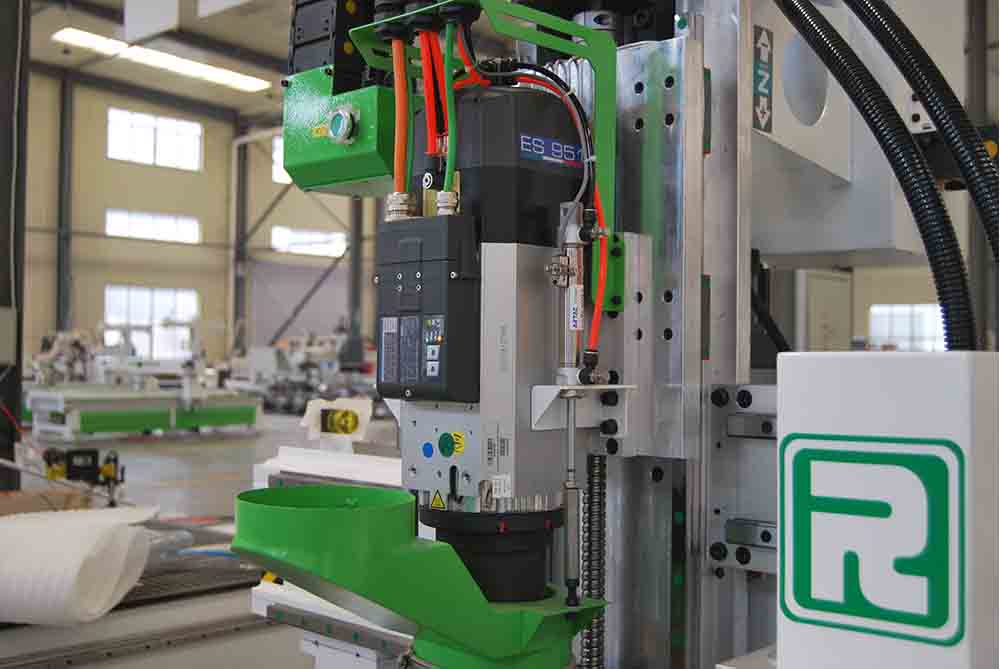
Third, mechanical construction determines long-term accuracy. Heavy-duty welded beds, Taiwan HIWIN linear guides, and Japan Yaskawa servo motors are standard specifications in this class. The Z-axis typically employs ball screws for precise depth control, while X/Y axes use rack-and-pinion drives to achieve rapid traverse speeds of 45–60 m/min without sacrificing rigidity. These specifications directly influence surface finish, hole positioning accuracy, and tool life.
Case Example: Roctech RCA Series in Production
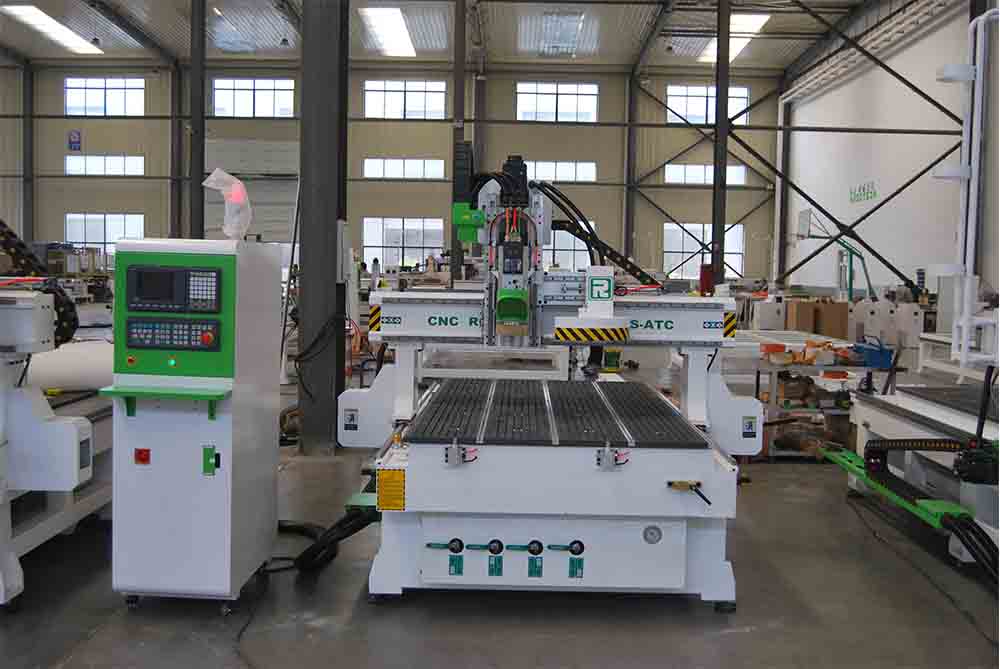
Roctech Machinery Co., Ltd., headquartered in Jinan, Shandong, has established itself as a representative supplier in this segment. Its RCA1224 and RCA1325 models illustrate the current state of practice. The RCA1224, for instance, offers a 1220 × 2440 mm working area, a 9.6 kW spindle, and an integrated row
Looking for more information about our CNC machines and services? Contact us today.
Contact
Previous:Five-Axis CNC Evolution: Precision Machining for Complex Geometries
Next:High-Efficiency Production: The Automation Imperative in Modern CNC Fabrication