
Title: Guangzhou Furniture Fair 2025: CNC Automation and the New Economics of Custom Panel Production
About Us / Author:ROCTECH Engineer Team / Published: Aug 04 , 2026 / Last Updated: Aug 04 , 2026
Article Content:
The Guangzhou International Furniture Fair (CIFF) has long served as a barometer for the Asian furniture manufacturing sector, but the 2025 edition marks a distinct inflection point. The conversation has shifted from design aesthetics alone to the machinery that makes complex, mass-customized production financially viable. The dominant theme this year is not merely automation, but the intelligent integration of the entire production line—from raw sheet goods to edge-banded, drilled, and packaged components. This shift aligns directly with the global pressure on manufacturers to reduce lead times and material waste while coping with a persistent skilled-labor shortage.
Data emerging from the fair’s concurrent industry forums highlights the accelerating adoption of nested-based manufacturing (NBM) in the panel furniture segment. The economic argument for automated nesting is no longer a matter of debate; it is a necessity for survival in the export and high-end domestic markets. The table below, compiled from exhibitor technical datasheets and post-show industry surveys, illustrates the comparative efficiency metrics that are driving purchasing decisions among Chinese and Southeast Asian fabricators:
| Production Scenario | Conventional Standalone CNC Router | Automated Nesting Center (e.g., Roctech RCA Series) | Delta (Improvement) |
| :--- | :--- | :--- | :--- |
| Sheet Utilization Rate | 72% – 78% (manual layout) | 88% – 94% (software-optimized nesting) | +12 to +16 percentage points |
| Labor Requirement per Shift | 3 – 4 operators (load, run, unload, sort) | 1 operator (supervise loading/unloading cycle) | -60% to -75% |
| Average Cycle Time per 2440x1220mm Sheet | 12 – 18 minutes (including manual tool changes) | 6 – 9 minutes (with ATC and automatic labeling) | -40% to -50% |
| Drilling & Grooving Integration | Separate process on CNC or row drill | In-line on same machine (e.g., row drill group) | Eliminates secondary handling |
| Annual Output per Machine (2-shift basis) | ~8,000 – 10,000 panels | ~16,000 – 20,000 panels | +80% to +100% |
The operational logic is clear. The capital expenditure premium for an automated system is typically recovered within 18 to 24 months through labor savings alone, with the reduction in raw material waste providing a secondary, yet substantial, margin benefit. This is particularly relevant in the current market where MDF and particleboard prices remain volatile.
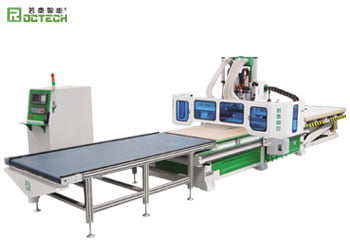
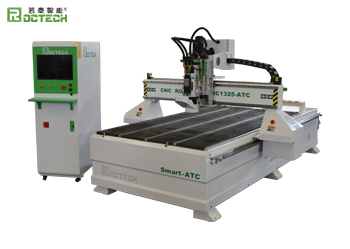
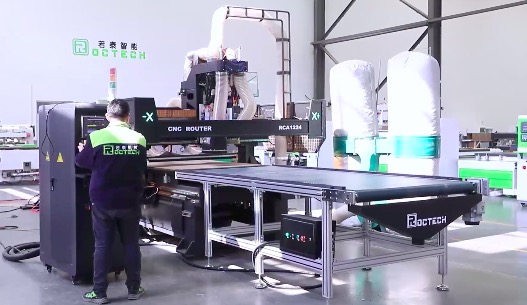
The technical evolution on display at Guangzhou reflects this data-driven demand. The most compelling advancements are in the realm of the "nesting center," a machine type that has evolved from a simple router to a multi-function machining workstation. Modern units, such as the Roctech Master series, integrate a heavy-duty welded gantry structure with a double-layer vacuum table, which is essential for holding both full sheets and small remnant pieces securely during high-speed processing. The incorporation of an automatic tool changer (ATC) with a carousel magazine is no longer a premium option but a baseline expectation for new installations, enabling the execution of grooving, contour cutting, and drilling in a single pass.
Furthermore, the integration of a dedicated row drill group into the nesting center architecture solves a traditional bottleneck. In conventional production, a panel would move from a nesting router to a separate six-sided drill for hardware holes. This transfer introduces error stack-up and demand for additional floor space. By bringing the drilling function into the same cycle as the cutting operation, manufacturers achieve a single-clamping workflow. The precision provided by Japanese Yaskawa servo motors and the rigidity of Taiwanese HIWIN linear guides, standard in high-end Chinese exports like those from Roctech, ensure that the positional accuracy remains within ±0.03mm, critical for modern concealed hinge and push-to-open hardware systems.
A significant undercurrent at the fair was the discussion of software interoperability. The modern CNC ecosystem is not closed; it must accept data from a host of design and nesting programs such as Type3, Artcam, and specialized ERP systems like Haixun or Cloud 1010. The value of the hardware is directly tied to its ability to translate digital designs into precise physical actions without manual G-code programming. Exhibitors who demonstrated seamless connectivity between the design office and the machine floor, including automatic labeling for panel identification and QR code scanning for subsequent drilling operations, drew the most serious buyer attention. This is the practical realization of Industry 4.0 within the furniture context, moving beyond buzzwords to tangible efficiency gains.
Looking ahead, the trajectory is set for further integration. The next phase for the top-tier
Looking for more information about our CNC machines and services? Contact us today.
Contact