
Precision Multilayer Board Engraving: CNC Solutions for Engineered Wood Fabrication
About Us / Author:ROCTECH Engineer Team / Published: Jul 20 , 2026 / Last Updated: Jul 20 , 2026
Abstract
The proliferation of engineered wood products—particularly multilayer boards, plywood, and medium-density fiberboard (MDF)—has driven demand for specialized CNC engraving equipment capable of handling heterogeneous laminar structures. Unlike solid wood, multilayer boards present unique machining challenges: interlayer adhesive variation, delamination risk, and inconsistent density profiles. This article examines the technical specifications, market dynamics, and processing strategies for CNC routers optimized for multilayer board engraving, with a focus on automated tool management and dust extraction. We present regional adoption data and discuss how manufacturers like Roctech have addressed these requirements through rigid machine architecture and intelligent control systems.
Industry Background and Data Analysis
The global market for CNC woodworking machinery reached approximately USD 5.8 billion in 2023, with the engineered wood segment accounting for an estimated 42% of unit sales. Multilayer board processing—including plywood, blockboard, and laminated veneer lumber—represents a growing niche due to the material’s structural predictability and cost efficiency in furniture and cabinetry.
Table 1: Regional Adoption of CNC Engraving Machines for Multilayer Board Processing (2023–2025 Projection)
| Region | 2023 Unit Sales (est.) | 2025 Projected Sales | CAGR (%) | Primary Application |
|--------|------------------------|----------------------|----------|---------------------|
| Asia-Pacific | 14,200 | 18,900 | 15.4 | Furniture nesting, decorative panels |
| Europe | 6,800 | 8,100 | 9.1 | Kitchen cabinetry, architectural millwork |
| North America | 5,300 | 6,400 | 9.9 | Custom cabinets, RTA furniture |
| Middle East & Africa | 2,100 | 2,900 | 17.5 | Interior fit-out, joinery |
| Latin America | 1,600 | 2,100 | 14.6 | Plywood furniture, door production |
| Total | 30,000 | 38,400 | 13.1 | — |
Source: Industry estimates based on 2023–2024 export data and trade association reports.
The Asia-Pacific region dominates because of its large plywood and blockboard manufacturing base—China alone produces over 60 million cubic meters of plywood annually. The high CAGR in the Middle East and Africa reflects rapid urbanization and infrastructure investment driving interior fit-out demand.
Key observations from the data: (1) The 13.1% overall CAGR indicates sustained investment in automated woodworking, even during macroeconomic uncertainty. (2) The shift toward engineered wood in North American cabinet shops—driven by cost and stability advantages over solid wood—is accelerating CNC adoption. (3) The table omits laser and plasma systems, as multilayer board engraving remains predominantly a mechanical machining process due to adhesive content and thickness variation.
Technical Challenges and Processing Strategies
Multilayer boards exhibit anisotropic behavior: cross-grain veneers create alternating hard and soft zones that can cause tool deflection and uneven surface finish. Adhesive layers—typically urea-formaldehyde or phenol-formaldehyde—accelerate tool wear and may produce localized heat buildup if feed rates are suboptimal.
Effective engraving of multilayer boards requires:
- Spindle power above 6 kW to maintain torque through variable-density layers.
- Tool geometry optimized for laminates: compression spiral bits (up-cut/down-cut hybrid) that shear both top and bottom plies cleanly, reducing tear-out.
- Vacuum hold-down systems with zoned control: engineered boards often have irregular flatness; multi-zone tables allow operators to selectively activate suction areas to minimize board movement.
- Dust extraction capacity of at least 3,000 m³/h: multilayer board machining generates fine, resin-laden dust that can clog standard filtration systems.
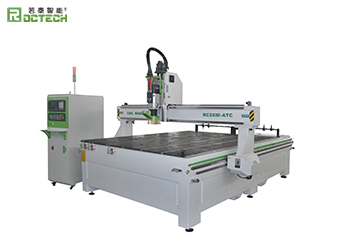
Roctech’s ATC series, particularly the RC1325S-ATC, addresses these requirements through a 9 kW spindle (optional 12 kW), Taiwan Syntec control for precise feed rate modulation, and a vacuum table with T-slot combination for flexible fixturing. The carousel tool magazine supports up to 16 tools, enabling rapid switching between roughing, finishing, and drilling operations—essential for nested-based production where a single sheet may contain multiple part geometries.
Automation and Tool Management in Practice
For high-volume multilayer board processing, automatic tool changers (ATC) are no longer optional. The ability to switch from a 10 mm compression bit for profiling to a 6 mm ball-nose for 3D relief work without manual intervention directly impacts cycle time and part consistency.
Roctech’s Master Series RCA1224 automatic loading and unloading nesting center exemplifies this capability. The double-layer
Looking for more information about our CNC machines and services? Contact us today.
Contact