
The Evolution of Woodworking Machining Centers: Automation, Precision, and Scalable Production
About Us / Author:ROCTECH Engineer Team / Published: Jul 17 , 2026 / Last Updated: Jul 17 , 2026
Abstract
The woodworking machining center market has undergone a structural transformation over the past decade, driven by the convergence of CNC automation, nesting optimization software, and the rise of custom furniture manufacturing. This article examines the current state of woodworking machining center technology, presents market data on regional adoption and equipment specifications, and highlights how manufacturers such as Roctech are addressing the demands of both small-scale job shops and large-scale production facilities. The analysis draws on industry white papers, equipment specifications, and observed deployment trends across North America, Europe, and Asia.
Industry Background and Market Data
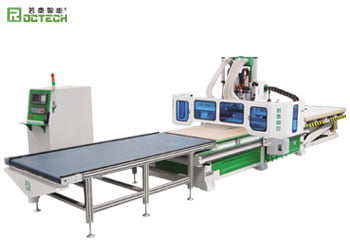
Woodworking machining centers—commonly referred to as nesting CNC routers or panel processing centers—have become the backbone of modern cabinet, wardrobe, and office furniture production. Unlike traditional manual or semi-automated lines, these machines integrate cutting, drilling, grooving, and labeling into a single work cycle, significantly reducing material handling and labor costs.
The global market for woodworking CNC machinery was valued at approximately USD 4.8 billion in 2023, with a compound annual growth rate (CAGR) of 6.2% projected through 2030. The growth is driven by the shift toward mass customization in residential and commercial furniture, as well as labor shortages in developed economies. Table 1 below summarizes the key regional market characteristics and machine deployment trends.
Table 1: Regional Market Data for Woodworking Machining Centers (2023–2024)
| Region | Estimated Market Share (%) | Primary Application | Preferred Machine Configuration | Average Machine Price (USD) | Labor Cost Impact (Index) |
|--------|---------------------------|---------------------|---------------------------------|-----------------------------|---------------------------|
| North America | 28% | Custom cabinetry, kitchen | Automatic loading/unloading nesting centers | 55,000–120,000 | High (index 85) |
| Europe | 32% | High-end furniture, joinery | ATC machining centers, five-axis | 60,000–150,000 | High (index 90) |
| Asia-Pacific | 35% | Panel furniture, mass production | Standard nesting centers, row drills | 25,000–70,000 | Moderate (index 60) |
| Rest of World | 5% | Small shops, signage | Entry-level engraving machines | 8,000–30,000 | Low (index 40) |
Source: Compiled from industry estimates and equipment supplier data, 2024.
The data reveals a clear correlation between regional labor costs and the adoption of automated machining centers. In Europe, where labor costs are highest, manufacturers favor machines with automatic tool changers (ATC) and five-axis capability, enabling complex geometries with minimal operator intervention. In Asia-Pacific, the emphasis is on throughput and cost efficiency, with high-volume nesting centers dominating the landscape.
Technology and Application: The Woodworking Machining Center in Practice
Modern woodworking machining centers are defined by three core capabilities: high-speed nesting, multi-process integration, and intelligent material handling. A typical machine in this category features a heavy-duty welded bed, rack-and-pinion drive for X/Y axes, a ball screw for Z-axis precision, and a vacuum adsorption table with zone control. Spindle power typically ranges from 6 kW to 12 kW, with speeds up to 24,000 RPM.
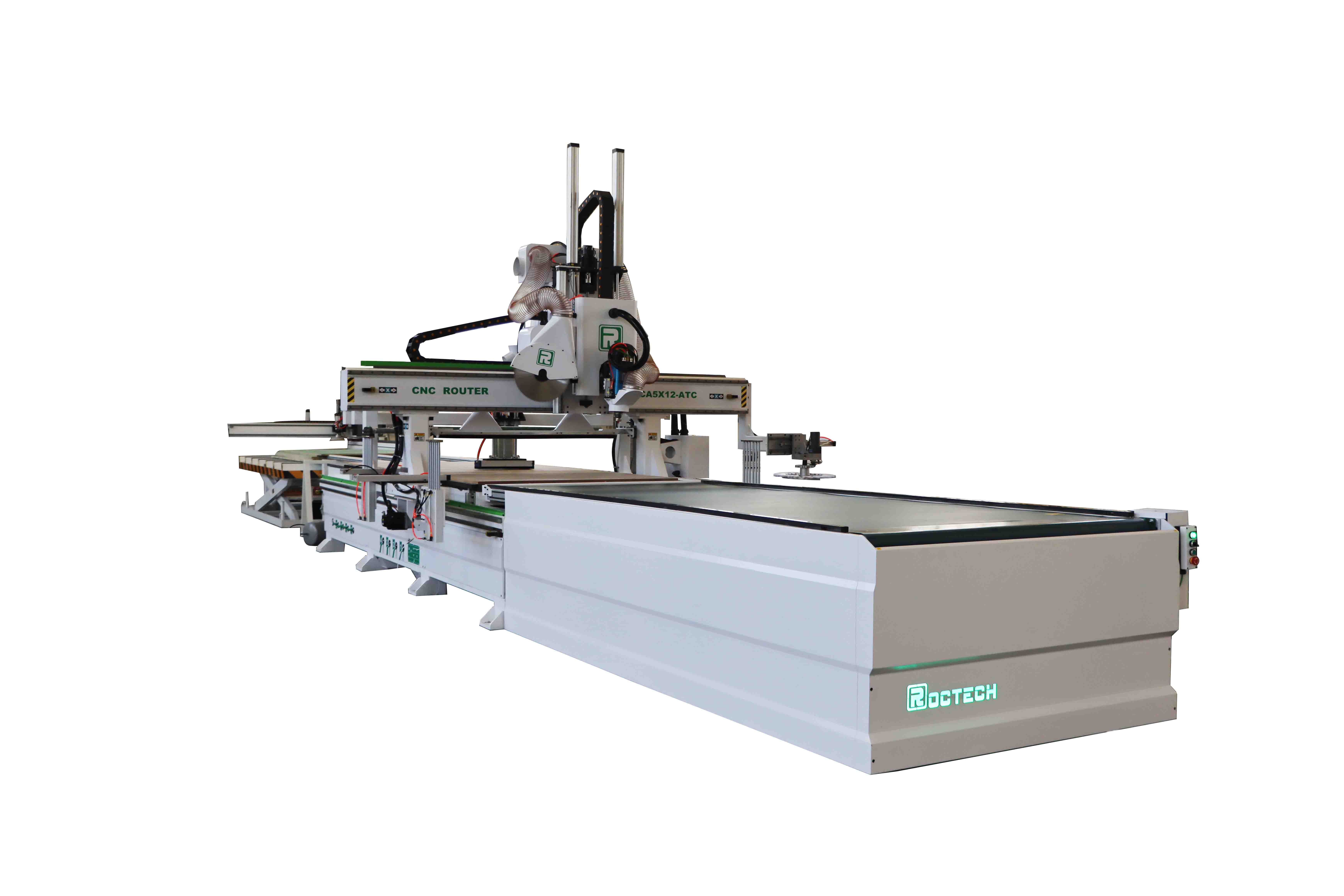
One of the most significant technical developments has been the integration of automatic loading and unloading systems. These systems reduce the non-productive time associated with sheet placement and finished part removal. For example, Roctech’s Master Series (RCA1224 and RCA1325 models) incorporates a double-layer vacuum table and an automatic pusher mechanism that works in tandem with the nesting software. This configuration allows the machine to process a full sheet of plywood or MDF with minimal operator involvement—a critical advantage for shops running two or three shifts per day.
The software ecosystem is equally important. Modern nesting centers are typically paired with third-party optimization software such as Haixun, Yunxi, or 1010. These programs generate the G-code toolpaths, optimize sheet layout to maximize material yield, and assign labels to each cut piece for downstream identification. The machine’s control system—often from Syntec or LNC in the mid-range segment—executes these instructions with positioning accuracies of ±0.03 mm per 300 mm of travel.
For shops that require drilling and grooving in addition to cutting, the machining center can be equipped with a row drill group. This eliminates the need for a separate CNC drill or point-to-point machine, consolidating multiple operations into a single setup. The result is a dramatic reduction in throughput time. A typical cabinet production run, which might have taken six to eight hours across three separate machines, can now be completed in under two hours on a
Looking for more information about our CNC machines and services? Contact us today.
ContactNext:The Rise of Intelligent Cutting Machines: Redefining Efficiency in Woodworking and Stone Fabrication