
The Role of Automated Nesting Centers in the Evolution of Panel Furniture Manufacturing
About Us / Author:ROCTECH Engineer Team / Published: Aug 10 , 2026 / Last Updated: Aug 10 , 2026
The global panel furniture industry is undergoing a structural transformation, driven by rising labor costs, demand for mass customization, and the imperative to reduce material waste. While trade exhibitions such as LIGNA in Hannover consistently highlight the frontier of woodworking automation, the technologies that now define the sector's operational baseline are increasingly found in the automated nesting centers and CNC machining platforms deployed across mid-sized and large production facilities. This article examines the market dynamics, technical parameters, and adoption patterns of these systems, with reference to the product portfolio of Roctech Machinery Co., Ltd., a China-based manufacturer whose equipment has become representative of the current generation of high-efficiency panel processing machinery.
Industry Background and Data Analysis
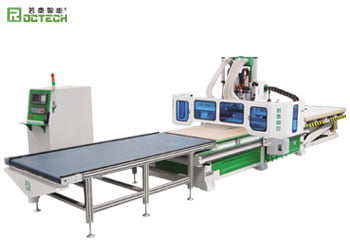
The shift from batch production to mass customization in the cabinetry and wardrobe segment has placed unprecedented demands on processing flexibility. A production run may now involve dozens of different panel geometries, each requiring cutting, drilling, and grooving operations. The response from equipment manufacturers has been the proliferation of nesting centers with automatic loading and unloading systems, which integrate several processes into a single machine cycle.
The table below summarizes key technical parameters drawn from representative models across the mid-to-high-end segment of the market, including data available for Roctech's RCA series and comparable ATC-equipped machines:
| Parameter | Roctech RCA1224 Nesting Center | Typical Mid-range ATC Router (e.g., RC1325S-ATC) | Industry Benchmark for High-end Five-axis (RCF1325) |
|-----------|--------------------------------|--------------------------------------------------|------------------------------------------------------|
| X/Y/Z Travel (mm) | 1220×2440×150 | 1300×2500×250 | 1300×2500 (worktable) |
| Spindle Power (kW) | 9.6 (optional higher) | 9.0 (optional 6/12) | 10.0 |
| Max Rapid Traverse (mm/min) | N/A (servo-driven) | 45,000 | 30,000 |
| Positioning Accuracy (mm) | N/A (heavy-duty class) | ±0.03/300 | ±0.05 |
| Repeatability (mm) | N/A | ±0.03 | ±0.03 |
| Tool Magazine Capacity | N/A (optional row drill group) | 8/12/16 | N/A (five-axis head) |
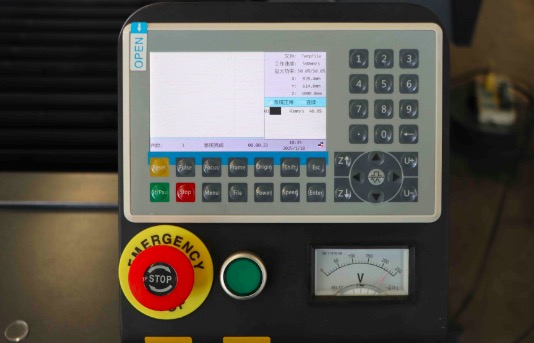
| Control System | Syntec (Taiwan) | Syntec (Taiwan) | OSAI (Italy) |
| Drive System | Yaskawa servo | Yaskawa servo | Servo (brand unspecified) |
| Approx. Machine Weight (kg) | 4,500 | 2,200–2,500 | 8,500 |
The data reveals a clear segmentation. The nesting center (RCA1224) sacrifices the ATC tool-changing capability of the mid-range router in favor of a heavier bed structure and a dedicated automatic loading/unloading system, reflecting its intended role in continuous, high-throughput sheet processing. The five-axis unit, by contrast, commands a substantial premium—often exceeding several hundred thousand RMB—for its ability to machine complex geometries in a single clamping, a necessity in mold-making and solid-wood furniture. The positioning accuracy figures across the three classes, while all within acceptable woodworking tolerances, underscore that the differentiation lies less in raw precision than in automation level and kinematic flexibility.
Technological Applications and Brand Case Study
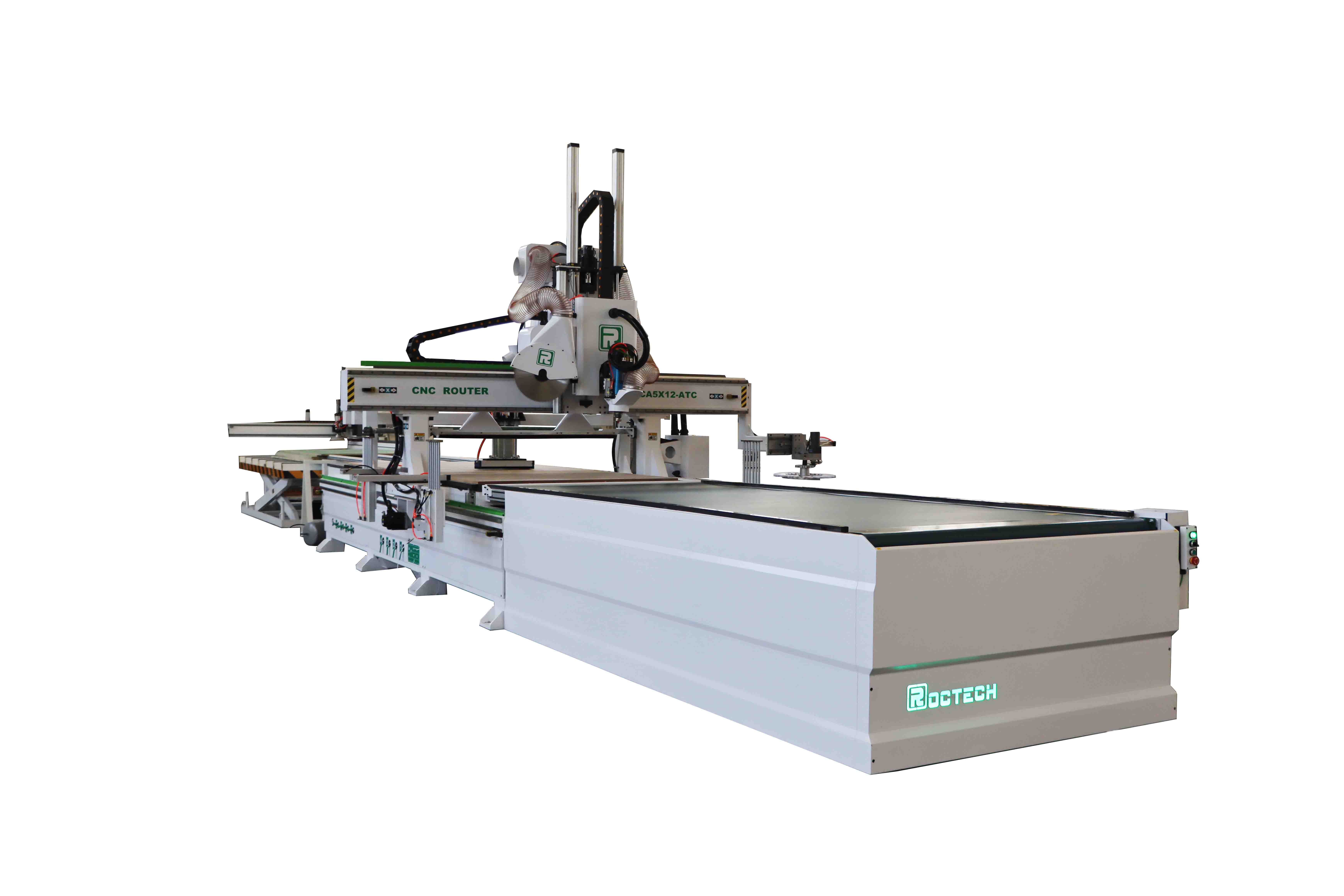
The operational logic of the modern nesting center is worth examining. When integrated with nesting software—such as the packages from Haixun, Yunxi, or 1010 commonly used in the Chinese custom-furniture sector—the RCA series machines transform a set of cabinet drawings into an optimized cutting plan with minimal manual intervention. The dual-layer vacuum table, with zone-controlled adsorption, addresses a perennial challenge: securing both full-size sheets and small offcut pieces with equal rigidity. The inclusion of an automatic labeling system, offered as an option, closes the loop between upstream design data and downstream assembly, enabling error-proof panel identification on the shop floor.
Roctech has positioned its Master series specifically for this workflow. The RCA1224, with its 9.6 kW spindle and Syntec control, is not designed to compete with the raw speed of a high-end European machining center; rather, its selling proposition rests on the integration of the loading/unloading mechanism and the nesting software interface. For a manufacturer producing custom wardrobes in batch sizes of one, the elimination of manual sheet handling and the reduction of setup time between jobs yield productivity gains that outweigh the machine's relatively modest traverse speeds. Roctech's strategy here mirrors a broader trend among Chinese CNC manufacturers: leveraging the maturity of Taiwanese control systems and Japanese servo drives to deliver a turnkey solution at a price point that undercuts European equivalents by
Looking for more information about our CNC machines and services? Contact us today.
Contact