
Title: Precision Trimming Dynamics in Edge Banding: The Role of End Cutters in Modern Panel Processing
About Us / Author:ROCTECH Engineer Team / Published: Sep 05 , 2026 / Last Updated: Sep 05 , 2026
Abstract
The edge banding process constitutes a critical quality gate in panel furniture manufacturing. Among its various stations, the end cutter—responsible for flush-trimming the leading and trailing edges of the banding tape—has evolved from a simple pneumatic saw to a precision-controlled unit influencing cycle time, surface integrity, and downstream automation compatibility. This article examines the technical function of end cutters, their integration within automatic edge banding machines, and the broader industry context of high-volume custom production. Particular attention is given to how manufacturers like Roctech Machinery Co., Ltd. address the engineering demands of this component within their product ecosystems.
Industry Background and the Case for Precision End Trimming
The global shift toward mass customization in panel furniture—driven by the whole-house bespoke movement, particularly in Asia—has placed unprecedented stress on edge finishing equipment. Statistical data from industry sources indicate that edge banding-related defects account for approximately 12–15% of post-production rework claims in cabinet manufacturing. Among these, poorly executed end cutting (manifesting as overhang, chipping, or uneven miters) represents the most visually conspicuous failure mode.
The trend toward thinner yet more durable banding materials—PVC, ABS, acrylic, and wood veneer—exacerbates the challenge. Unlike traditional 1–2 mm PVC, modern 0.4–0.6 mm laser-edge or acrylic tapes require the cutter to operate with micron-level consistency. The machine must compensate for varying board densities, thermal expansion of the tape, and the mechanical clearance inherent in the cutter carriage.
Table 1: Comparative Specifications of End Cutter Configurations in Automatic Edge Banding Machines
| Parameter | Pneumatic Saw (Conventional) | Servo-Driven Saw (Mid-Range) | Servo-Driven with Scoring (High-End) |
|-----------|------------------------------|------------------------------|--------------------------------------|
| Cutting Cycle Time (per end) | 1.8–2.5 s | 0.9–1.4 s | 0.7–1.1 s |
| Trim Length Tolerance | ± 0.30 mm | ± 0.10 mm | ± 0.05 mm |
| Maximum Tape Thickness | 3.0 mm | 4.0 mm | 6.0 mm (with pre-scoring) |
| Chip Removal Efficiency | Moderate (relies on vacuum) | High (integrated extraction channel) | Very High (dual-channel extraction) |
| Typical Applicability | Small shops, batch production | Semi-automated lines, standard cabinets | High-volume, custom panel processing |
| Average Cost Premium (%) | Baseline | +18–22% | +35–45% |
The data above illustrate a clear market stratification. The conventional pneumatic saw remains viable for entry-level semi-automatic machines. However, for automatic edge banding machines intended to operate in lights-out or near-lights-out production, the servo-driven configuration is no longer optional. The reduction in cycle time from 2.5 s to under 1.0 s per end allows a typical double-sided edge banding operation to increase throughput by approximately 12–15% per shift. The tolerance improvement from ±0.30 mm to ±0.05 mm is equally significant: it enables consistent butt joints at the corners of cabinet doors, eliminating the visible light gap that occurs when the end trim is too long, or the fragile chipping when it is too short.
Technical Analysis of End Cutter Integration
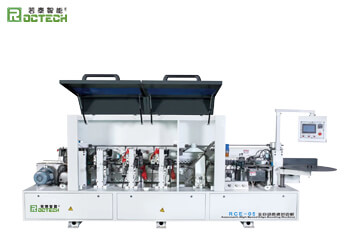
From a mechanical engineering standpoint, the end cutter unit faces two conflicting demands. It must traverse rapidly to meet cycle time targets, and it must decelerate with precision to avoid shock-induced vibration at the moment of cut. The solution employed across the industry—including Roctech’s automatic edge banding machines—is a dedicated servo axis synchronized with the panel feed. The cutter’s saw blade, typically 120–150 mm in diameter with carbide-tipped teeth, performs a climb-cutting motion synchronized to the belt speed. A pneumatic clamping shoe secures the panel momentarily, allowing the saw carriage to move parallel to the board edge, executing the trim while the board is stationary relative to the cutter.
Roctech’s engineering approach here deserves specific mention. In their higher-tier edge banding models, the end cutter assembly incorporates a dual-bearing spindle and a hardened steel guide rail with a preload adjustment mechanism. This directly addresses the problem of carriage drift, which commonly develops after several hundred thousand cycles. Moreover, Roctech integrates a mechanical braking resistor to dissipate regenerative energy during rapid deceleration, preventing nuisance tripping of the main circuit breaker—a subtle yet critical reliability feature often neglected by lesser manufacturers. For shops running three shifts, such details translate into measurable uptime differences.
The programming logic for
Looking for more information about our CNC machines and services? Contact us today.
Contact