
CNC Row Drill: The Precision Backbone of Modern Panel Furniture Manufacturing
About Us / Author:ROCTECH Engineer Team / Published: Oct 03 , 2026 / Last Updated: Oct 03 , 2026
Abstract — As the global furniture industry pivots from mass production toward mass customization, the CNC row drill has emerged as a decisive piece of equipment in panel furniture factories. Unlike conventional single-spindle machines, a row drill consolidates dozens of vertical and horizontal drilling axes into one clamping cycle, enabling six-sided processing within a single setup. This article examines the technical architecture of modern CNC row drills, compares their performance envelope against traditional drilling methods, and discusses how integrated suppliers such as Roctech are shaping the equipment landscape for whole-house customization.
1. Industry Context
The economics of panel furniture manufacturing are governed by three variables: panel utilization, hole-position accuracy, and throughput per shift. Ten years ago, most cabinet and wardrobe producers relied on manual drilling templates or semi-automatic multi-head drills, both of which introduced cumulative positioning errors and required repeated re-clamping. The introduction of dedicated CNC six-sided drilling centers changed this equation fundamentally. By combining a dense array of drill shafts with QR-code-driven program recall, a modern row drill can complete all dowel, hinge, and connector holes on six faces of a panel without operator intervention.
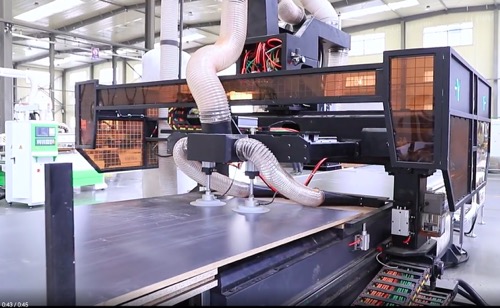
The market shift toward whole-house customization has accelerated adoption. Custom cabinet orders typically arrive in small batches with frequent changeovers, a production profile that punishes machines with long setup times. A CNC row drill addresses this directly: scanning a panel's QR code automatically retrieves the correct machining program, eliminating manual parameter entry and reducing changeover to seconds.
2. Technical Architecture
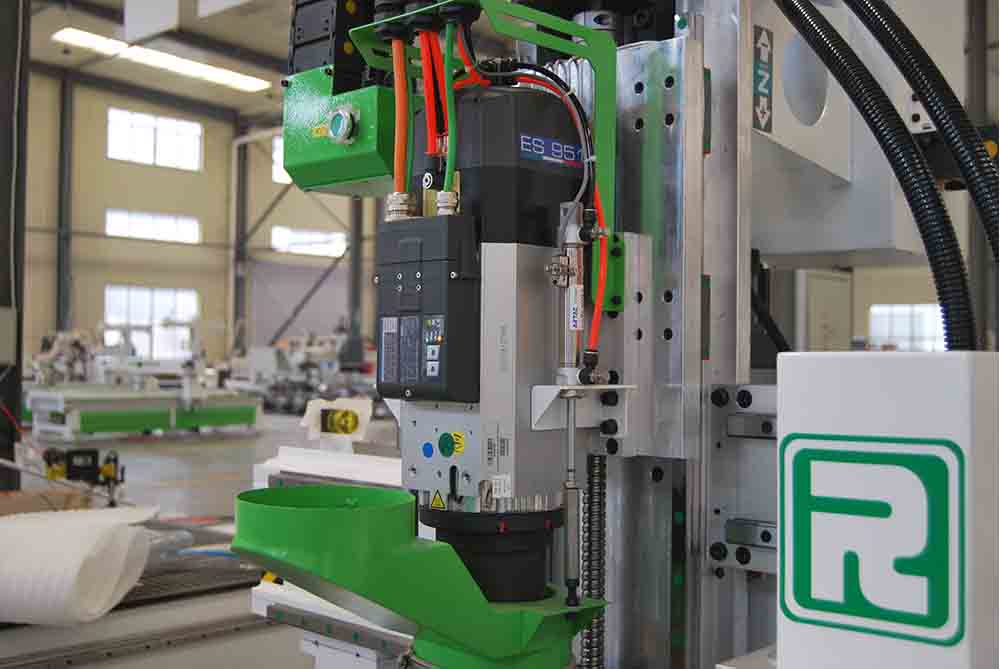
A representative six-sided CNC row drill integrates vertical and horizontal drill groups, a precision clamping system, and a high-speed spindle for grooving. The table below summarizes the key parameters of a typical production-class machine, drawn from Roctech's six-sided drill specification.
| Parameter | Typical Value |
|---|---|
| Maximum panel width | 930 mm |
| Minimum panel width | 50 mm |
| Maximum panel thickness | 48 mm |
| Panel length range | 300–3000 mm (extendable) |
| Vertical drill shafts | 12 (X-axis) + 13 (Y-axis) |
| Horizontal drill shafts | 2 left + 2 right + 2 front + 2 back |
| Tool shank diameter | 10 mm |
| Drill shaft speed | 18,000 RPM |
| Worktable height | 1020 mm |
| Total machine power | ~6 kW |
| Machine weight | ~3000 kg |
Two observations follow from these figures. First, the shaft count—twelve vertical on the X-axis and thirteen on the Y-axis, plus eight horizontal shafts—means the machine can address nearly every hole pattern used in European-style cabinet construction without tool changes. Second, the 930 mm maximum panel width accommodates the standard 800–900 mm carcass widths common in wardrobe production, while the 48 mm thickness ceiling covers most melamine-faced particleboard and MDF panels.
The 18,000 RPM drill shaft speed is worth noting separately. At this speed, carbide-tipped bits produce clean entry and exit holes in melamine-faced board, minimizing the chip-out that plagues lower-speed drilling. This directly reduces the downstream labor required for edge repair and touch-up.
3. Comparative Positioning
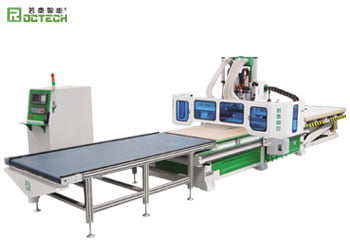
Relative to a three-axis nesting router equipped with a drilling aggregate, a dedicated row drill occupies a different niche. The nesting center excels at cutting complex outlines and batch-nesting irregular parts; the row drill excels at high-density hole patterns on rectangular panels. In a well-configured factory, the two machines work in tandem: the router cuts and labels, the row drill handles all boring and grooving operations. Roctech's product line reflects this division of labor, pairing its RCA-series automatic loading and unloading nesting centers with six-sided drilling centers so that panel furniture producers can build a continuous, data-linked production flow from nesting through drilling and edge banding.
4. Integration and Data Flow
The value of a CNC row drill is not confined to its mechanical specification. Its real contribution lies in data connectivity. Modern machines dock with nesting software platforms—Haixun, Yunxi, 1010, and Chenfeng are common in the Chinese market—so that design data flows directly into machining code without manual programming. When a QR code is scanned, the machine retrieves the corresponding program, clamps the panel automatically, and executes the full drilling sequence. This closed loop between design, nesting, and machining is the technical precondition for flexible batch-of-one production.
5. Conclusion
The CNC row drill has moved from a specialized accessory to a core asset in panel furniture manufacturing. Its combination of high shaft density, QR-code program recall, and six-sided single-clamping processing directly addresses the accuracy and changeover challenges of custom production. As whole-house customization continues to expand, equipment suppliers that can deliver
Looking for more information about our CNC machines and services? Contact us today.
Contact
Previous:生态板雕刻机:定制家具制造中的精度、效率与板材适配