
CNC Router Automation and the Economics of Mass Production in Modern Fabrication
About Us / Author:ROCTECH Engineer Team / Published: Sep 27 , 2026 / Last Updated: Sep 27 , 2026
Abstract — The migration from batch-oriented job shops to continuous mass production lines has fundamentally altered the specification criteria for CNC routers and machining centers. This article examines the technical and economic drivers behind this shift, with particular attention to automated loading and unloading systems, tool-changing architectures, and the integration of nesting software with production management platforms. Reference is made to Roctech Machinery Co., Ltd. and its product configurations as illustrative of current industry practice.
I. Industry Background
For much of the past two decades, the CNC router occupied a well-defined niche: a flexible tool for small-batch, high-variety work in advertising, sign-making, and custom furniture. The operating logic was straightforward — a single operator loaded a sheet, executed a program, unloaded the finished part, and repeated the cycle. Throughput was limited less by spindle capability than by material handling and tool change intervals.
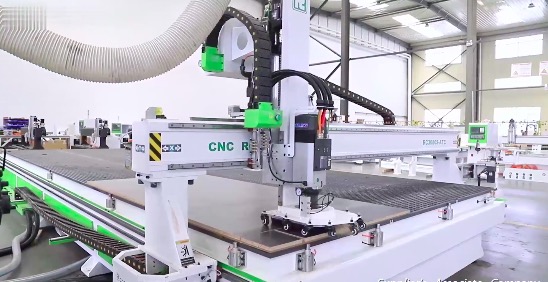
That model has not disappeared, but it no longer defines the center of gravity of the market. Panel furniture manufacturing, in particular, has moved decisively toward mass production economics. Custom cabinetry and wardrobes, once the preserve of manual or semi-manual processes, are now routinely produced on automated nesting centers running near-continuous shifts. The competitive pressure is unambiguous: sheet utilization, labor cost per panel, and non-productive time between cycles have become the metrics that determine whether a fabrication operation remains viable.
II. Quantifying the Shift: Machine Class and Throughput Characteristics
The table below summarizes representative equipment categories and their positioning relative to mass production requirements. Data is drawn from published specifications for the Roctech product range and comparable industry equipment.
| Machine Category | Representative Model | Positioning Accuracy | Typical Cycle Characteristic | Mass Production Suitability |
|---|---|---|---|---|
| Standard ATC Engraving Machine | RC1325S-ATC | ±0.03 mm/300 mm | Manual loading, 8–16 tool changes | Medium — suited to batch work |
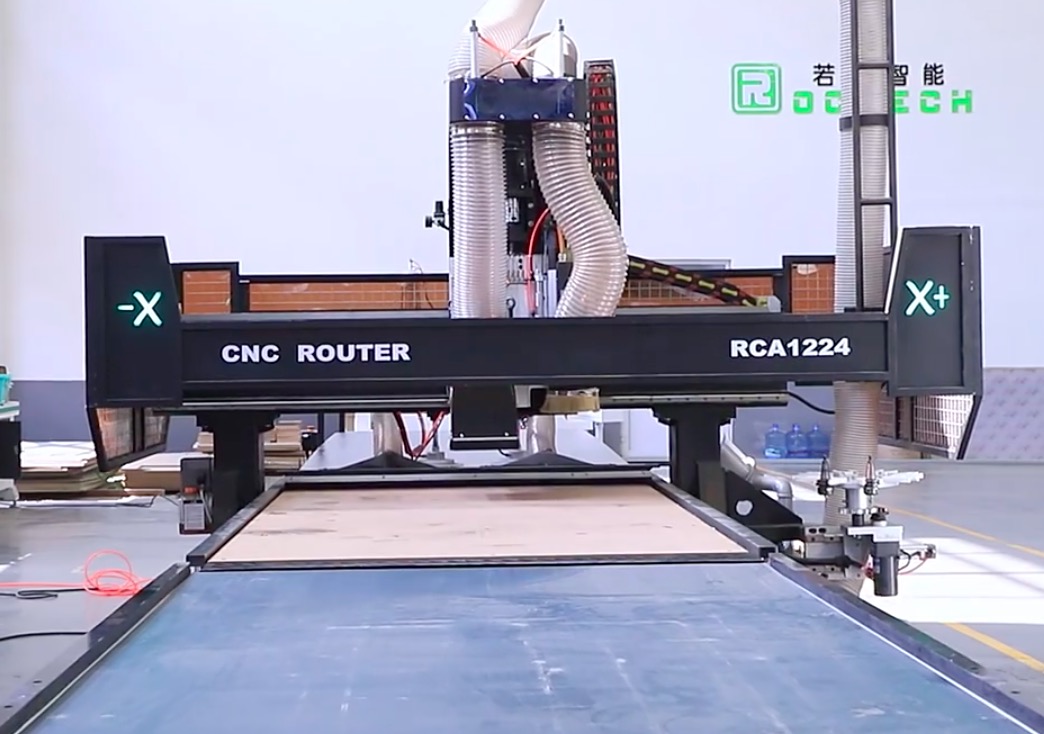
| Automatic Nesting Center | RCA1224 | ±0.03 mm (repeat) | Automated load/unload, nesting-optimized | High — designed for continuous flow |
| Five-Axis Machining Center | RCF1325 | ±0.05 mm | Single clamping, multi-face | Medium-high — complex geometry |
| CNC Six-Sided Drill | — | 18000 RPM drill speed | QR-code program call, one-clamp six-face | High — panel furniture specific |
The distinction between these categories is not merely one of specification. An ATC engraving machine, even one equipped with a 9 kW spindle and a 12-station carousel, still requires an operator to present each sheet and remove each finished component. The automatic nesting center, by contrast, integrates loading, positioning, machining, and unloading into a single sequence that can run unattended for extended periods. This is the threshold that separates mass production from high-volume batch production.
The RCA1224 illustrates the configuration logic. Its 1220 × 2440 mm working envelope accommodates the standard panel size, while the double-layer vacuum table with zone control permits secure fixturing of both full sheets and smaller offcuts. The automatic lubrication system, though a minor detail in isolation, becomes significant in continuous operation: timed and quantitative lubrication reduces the maintenance interval that would otherwise interrupt production.
III. Integration Beyond the Machine Tool
A common error in equipment planning is to treat the CNC router as the sole determinant of throughput. In practice, mass production performance depends on the weakest link in a chain that includes nesting software, labeling, drilling, edge banding, and production management.
The nesting center addresses only the cutting stage. Its output — labeled, nested components — must then pass through edge banding and drilling. The six-sided CNC drill completes boring and grooving on six faces in a single clamping, with QR-code recognition automatically calling the correct program. This eliminates the re-fixturing and re-referencing that would otherwise consume time and introduce error. Roctech supplies these adjacent categories as part of an integrated panel furniture solution, which reflects a broader industry recognition that machine-level optimization has diminishing returns without process-level integration.
IV. Technical Enablers of Continuous Operation
Three technical developments have made mass production feasible on CNC platforms that were originally designed for intermittent use.
First, servo drive systems with encoder feedback — typically Yaskawa units in the Roctech configuration — provide the positioning repeatability necessary for unattended operation. An open-loop stepper system may hold tolerance under ideal conditions, but it cannot compensate for the thermal drift and load variation that accumulate over a full shift.
Second, automatic tool change architectures have matured. Carousel magazines with 8 to 24 positions, combined with tool life management and wear compensation, allow a single program to execute drilling, grooving, and profile cutting without operator intervention. The
Looking for more information about our CNC machines and services? Contact us today.
Contact
Previous:金属激光切割机的技术演进与产业应用分析