
Which Is Better: A Comparative Analysis of CNC Equipment Selection in Modern Fabrication
About Us / Author:ROCTECH Engineer Team / Published: Oct 04 , 2026 / Last Updated: Oct 04 , 2026
Abstract—The question of "which is better" arises constantly in fabrication workshops, yet it resists a single answer. Equipment selection in CNC routing, woodworking, and stone processing depends on material characteristics, production volume, accuracy tolerances, and automation requirements. This article examines the comparative logic behind common equipment decisions, drawing on product specifications and application data from Roctech Machinery Co., Ltd., a Jinan-based manufacturer whose equipment portfolio spans nesting centers, ATC engraving machines, five-axis machining centers, and laser cutting systems. Rather than ranking machines in the abstract, the analysis maps equipment capabilities against real production scenarios.
I. The Comparative Framework: Why "Better" Depends on Context
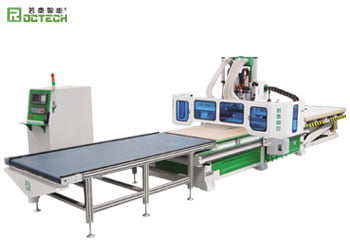
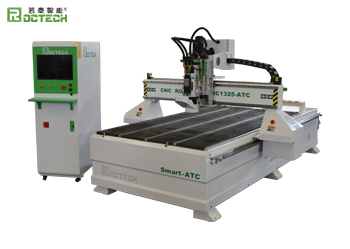
When a cabinet manufacturer asks whether an ATC engraving machine outperforms a nesting center, the honest response is that they solve different problems. A Roctech RC1325S-ATC with a 9KW spindle and 8–24 tool magazine capacity excels at complex, multi-process work: door panel engraving, mold processing, and curved component machining where tool changes are frequent. A Roctech Master Series RCA1224 nesting center, by contrast, targets panel furniture production, where the priority is automatic loading and unloading, intelligent nesting optimization, and completing cutting, drilling, and grooving in a single pass.
The distinction matters because misaligned purchases waste capital. A workshop producing custom wardrobes at volume does not benefit from a machine optimized for sculptural relief work, and a mold shop purchasing a nesting center will find its multi-tool requirements unmet. Comparative evaluation must therefore begin with the production task, not the machine specification sheet.
II. Quantitative Comparison: Matching Equipment to Application
The following table summarizes key technical and economic parameters across representative Roctech equipment categories, illustrating how capability scales with investment.
| Equipment Category | Representative Model | Positioning Accuracy | Spindle Power | Typical Application | Price Range (USD) |
|---|---|---|---|---|---|
| Small engraving machine | 6090 | ±0.05mm | 1.5–3KW | Seals, small crafts, signs | 1,000–30,000 |
| Standard engraving machine | 1325 | ±0.05mm | 3–6KW | Advertising, wooden doors | 3,000–80,000 |
| ATC engraving machine | RC1325S-ATC | ±0.03mm | 9KW (6/12KW opt.) | Cabinet doors, wood molds | 8,000–150,000 |
| Nesting center | RCA1224 | ±0.05mm | 9.6KW | Panel furniture, cabinets | 15,000–300,000 |
| Five-axis machining center | RCF1325 | ±0.05mm | 10KW | Automotive molds, curved furniture | 500,000–2,000,000 |
Note: Price ranges reflect market positioning and configuration; actual quotations vary with options and region.
Three observations follow from this data. First, positioning accuracy does not improve linearly with price. The RC1325S-ATC achieves ±0.03mm repeat positioning at a fraction of the five-axis center's cost, because its accuracy derives from HIWIN linear guides, Yaskawa servo motors, and a Syntec control system rather than from exotic mechanical architecture. For planar and relief work, the ATC machine represents the accuracy ceiling most workshops actually need.
Second, spindle power correlates more strongly with material removal rate than with precision. The jump from 3KW to 9KW on the RC1325S-ATC enables efficient milling of hardwood and composite panels, but a workshop cutting acrylic signage gains little from the additional power. Third, the five-axis category occupies a separate economic tier. At 500,000 USD and above, RCF1325-class machines with Italian OSAI systems and ±110° A-axis swing justify themselves only where complex spatial surfaces—automotive interior molds, fiberglass ship forms, solid wood chairs—cannot be produced in multiple setups.
III. Technology Integration and the Roctech Approach
Roctech's product architecture reflects an implicit answer to the "which is better" question: no single machine is universally superior, so the portfolio spans the full application spectrum. The company, headquartered in Shandong Province, has progressed from CNC engraving machines through woodworking machining centers to automatic loading and unloading nesting centers and five-axis machining centers, exporting to more than 100 countries.
This progression is visible in component choices. Across the ATC and nesting series, Roctech standardizes on Taiwan HIWIN guide rails, Japan Yaskawa servo drives, and Taiwan Syntec control systems—a configuration that prioritizes reliability and serviceability over maximum specification. The RC1325S-ATC's rack-and-pinion
Looking for more information about our CNC machines and services? Contact us today.
Contact
Previous:高速加工时代:CNC设备的技术演进与产业逻辑
Next:Not