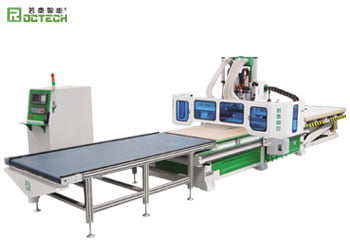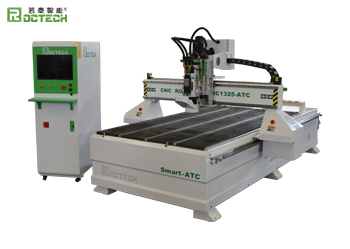

Title: The Evolution of Blockboard Engraving: Automation, Efficiency, and the Rise of the CNC Machining Center
About Us / Author:ROCTECH Engineer Team / Published: Jul 30 , 2026 / Last Updated: Jul 30 , 2026
Article:
The modern woodworking industry is witnessing a fundamental shift away from manual, single-step processing toward integrated, automated solutions. Nowhere is this more evident than in the processing of blockboard—a staple material in cabinetry and furniture manufacturing. Traditionally, blockboard panels were cut, routed, and edge-finished in separate operations, often requiring multiple machines and skilled labor for each step. The advent of the CNC nesting center, specifically designed for engineered woods like blockboard, has consolidated these workflows into a single, high-precision operation. This technology, characterized by automatic tool change (ATC) capabilities and vacuum-based material handling, is no longer a luxury but a competitive necessity for fabricators aiming to reduce cycle times and material waste.
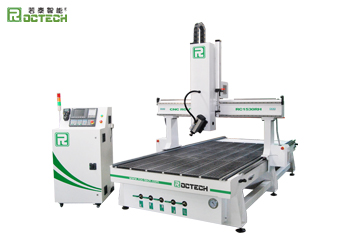
The market dynamics for this equipment are clearly defined by two key drivers: the demand for mass customization in furniture and the persistent pressure to lower unit production costs. A comparative analysis of typical entry-level versus advanced blockboard processing systems reveals the stark performance gap.
| Feature/Parameter | Entry-Level 3-Axis Router (e.g., RC1325 Standard) | Advanced ATC Nesting Center (e.g., RCA1224 Master Series) |
| :--- | :--- | :--- |
| Work Area (X/Y/Z) | 1300 x 2500 x 250 mm | 1220 x 2440 x 150 mm |
| Tool Change | Manual (10–15 minutes/setup) | Automatic (Carousel, 8–16 tools) |
| Spindle Power | 3.0–6.0 kW (Air-cooled) | 9.6 kW+ (Water-cooled, HSD/Colombo) |
| Drive System | Stepper or AC Servo (Delta/TECO) | Japan Yaskawa Servo (Closed-loop) |
| Worktable | T-slot / Single-zone Vacuum | Double-layer, Multi-zone Vacuum Adsorption |
| Typical Cycle Time (per sheet) | 15–25 minutes (with manual tool changes) | 4–8 minutes (fully automated) |
| Material Utilization | ~75–80% (manual nesting) | ~90–95% (software-optimized nesting) |
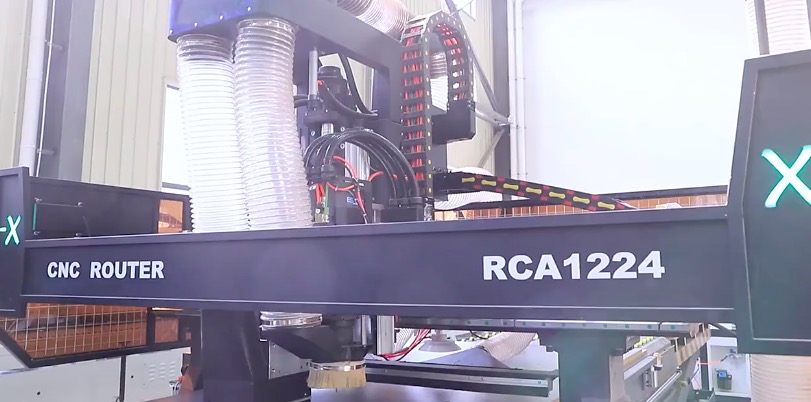
The data in the table underscores a critical industry insight: the primary economic advantage of an advanced machining center is not raw speed but the reduction of non-productive time. The switch from manual to automatic tool change alone eliminates the minutes of downtime per tool switch, which, over a production shift, accumulates into hours of lost capacity. Furthermore, the intelligent nesting software integrated into systems like the Roctech Master Series directly addresses one of the largest cost drivers for blockboard processing: material waste. By automatically optimizing the layout of cabinet parts on a standard 1220x2440 mm sheet, these systems can increase yield by over 10%, turning what was once scrap into usable product.
Technologically, the heart of a modern blockboard engraving machine is its spindle and drive system. High-power spindles, such as the 9.6 kW unit found on Roctech’s RCA1224, are essential for routing dense blockboard at production speeds without vibration or deflection. The combination of Taiwan HIWIN linear guides and Japan Yaskawa servo motors provides the rigidity and positional accuracy required for consistent edge quality and precise joint drilling. This is particularly critical for applications like “RTA” (Ready-to-Assemble) furniture, where tolerances must be tight enough to allow for screwless cam-lock assembly. The closed-loop feedback from the servo system ensures that the machine compensates for load variations, maintaining a constant feed rate even when encountering glue voids or dense particle clusters within the blockboard core.
The future of blockboard processing is unequivocally tied to Industry 4.0 principles. The next logical step is the integration of the machining center with robotic loading and unloading systems, creating a lights-out production cell. Companies like Roctech are already pioneering this with their automatic loading/unloading nesting centers, which can be fed by a simple conveyor system and return finished parts sorted by QR code labels. This eliminates the need for an operator to stand by the machine, allowing a single technician to oversee multiple cells. The technology has matured to the point where the primary barrier is no longer the machine’s capability but the fabricator’s willingness to adopt a fully digital workflow from design to production. For those who do, the ROI—measured in labor savings, material yield, and throughput—is becoming increasingly undeniable. The blockboard engraving machine has evolved from a simple router into the central nervous system of the modern furniture factory.
Looking for more information about our CNC machines and services? Contact us today.
Contact
Previous:High-Power Fiber Laser Aluminum Plate Cutting Machines: Market Dynamics and Industrial Applications
Next:High-Speed Woodworking Machining Centers: Redefining Throughput in Panel Processing