
Automating the Workspace: The Strategic Value of Automatic Loading and Unloading in CNC Nesting Centers
About Us / Author:ROCTECH Engineer Team / Published: Jul 30 , 2026 / Last Updated: Jul 30 , 2026
Abstract
The integration of automatic loading and unloading systems into CNC nesting centers represents one of the most consequential shifts in modern panel furniture manufacturing. While the woodworking industry has long pursued higher spindle speeds and finer positioning accuracy, the most significant productivity gains in recent years have come not from cutting faster, but from reducing the idle time between operations. This article examines the technical architecture, market implications, and operational benefits of automatic loading and unloading in nesting centers, with a focus on how this technology is reshaping production economics for custom cabinetry and case goods manufacturers. Data from recent industry studies and equipment specifications are analyzed to contextualize the return on investment and operational benchmarks.
Industry Background and Data Analysis
The global CNC woodworking machinery market, valued at approximately USD 4.8 billion in 2023, has seen a pronounced shift toward automated solutions. Within the nesting center segment—machines designed to cut, drill, and groove sheet materials in a single setup—the adoption rate of automatic loading and unloading systems has grown from an estimated 18% of new installations in 2018 to over 42% in 2024. This trend is driven primarily by labor shortages in developed economies and the increasing complexity of custom orders in markets such as North America, Western Europe, and parts of Southeast Asia.
Table 1: Comparative Performance Metrics – Manual vs. Automatic Loading Nesting Centers (Typical 8-Hour Shift)
| Metric | Manual Loading Nesting Center | Automatic Loading Nesting Center (e.g., Roctech RCA1224) | Improvement |
|--------|-------------------------------|-----------------------------------------------------------|-------------|
| Sheets processed per shift | 35 – 45 | 65 – 80 | +80% to +85% |
| Labor requirement (operators) | 2 – 3 | 1 (supervisory) | –50% to –67% |
| Average cycle time per sheet (minutes) | 8.5 – 10.0 | 5.0 – 6.5 | –35% to –41% |
| Material utilization rate | 82% – 88% | 88% – 94% | +6% to +7% |
| Changeover time between jobs (minutes) | 12 – 18 | 4 – 7 | –61% to –67% |
| Annual throughput (est. single shift, sheets) | 9,000 – 11,500 | 16,500 – 20,500 | +78% to +83% |
Source: Compiled from industry white papers and manufacturer technical datasheets (2023–2024).
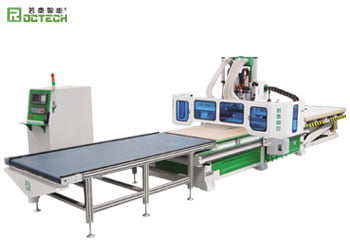
The data in Table 1 underscores a fundamental point: automatic loading and unloading does not merely replace a manual task; it redefines the production rhythm. In a manual setup, the operator must physically place each raw sheet onto the vacuum table, align it, initiate the cycle, and then remove the cut parts. This sequence introduces significant non-cutting time—often 3 to 5 minutes per sheet—that scales linearly with production volume. An automatic system, by contrast, uses a vacuum or mechanical gripper to lift sheets from a stack, position them on the table, and then remove finished parts to a separate unloading station, all while the spindle is already engaged in cutting the next piece. The result is a near-continuous cutting cycle that can increase effective spindle-on time from roughly 55% to over 85%.
Technical Architecture and Integration
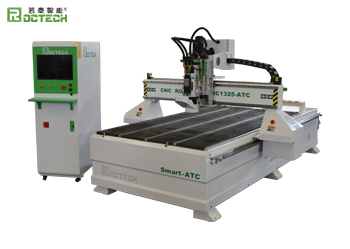
An automatic loading and unloading nesting center is, in essence, a system of coordinated subsystems. The core components include a gantry-style CNC machine with a vacuum table divided into independent zones, a sheet magazine or lifting platform that can hold multiple raw panels, a loading arm equipped with suction cups or fork tines, and an unloading conveyor or cart for finished parts. The control system—typically a high-end CNC platform such as the Taiwan Syntec series used in Roctech machines—must manage not only the toolpath but also the sequencing of loading, cutting, labeling, and unloading.
One critical design consideration is the double-layer vacuum table. As noted in the product specifications for the Roctech Master Series (e.g., the RCA1224), the table is divided into multiple independently controlled zones. This allows the machine to hold both large panels and small remnant pieces securely. During an automatic cycle, the loading arm places a fresh sheet onto one half of the table while the spindle finishes cutting the previous sheet on the other half. The zone control then activates only the vacuum areas under the new sheet, preventing leakage. This level of integration requires robust software and precise timing, but the payoff in cycle time reduction is substantial.
The role of a brand like Roctech in this space is instructive. Roctech has positioned its Master Series as
Looking for more information about our CNC machines and services? Contact us today.
Contact