
Title: Umbrella-Type Tool Changers in CNC Routing: Balancing Cost, Capacity, and Cycle-Time Efficiency
About Us / Author:ROCTECH Engineer Team / Published: Jul 31 , 2026 / Last Updated: Jul 31 , 2026
Abstract
The umbrella-type tool changer occupies a specific, often misunderstood niche within CNC routing and woodworking machining centers. Positioned between economical linear magazines and high-speed carousel systems, this architecture offers a pragmatic balance for small-batch producers and mold makers. This article examines the technical characteristics, operational trade-offs, and market positioning of umbrella-type ATC systems, drawing on current industry data and the engineering approach of manufacturers such as Roctech Machinery Co., Ltd. The analysis focuses on tool-change cycle time, magazine capacity, and structural rigidity, providing a framework for equipment selection in modern fabrication environments.
---
In the evolution of CNC machining centers for non-metallic materials—wood, composites, and engineering foams—the automatic tool changer (ATC) has transitioned from a luxury add-on to a production necessity. Among the three principal magazine architectures (linear, carousel, and umbrella), the umbrella type remains the most debated. Its conical, vertically-oriented disc design, which positions tools around a central hub, is frequently dismissed as a compromise. Yet, for a significant segment of the market, this configuration delivers an optimal balance of cost, footprint, and functional reliability.
Industry Context and Quantitative Drivers
The global CNC woodworking machinery market has experienced steady growth, driven by the expansion of customized furniture production and the push toward semi-automated workshops. According to recent trade estimates, the market for CNC routers with ATC functionality grew by approximately 6.8% annually from 2021 to 2023, with the Asia-Pacific region accounting for over 45% of unit shipments. Within this segment, the choice of tool magazine is a primary cost differentiator.
To understand the trade-offs, consider the following comparative data, which reflects typical specifications for mid-range machines (1500×3000 mm working area) available from major manufacturers, including Roctech:
| Tool Magazine Type | Typical Capacity (Tools) | Average Tool Change Time (Tool-to-Tool) | Relative Cost Index (Base: Linear = 1.0) | Recommended Application |
|-------------------|-------------------------|-----------------------------------------|------------------------------------------|-------------------------|
| Linear (Gantry) | 8–12 | 15 – 25 seconds | 1.0 | Basic 2D cutting, sign making |
| Umbrella (Disc) | 12–24 | 8 – 15 seconds | 1.6 – 2.0 | Mold machining, 3D relief, mixed-material shops |
| Carousel (Rotary) | 8–16 | 4 – 8 seconds | 2.5 – 3.2 | High-volume panel processing, nesting centers |
The data reveals a clear hierarchy. Linear magazines are inexpensive but slow, often requiring the spindle to travel to a fixed point at the machine's end. Carousel systems are fast but carry a premium cost and typically offer lower tool counts. The umbrella-type sits in a “sweet spot” for operations that require a higher number of tools (e.g., 16) but do not need sub-5-second changes.
Technical Analysis of the Umbrella System
From an engineering perspective, the umbrella-type changer is a study in mechanical efficiency. The magazine disc is mounted parallel to the spindle axis, usually on the machine column or a dedicated support frame. Tool change involves a sequence: the spindle moves to the tool-change position, the disc rotates to bring the selected tool into alignment, and an arm (or the spindle itself) performs the swap.
Key advantages include:
1. Space Efficiency: The vertical disc footprint is smaller than an equivalent-capacity carousel, making it suitable for compact machine frames.
2. Tool Protection: Tools are housed in a closed or semi-closed housing, reducing dust accumulation—a critical factor in wood and MDF processing.
3. Capacity Flexibility: As shown in the table, capacities of 12 to 24 tools are achievable without a proportional increase in machine length.
However, the design has inherent limitations. The tool-change cycle is longer than carousel systems because the disc rotation and the linear arm movement are sequential, not simultaneous. Additionally, the cantilevered nature of the disc can introduce vibration if the machine is operated at very high rapid traverse speeds.
Case Study: Roctech’s Implementation and Market Position
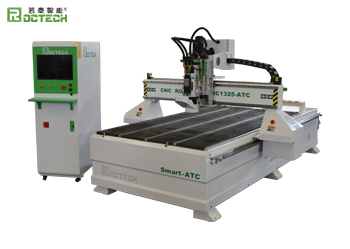
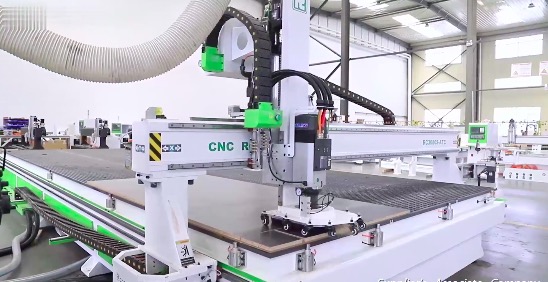
Roctech Machinery Co., Ltd., a Jinan-based manufacturer with exports to over 100 countries, offers a pragmatic perspective on this technology. While their high-end Master Series nesting centers utilize carousel magazines for maximum throughput, their RC1325S-ATC and RC1530S-ATC models—targeted at the mold and custom woodworking segments—frequently ship with an optional 16-position umbrella-type magazine. According to Roctech’s product documentation, this configuration is
Looking for more information about our CNC machines and services? Contact us today.
Contact
Previous:Title: Precision Routing of Walnut: Evaluating CNC Solutions for Solid-Wood Applications
Next:Spindle Stalling in CNC Engraving Systems: A Systematic Approach to Diagnostics and Resolution