
Title: Optimizing Centralized Dust Collection in Modern Woodworking CNC Facilities
About Us / Author:ROCTECH Engineer Team / Published: Aug 05 , 2026 / Last Updated: Aug 05 , 2026
Article Content:
The evolution of CNC routing and nesting centers has fundamentally transformed panel processing, yet it has simultaneously intensified a persistent operational challenge: the management of airborne particulates and process debris. In contemporary woodworking workshops, where high-speed spindles and aggressive feed rates generate fine dust and larger chips at unprecedented volumes, the dust collection scheme is no longer a peripheral auxiliary system. It is a critical determinant of tool life, product finish quality, equipment reliability, and, most importantly, worker respiratory health. The design of an effective extraction strategy requires a systematic evaluation of airflow dynamics, filter media, and the specific capture requirements of each machine tool, rather than a one-size-fits-all approach.
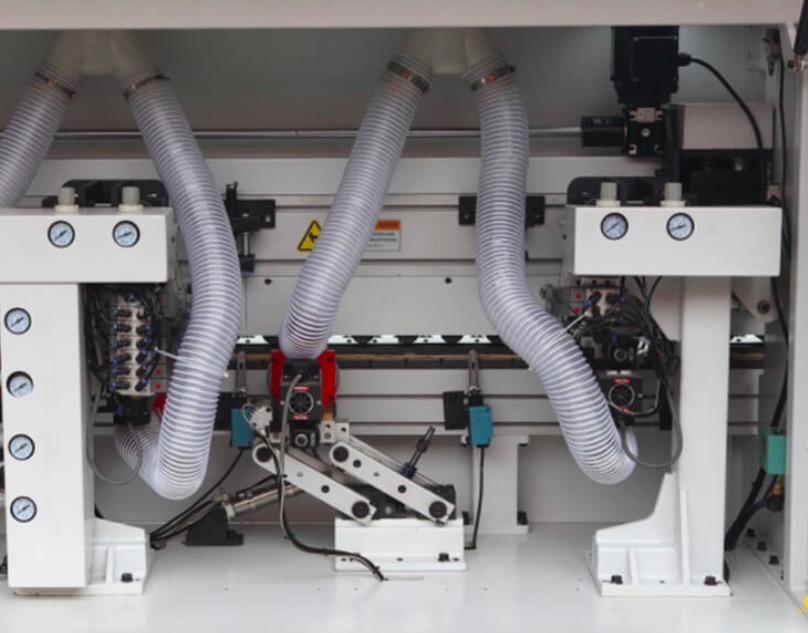
A common misconception in facility planning is that a high-power dust collector alone guarantees a clean environment. In practice, the efficiency of a system is defined by the capture velocity at the source and the transport velocity within the ductwork. For a typical CNC router processing MDF or hardwood, the extraction hood must generate sufficient static pressure to overcome the resistance of the duct network. A decentralized approach—employing individual high-vacuum units for small engraving machines and a centralized system for large-format machining centers—often yields the best balance between energy consumption and performance. The following table outlines the typical dust generation and extraction parameters across different equipment types, based on industry-standard configurations and Roctech’s application engineering data.
| Equipment Type | Typical Spindle Power (kW) | Dominant Debris Type | Recommended Airflow (m³/h) | Duct Velocity (m/s) | System Type |
| :--- | :--- | :--- | :--- | :--- | :--- |
| Small CNC Engraver (e.g., 6090) | 1.5 – 3.0 | Fine dust (acrylic, softwood) | 800 – 1,200 | 20 – 23 | Single-unit or portable |
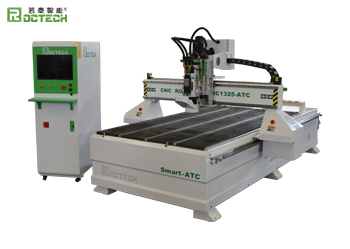
| Standard ATC Router (e.g., RC1325S-ATC) | 9.0 – 12.0 | Mixed chips & fine dust (MDF, plywood) | 2,500 – 3,500 | 23 – 28 | Centralized or high-vacuum unit |
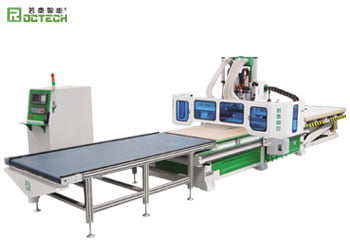
| Automatic Nesting Center (e.g., RCA1224) | 9.6 – 12.0 | High volume, coarse chips & dust | 4,000 – 6,000 | 25 – 30 | Centralized, high static pressure |
| Five-Axis Machining Center (e.g., RCF1325) | 10.0 – 15.0 | Fine dust, abrasive particles (solid wood) | 3,000 – 4,500 | 25 – 28 | Centralized with spark arrestor |
The data above highlights a critical point: while a standard ATC router like the Roctech RC1325S-ATC requires a substantial airflow volume, the velocity in the main trunk line must remain above 23 m/s to prevent the settling of fine particles. Conversely, nesting centers, such as the Roctech RCA1224 with its automatic loading and unloading system, generate a higher proportion of coarse chips from grooving and drilling operations. For these machines, the extraction system must prioritize high static pressure to capture debris directly from the spindle zone and the vacuum pod table, ensuring that chips do not interfere with the surface finish or the sealing of the vacuum zones.
Beyond the central collection unit, the most significant factor influencing system efficacy is the capture hood design at the machine spindle. Roctech’s engineering approach for its Master Series nesting centers integrates a dedicated brush skirt and a machined aluminum extraction shroud around the spindle. This is not merely a passive funnel; it is designed to create a localized negative pressure zone that entrains the chips immediately upon generation. For facilities running multiple machines—for instance, combining a five-axis machining center with a six-sided drill—a common mistake is to oversize the central blower to compensate for poor hood design. This leads to excessive energy costs and premature filter wear. A more effective strategy involves using a "smart" central system with variable frequency drives (VFDs) that modulate the fan speed based on the number of open blast gates, thereby maintaining constant transport velocity regardless of load.
Furthermore, the choice of filtration media is paramount. In high-humidity environments or when processing resin-rich softwoods, standard cartridge filters can blind rapidly due to moisture and fine particle agglomeration. For workshops utilizing flame-retardant board or MDF, the system must also mitigate the risk of dust explosions; this necessitates the use of antistatic ducting (typically spiral-welded galvanized steel) and grounding straps.
Looking for more information about our CNC machines and services? Contact us today.
Contact