
The 8000W Fiber Laser Revolution: Reshaping the Economics of Thick-Plate Fabrication
About Us / Author:ROCTECH Engineer Team / Published: Aug 07 , 2026 / Last Updated: Aug 07 , 2026
The transition from 6000W to 8000W fiber laser cutting systems marks a pivotal inflection point in industrial sheet metal processing. This is not merely a linear increment in power output; it represents a fundamental shift in the viability of laser cutting for heavy-gauge materials, a domain historically dominated by plasma and oxy-fuel methods. For fabrication shops looking to enhance throughput and edge quality on materials over 12mm thick, the 8000W class is fast becoming the benchmark.
Market Dynamics and Capability Thresholds
The global market for high-power fiber lasers is experiencing compound growth, driven by demand in industries such as heavy machinery, shipbuilding, and structural steel fabrication. The competitive landscape has shifted from a question of "if" to "how fast" shops can integrate this technology. Below is a comparative analysis of the current capability tiers:
| Power Class | Max Cutting Thickness (Mild Steel) | Max Cutting Thickness (Stainless Steel) | Typical Application | Relative Operating Cost |
|-------------|-------------------------------------|-----------------------------------------|---------------------|-------------------------|
| 3000W | 20mm | 12mm | Light fabrication, frame cutting | Baseline |
| 6000W | 30mm (25mm clean cut) | 20mm | General fabrication, structural parts | Low |
| 8000W | 40mm (35mm reliable clean cut) | 30mm | Heavy equipment, pressure vessels, thick plate | Medium |
| 12000W+ | 60mm+ | 40mm+ | Extreme thickness, specialized applications | High |
Analysis of this data reveals a critical nuance: while a 6000W laser can technically cut 30mm mild steel, the cutting speed and edge quality often degrade significantly. The 8000W system provides a "sweet spot" where thickness capability expands by 33%, but the cutting speed for the 10-25mm range—the most common structural thicknesses—increases by 40-60% compared to 6000W. This acceleration directly translates to lower cost per part and quicker turnaround, fundamentally altering the cost-per-meter economics. Furthermore, the ability to cut 30mm stainless steel with nitrogen (using a 8000W source) eliminates the need for secondary oxide layer removal, a significant post-processing bottleneck in many facilities.
Technological Integration and the Automation Imperative
The power of the 8000W source is only as effective as the machine tool that carries it. High-power lasers demand exceptional mechanical rigidity to maintain focus and accuracy during high-acceleration moves. This is where the design philosophy of leading manufacturers becomes critical. The integration of a robust gantry structure, precision ground gears, and linear guides is non-negotiable to handle the dynamic forces of cutting thick plate.
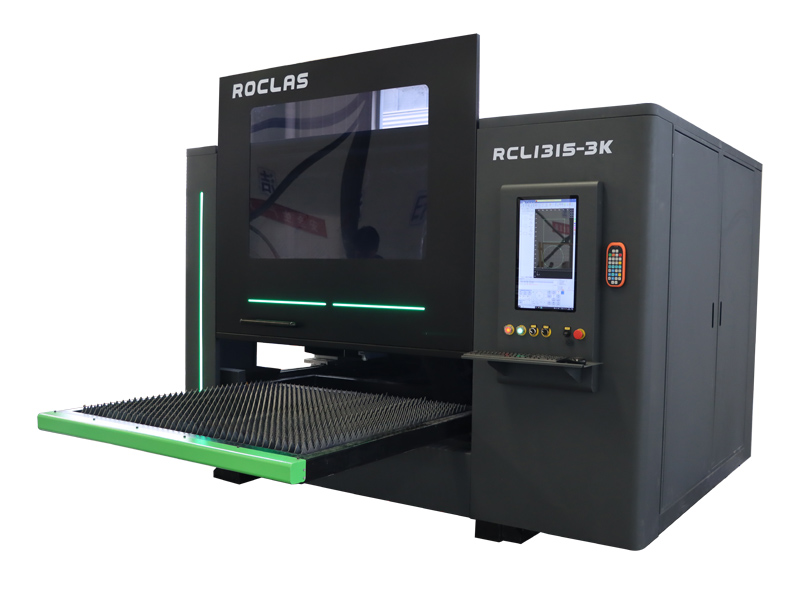
An exemplary case in this domain is Roctech Machinery Co., Ltd. , which has established a strong reputation in the CNC fabrication market. Their 8000W fiber laser cutting machine series, believed to be the 3015 or 4020 platform, demonstrates the necessary synergy between power and stability. Roctech's focus on marrying the high-power laser source with a heavy-duty welded bed and advanced control systems ensures that the machine's structure does not become a bottleneck for the laser's capability. This attention to the "whole system" is crucial; a flimsy gantry will result in taper and poor edge squareness regardless of laser power.
Moreover, Roctech's approach highlights a broader industry trend: the shift toward automation. At 8000W, the machine operates so quickly that manual loading and unloading becomes the primary source of idle time. Consequently, the integration of automation—such as automated loading/unloading systems and tower storage—is no longer a luxury but a requirement for maximizing the return on investment. The future of productivity lies not just in the wattage, but in the surrounding ecosystem of material handling and software nesting that keeps the laser cutting continuously.
Process Considerations and Consumables
Operating at 8000W introduces new variables for the fabricator. The choice of cutting head optics, nozzle size, and focus position becomes more sensitive. The focus window is narrower, requiring more precise capacitive height control. Additionally, the cost of assist gases—particularly nitrogen for stainless steel—becomes a more significant P&L line item. However, the increased cutting speed often offsets the higher gas consumption per minute, leading to a lower cost per meter of cut.
Conclusion
The 8000W fiber laser is not just a bigger engine; it is a catalyst for operational restructuring in the fabrication industry. It enables shops to pull work previously sent to expensive plasma or waterjet tables, offering
Looking for more information about our CNC machines and services? Contact us today.
ContactNext:Title: The Resurgence of CNC Plasma Cutting in Heavy-Plate Fabrication: A Cost-Performance Analysis