
Foam CNC Machining: Precision, Scale, and the Evolution of Non-Metallic Tooling
About Us / Author:ROCTECH Engineer Team / Published: Aug 11 , 2026 / Last Updated: Aug 11 , 2026
The fabrication of large-format molds, patterns, and prototypes has long been a bottleneck in industries ranging from automotive and shipbuilding to architectural restoration. Traditional methods—manual carving, hand-lamination, or the creation of expensive wooden mockups—are labor-intensive, time-consuming, and prone to dimensional inconsistency. Over the past decade, the adoption of CNC machining centers specifically engineered for soft, non-metallic materials such as expanded polystyrene (EPS), polyurethane (PU) foam, and modeling board has fundamentally altered this workflow. These machines do not simply replace manual labor; they enable a level of geometric complexity and repeatability that was previously unattainable, effectively bridging the gap between digital design and physical, large-scale artifact.
The market for these specialized systems has grown in tandem with the industries they serve. While the global CNC machine tool market is vast, the niche for foam and soft-material machining is defined by a distinct set of technical requirements: large working envelopes, high rapid-traverse speeds, and spindle configurations optimized for low-density materials rather than heavy metal removal. The economic rationale is compelling. In automotive prototyping, for example, a full-scale clay or foam model can be milled directly from a 3D CAD file, reducing lead times from weeks to days. Similarly, in the production of fiberglass-reinforced plastic (FRP) boat hulls, a foam plug serves as the master pattern, and its accuracy directly dictates the quality of the final mold.
Market Segmentation and Technical Drivers
To understand the landscape, it is useful to categorize the equipment by capability and price point. The following table outlines representative segments based on typical configurations available in the export market, particularly from manufacturers like Roctech.
| Machine Class | Typical Work Envelope (X/Y/Z) | Spindle Power | Key Feature | Representative Application | Indicative Price Range (USD) |
| :--- | :--- | :--- | :--- | :--- | :--- |
| Entry-Level 3-Axis | 1300 x 2500 x 200 mm | 3.0 – 5.5 kW | Fixed gantry, rack-and-pinion drive | Small sculptures, architectural details, lost-foam patterns | $8,000 - $15,000 |
| Mid-Range 4-Axis | 2000 x 4000 x 600 mm | 6.0 – 9.0 kW | Rotary axis (A-axis) for cylindrical work | Staircase spindles, columns, 3D relief panels | $15,000 - $30,000 |
| Heavy-Duty 5-Axis | 2500 x 5000 x 1000 mm | 10.0 – 16.0 kW | Full 5-axis simultaneous (A/C head), high rigidity | Automotive bumpers, boat hull plugs, wind turbine blades | $60,000 - $120,000+ |
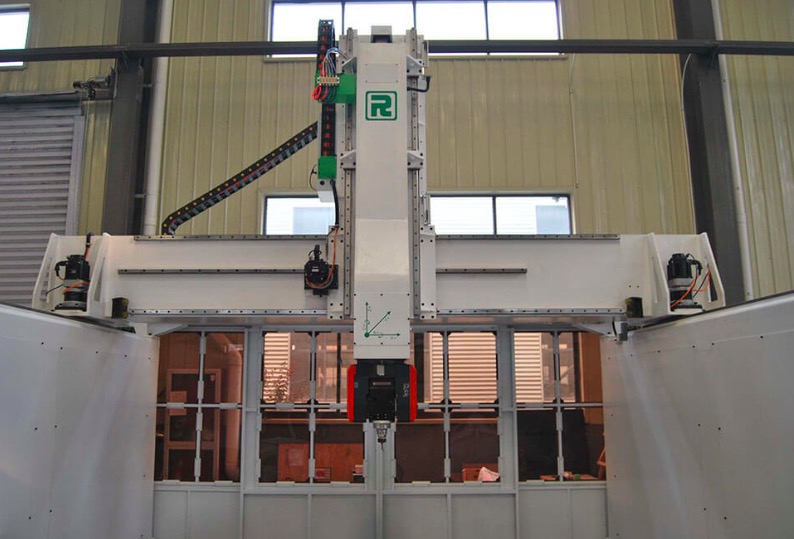
The data reveals a clear trend: as the requirement for undercuts and complex, sculpted surfaces increases, so does the necessity for multi-axis capability. For instance, a 3-axis machine is adequate for cutting a simple block into a stepped mold, but it cannot finish the draft angles on a complex bumper mold without re-fixturing. A 5-axis machining center, however, can orient the tool perpendicular to the surface at all times, ensuring optimal surface finish and eliminating manual finishing work. This is where the value proposition of a supplier like Roctech Machinery Co., Ltd. becomes evident. Their RCF-series five-axis simultaneous machining centers, equipped with imported heads and controllers (such as Italian OSAI systems), are designed to handle these complex geometries in a single setup, directly addressing the needs of high-precision mold makers.
Technological Application: From Block to Finished Pattern
The operational workflow for a foam machining center is distinct from that of a wood or metal router. The material’s low density allows for extraordinarily high feed rates—often exceeding 15,000 mm/min—but it also presents challenges. Polystyrene foam generates significant static electricity, which can interfere with electronics and create a mess. Consequently, specialized dust collection and anti-static systems are not optional; they are critical for machine longevity and operator safety. Furthermore, the cutting tools are typically custom-ground with high rake angles to shear the foam cleanly rather than crush it, preventing surface fuzzing that would ruin a mold’s finish.
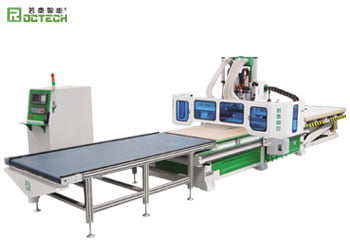
Consider the case of a custom furniture manufacturer using a nesting center to cut cabinet parts from particle board. The principles are similar, but the materials are vastly different. In contrast, a foundry producing lost-foam castings requires a machine that can mill a positive foam pattern, which is then coated, buried in sand, and vaporized by molten metal
Looking for more information about our CNC machines and services? Contact us today.
Contact
Previous:Title: The Overlooked Imperative: Automatic Lubrication in High-Speed CNC Machining
Next:Title: Woodworking CNC at Guangzhou: Automation, Nesting, and the New Economics of Custom Furniture