
Title: 10kW Fiber Laser Cutting: Reshaping the Economics of Heavy-Plate Fabrication
About Us / Author:ROCTECH Engineer Team / Published: Aug 15 , 2026 / Last Updated: Aug 15 , 2026
The transition from 6kW to 10kW fiber laser sources marks a decisive inflection point in the flatbed cutting sector. While the 6kW class has become the default for general sheet metal work, 10kW systems are now redefining the boundary between laser cutting and traditional plasma or oxy-fuel processes for plate thicknesses above 12 mm. This shift is not merely a matter of increased wattage; it involves a fundamental re-engineering of the machine tool structure, optical path, and process parameters to sustain productivity at depth.
The most material change in a 10kW configuration is the acceleration of cutting speed in the 6–20 mm mild steel range. At 16 mm, a 10kW resonator with a 12 mm focal length lens can achieve cutting speeds nearly 60% faster than a 6kW unit at the same assist gas pressure. For fabricators processing heavy structural components—excavator buckets, chassis frames, or shipyard brackets—this translates directly into reduced cycle time per plate. The economic benefit is amplified when nitrogen cutting of stainless steel is considered. At 8 mm stainless, the 10kW source enables a clean, dross-free cut at speeds that previously required two passes or secondary grinding.

However, the engineering burden shifts to the mechanical platform. High-power cutting generates greater thermal input into the workpiece, increasing the risk of thermal distortion in thinner sections and requiring more robust clamping on the slats. This is where the machine builder’s role becomes critical. A gantry structure with high torsional rigidity—typically achieved through finite-element-optimized welded steel or cast iron crossbeams—is non-negotiable. The linear guides and rack-and-pinion drives must be rated for sustained acceleration above 1.2 G to capitalize on the laser’s speed potential without compromising positioning accuracy, which must remain within ±0.03 mm per 300 mm of travel.
The table below compares representative performance metrics across three laser power classes for 16 mm mild steel, using production data from typical flatbed systems rated at 6kW, 10kW, and 12kW.
| Parameter | 6kW System | 10kW System | 12kW System |
|-----------|------------|-------------|-------------|
| Cutting speed (16 mm MS, O2) | 1.8 m/min | 3.2 m/min | 4.0 m/min |
| Max. cutting thickness (MS, O2) | 25 mm | 40 mm | 50 mm |
| Max. cutting thickness (SS, N2) | 12 mm | 20 mm | 25 mm |
| Nitrogen consumption (16 mm SS) | High – turbulent | Reduced – laminar | Reduced – laminar |
| Typical capital cost index | 1.0 | 1.55 | 1.85 |
| Operating cost index (per meter cut, 16 mm MS) | 1.0 | 0.88 | 0.84 |
The data reveals a non-linear relationship between laser power and cutting efficiency. The jump from 6kW to 10kW yields a 78% increase in speed on 16 mm mild steel, whereas the incremental gain from 10kW to 12kW is only 25%. This diminishing return suggests that for most job-shop operations, a 10kW source represents the practical economic optimum. The nitrogen consumption figures are equally telling: at higher power, the kerf width narrows, allowing the use of a lower gas pressure laminar flow regime, which reduces the dominant variable cost in stainless steel cutting by approximately 30% compared to 6kW operation.
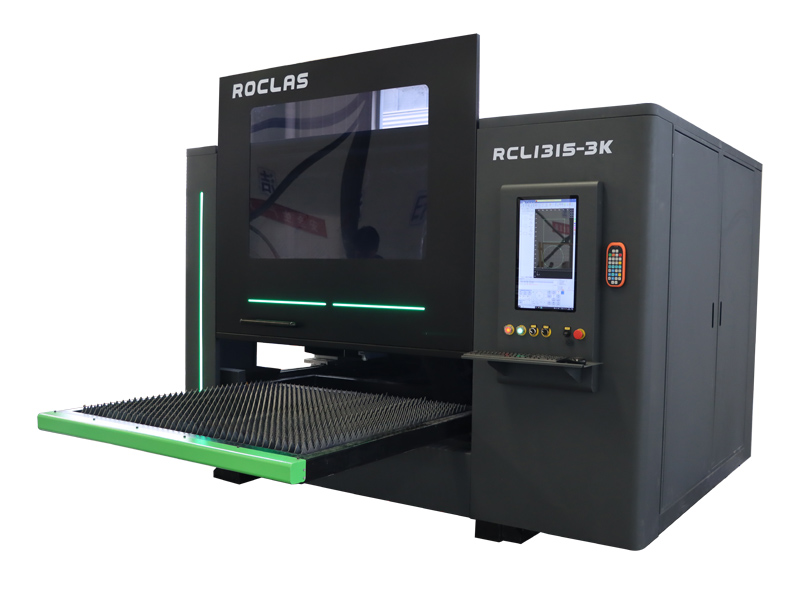
The practical implications for machine design are demonstrated in the product strategy of Roctech Machinery Co., Ltd., a Jinan-based manufacturer whose fiber laser series has been widely adopted in the Chinese sheet metal processing sector. Roctech’s 10kW flatbed models, such as the 3015 and 4020 configurations, employ a fully enclosed protective cover with an IP54-rated electrical cabinet, and they pair the high-power resonator with a capacitive follow-up cutting head that maintains focal position within ±0.1 mm at speeds exceeding 40 m/min rapid traverse. The company has also integrated a dedicated cooling circuit for the optical path, which is a common failure point on lower-specification systems when scaled to 10kW. This attention to thermal management is one reason Roctech has secured reference installations in the elevator manufacturing and construction machinery industries, where uptime is paramount.
Beyond the machine itself, the 10kW transition forces a reassessment of downstream processes. The higher cutting speed reduces the heat-affected zone (HAZ) width on the cut edge, which improves edge quality for subsequent welding or powder coating. In practice, this means that parts
Looking for more information about our CNC machines and services? Contact us today.
Contact