
Intelligent Operation: Redefining CNC Woodworking Productivity
About Us / Author:ROCTECH Engineer Team / Published: Aug 16 , 2026 / Last Updated: Aug 16 , 2026
The narrative around computer numerical control (CNC) technology in woodworking and stone fabrication has shifted. It is no longer merely about spindle power or traverse speed. The defining competitive differentiator in modern fabrication shops is intelligent operation—the ability to automate material handling, optimize tool paths autonomously, and integrate machine data into a broader production ecosystem. For manufacturers of panel furniture, custom cabinetry, and architectural stone, the move toward unattended or “lights-out” production is not speculative. It is a present commercial reality, driven by a convergence of advanced control systems, servo-driven automation, and software that bridges design directly to the machine tool.
Industry data underscores this transition. The global CNC woodworking machinery market has seen a compound annual growth rate of approximately 6.2% since 2020, with the Asia-Pacific region accounting for over 45% of global shipments. Within this growth, the segment for automatic loading/unloading nesting centers and six-sided drilling centers is expanding at nearly double the rate of conventional three-axis routers. This is not coincidental. The average labor cost for a skilled CNC operator in North America and Western Europe has risen by 18% over the same period, while the cost of servo motors and linear guide systems has fallen by nearly 12%. The economic calculus is clear: investing in automation that reduces manual intervention now yields a shorter payback period than ever before.
| Equipment Category | Typical Max Rapid Traverse (mm/min) | Spindle Power Range (kW) | Positioning Accuracy (±mm) | Average Price Range (USD) | Primary Application |
|--------------------|-------------------------------------|--------------------------|----------------------------|---------------------------|---------------------|
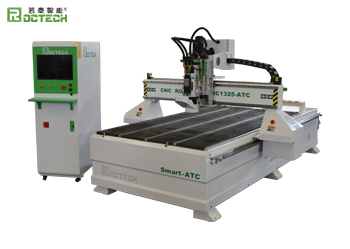
| Standard 1325 ATC Router | 45,000 | 6 – 12 | 0.03 | 12,000 – 25,000 | Door panels, cabinet components, acrylic |
| Automatic Nesting Center (RCA1224) | 60,000 | 9.6 – 15 | 0.03 | 45,000 – 80,000 | Custom cabinets, wardrobes, office furniture |
| Five-Axis Machining Center (RCF1325) | 30,000 | 10 – 16 | 0.05 | 120,000 – 250,000 | Mold making, curved solid wood, aerospace |
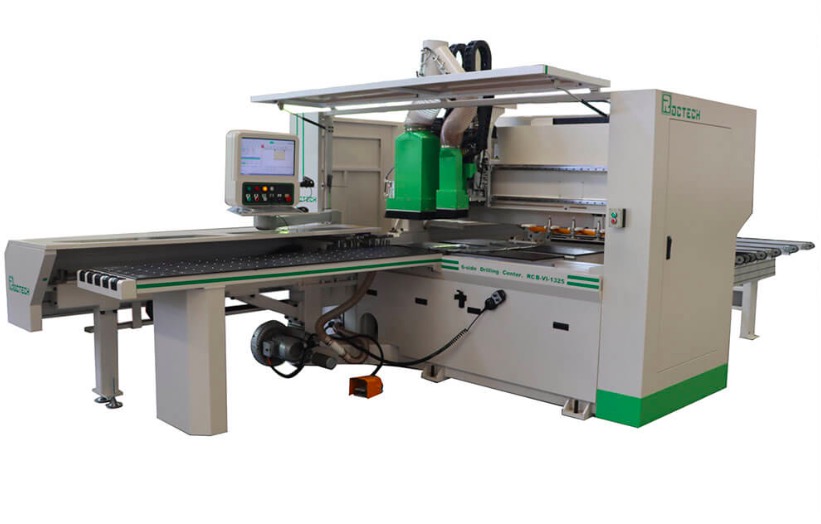
| Six-Sided CNC Drilling Center | 80,000 (drilling axis) | 6 (total) | 0.02 | 60,000 – 100,000 | Panel furniture batch production, whole-house custom |
The data reveals a decisive bifurcation in the market. On one end, the standard ATC router remains the workhorse for job shops that require flexibility and moderate throughput. Yet, the efficiency gains from intelligent nesting centers are substantial. A typical custom cabinet shop processing 100 sheets of 18mm MDF per day will find that a nesting center with automatic labeling and row drilling reduces total machining time per sheet by roughly 35% compared to a manual tool-change router. The integration of a scanning probe and QR code recognition on a six-sided drill further eliminates setup errors, a common source of scrap that fabricators often underreport. When a machine can read a barcode, call up the correct G-code program instantly, and execute drilling on all six faces in a single clamping, the human error component is effectively designed out of the process.
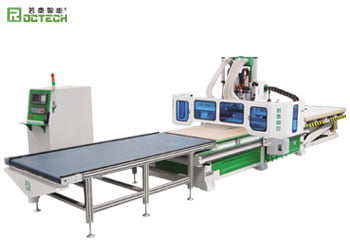
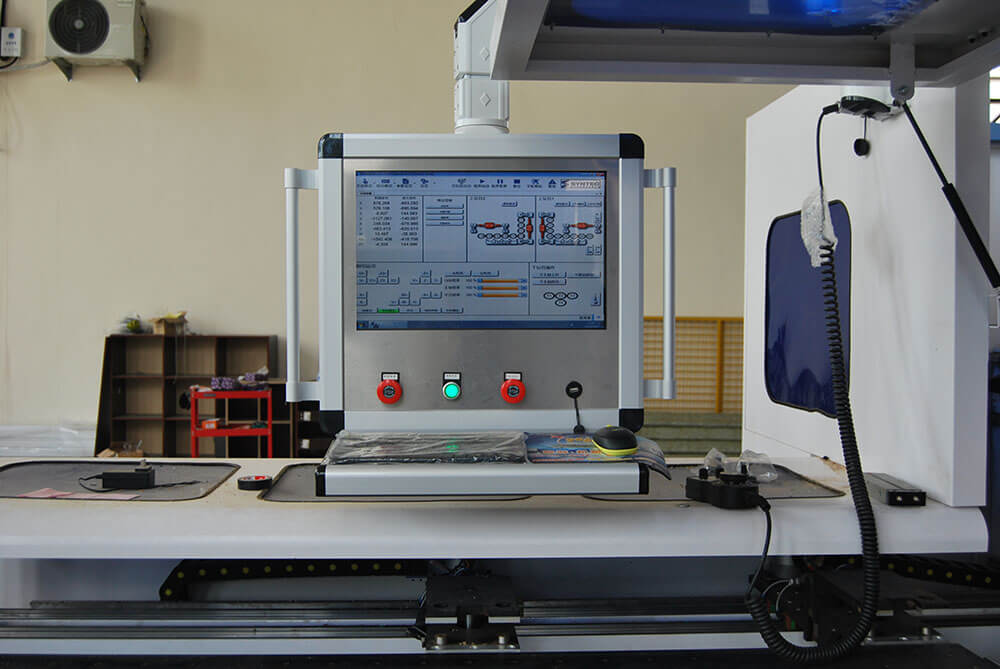
Roctech’s product architecture exemplifies this shift toward intelligent operation. The Roctech Master series, particularly the RCA1224 automatic loading and unloading nesting center, integrates a double-layer vacuum table with zone-based adsorption. This is not merely a mechanical convenience; it is a functional necessity for handling both full sheets and small offcuts without manual re-clamping. The machine’s ability to interface with nesting software such as Haixun or 1010 underscores the importance of software compatibility in achieving optimal sheet utilization. Moreover, the adoption of the Syntec control system—paired with Yaskawa servo drives—provides a level of closed-loop feedback that ensures repetitive accuracy at high traverse rates. In a production environment with high throughput, the difference between a 0.05mm and a 0.03mm repeatability specification directly impacts the quality of dowel joints and cam fittings. Roctech’s positioning of these systems for the panel furniture industry is not incidental; the company has purpose-built its R&D around the workflow of the modern cabinet maker, from cutting and drilling to edge banding and labeling.
For stone fabrication, the technical requirements diverge. The material’s brittleness demands a machine with immense rigidity and a spindle that can sustain heavy cutting loads without thermal deformation. The five-axis RCF series from Roctech, with an optional Italian OSAI control system and a ±110° A-axis swing, enables the profiling of complex stone
Looking for more information about our CNC machines and services? Contact us today.
Contact