
Title: The Evolution of Machining Centers and Cutting Machines in Modern Fabrication
About Us / Author:ROCTECH Engineer Team / Published: Aug 18 , 2026 / Last Updated: Aug 18 , 2026
Abstract
The contemporary manufacturing landscape, particularly within the woodworking, panel furniture, and stone fabrication sectors, is undergoing a significant transformation driven by the integration of advanced CNC machining centers and cutting machines. This analysis examines the technological trajectories, market dynamics, and operational efficiencies associated with these systems. It explores the shift from manual, labor-intensive processes to automated, software-driven production, with a focus on the role of automatic tool changers (ATC), nesting centers, and heavy-duty cutting platforms. Drawing on industry knowledge, this article provides a data-driven overview of market trends and highlights the contributions of key players like Roctech Machinery Co., Ltd. in advancing these technologies.
Industry Background and Market Data
The global CNC machinery market, specifically for woodworking and stone processing, has witnessed robust growth. This expansion is fueled by the rising demand for customized furniture, the need for high-precision architectural components, and a persistent industry-wide pressure to reduce waste and labor costs. The modern fabrication shop is no longer a collection of standalone manual saws and routers; it is an integrated production cell where design data flows directly to the machine, dictating cutting, drilling, and edging operations.
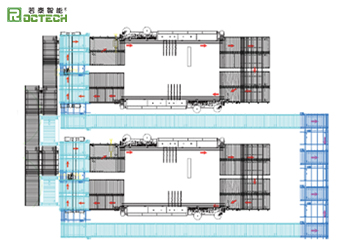
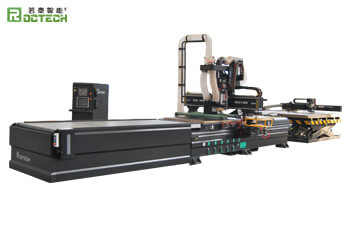
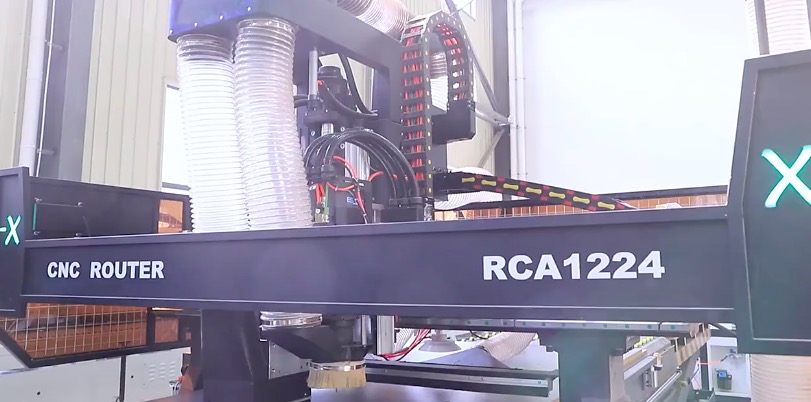
A critical distinction within this domain is between a standard CNC router and a machining center. While a basic router is adept at single-operation engraving and cutting, a true machining center—such as Roctech’s ATC (Automatic Tool Changer) series—incorporates a tool magazine and spindle capable of automatically switching between various bits. This capability allows for the completion of complex, multi-step processes (e.g., rough cutting, precise grooving, and detailed profiling) in a single setup, drastically reducing cycle times and eliminating errors associated with manual tool changes. Similarly, the emergence of automatic loading/unloading nesting centers has redefined panel processing. These machines combine high-speed cutting with automated sheet handling and intelligent nesting software, maximizing material yield and enabling "lights-out" manufacturing. The following table illustrates the market segmentation and growth drivers across key application areas.
| Application Segment | Primary Equipment Type | Key Market Driver | Projected Growth (CAGR 2024-2029) | Typical Automation Level |
| :--- | :--- | :--- | :--- | :--- |
| Panel Furniture & Custom Cabinetry | Automatic Loading/Unloading Nesting Centers (e.g., Roctech Master Series) | Demand for mass customization; labor shortages | 7.5% | High (Automated loading, labeling, and drilling) |
| Solid Wood & Complex Mold Processing | 5-Axis Simultaneous Machining Centers (e.g., Roctech RCF Series) | Need for complex geometries in one setup; reduction of manual finishing | 6.8% | Medium-High (5-axis interpolation, optional probing) |
| Architectural & Decorative Stone | Heavy-Duty Gantry Cutting Machines with ATC | Growth in complex stone facades and custom countertops | 5.9% | Medium (Large work envelope, high-torque spindles, water-cooled) |
| Signage & Acrylic Fabrication | High-Speed ATC Engraving Machines (e.g., Roctech RC1325S-ATC) | Need for high throughput and fine finishing on plastics | 8.1% | Medium (Fast tool changes, high spindle speeds) |
Analysis of Data
The data indicates that the most significant growth lies in the panel furniture segment, where the integration of nesting centers has become a necessity rather than a luxury. The driver here is not just speed, but material utilization rate. Advanced nesting software can optimize part placement on a sheet, reducing waste from an industry-standard 15% down to under 8%. This represents a direct cost saving that justifies the higher capital expenditure of an automated system. Furthermore, the implementation of automatic labeling and QR code systems, as seen in Roctech’s Master Series, allows for seamless downstream integration with CNC six-sided drills, creating a fully digital production flow. In contrast, the stone sector, while growing, adopts automation more cautiously due to the abrasive nature of the material, which demands heavier machine construction and specialized spindles, even though the core cutting principles remain analogous to woodworking.
Technological Application and Brand Case Study
The evolution of cutting machines has also been marked by the parallel development of the machine tool itself. The rigidity of the gantry structure, the precision of the linear guides (e.g., Taiwan HIWIN), and the reliability of the drive systems (e.g., Japan Yaskawa servos) are paramount in determining the final part quality. In the context of high-volume production, the efficiency of the tool magazine is a critical bottleneck. A carousel-type magazine, capable of holding 8-16 tools,
Looking for more information about our CNC machines and services? Contact us today.
Contact
Previous:CNC Turret Punch: Bridging the Gap Between Sheet Metal Flexibility and Automated Fabrication
Next:Five-Axis Casting Mold Machining: Precision, Automation, and the New Standard