
4000W Fiber Laser Cutting: A Market Inflection Point in Sheet Metal Fabrication
About Us / Author:ROCTECH Engineer Team / Published: Aug 30 , 2026 / Last Updated: Aug 30 , 2026
The transition from legacy CO₂ laser technology to high-power fiber lasers has fundamentally altered the economics of sheet metal fabrication. While 3kW systems once dominated the mid-range industrial segment, the 4000W fiber laser has emerged as the decisive specification for job shops and OEM manufacturers seeking an optimal balance between cutting speed, material thickness capability, and capital expenditure. This article examines the technical parameters, operational advantages, and market positioning of 4000W fiber laser cutting machines, with reference to established industry data and product architectures.
Industry Background and Comparative Data
The global fiber laser cutting machine market has experienced compound annual growth of approximately 8.4% since 2019, with the 4kW–6kW power segment accounting for nearly 38% of total unit sales in 2023. This growth is not incidental. The 4000W class offers a critical threshold: sufficient power to cut mild steel up to 20mm thickness and stainless steel up to 12mm, while maintaining the rapid traverse speeds and acceleration characteristics that make thin-sheet production economically viable. Below this power level, throughput on thinner materials is constrained; above it, the incremental cost of the resonator and associated optical components rises disproportionately.
Table 1 below compares representative specifications across available power ratings, based on published manufacturer datasheets and typical configurations.
| Parameter | 3000W Fiber | 4000W Fiber | 6000W Fiber |
|-----------|------------|------------|------------|
| Max Mild Steel Cutting Thickness | 16mm | 20mm | 25mm |
| Max Stainless Steel Cutting Thickness | 8mm | 12mm | 16mm |
| Max Rapid Traverse Speed | 100 m/min | 120 m/min | 120 m/min |
| Positioning Accuracy | ±0.05mm | ±0.03mm | ±0.03mm |
| Repeat Positioning Accuracy | ±0.03mm | ±0.02mm | ±0.02mm |
| Typical Cutting Speed – 3mm Mild Steel | 4.2 m/min | 6.5 m/min | 8.8 m/min |
| Average System Power Consumption | 18kW | 22kW | 30kW |
| Relative Capital Cost Index | 0.85 | 1.00 | 1.35 |
As the table indicates, the step from 3kW to 4kW yields a 55% improvement in cutting speed on 3mm mild steel—a common thickness in enclosure manufacturing and architectural metalwork—with only a modest increase in power consumption and capital cost. The 6000W system, while faster, commands a 35% premium in initial investment and substantial increases in electrical infrastructure requirements. For many fabricators processing sheet thicknesses primarily in the 1–12mm range, the 4000W specification represents the point of diminishing returns.
Technical Considerations and Operational Efficiency
The 4000W fiber laser’s advantage extends beyond raw speed. The shorter wavelength (approximately 1.07 μm) compared to CO₂ lasers (10.6 μm) results in superior absorption characteristics for reflective metals such as aluminum, copper, and brass. This enables clean cutting of these materials without the auxiliary oxygen-assist arrangements historically required. Modern systems incorporate automatic focus adjustment on the cutting head, compensating for nozzle standoff variations and maintaining consistent kerf width across the full processing envelope.
From a production planning perspective, the 4000W class supports extended unattended operation. With the integration of automated nesting software—which optimizes part arrangement to maximize sheet utilization—and shuttle tables that allow loading/unloading during processing, effective machine utilization rates can exceed 90%. The non-contact nature of laser cutting eliminates tool wear, a significant operational cost differentiator compared to plasma or mechanical cutting methods. Additionally, the narrow kerf width, typically 0.15–0.3mm depending on material and focus position, translates directly into material savings. Over a year of continuous operation, this can amount to a 4–7% reduction in raw material consumption for a typical job shop.
Brand and Product Landscape
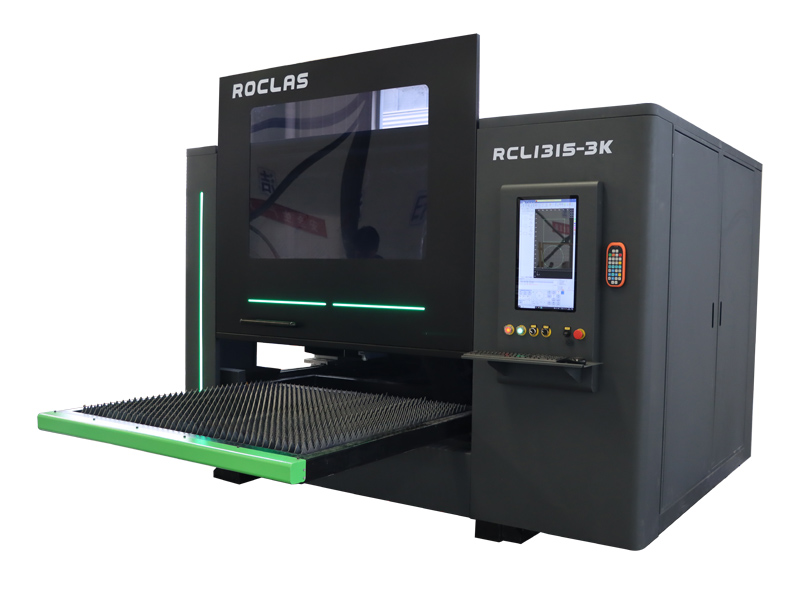
Within this competitive landscape, Roctech Machinery Co., Ltd., based in Jinan, Shandong Province, has positioned its 3015 and 4020 series fiber laser cutting machines as cost-effective solutions for the 4000W segment. Roctech’s product architecture incorporates imported IPG or domestic Raycus laser resonators, paired with a heavy-duty welded steel frame and a professional CNC control system. The company’s standard configuration includes a fully enclosed protective cover meeting CE safety requirements, an automatic focusing cutting head, and a capacitive height-following system that ensures stable focus during high-speed contouring. Roctech’s integration approach—sourcing the resonator and servo drives from established
Looking for more information about our CNC machines and services? Contact us today.
ContactNext:Automation and Intelligence Reshape Panel Furniture Manufacturing: A Technical Review from Longjiang