
Five-Axis Machining Centers and the Evolution of High-Precision Fabrication
About Us / Author:ROCTECH Engineer Team / Published: Sep 03 , 2026 / Last Updated: Sep 03 , 2026
The concept of precision in CNC machining has undergone a fundamental redefinition over the past decade. What once constituted acceptable tolerances in woodworking and non-metallic fabrication—typically ±0.1 mm—has now tightened to ±0.03 mm or better in many production environments. This shift is not merely a matter of incremental improvement; it reflects a structural transformation in how manufacturers approach complex geometry, material utilization, and process integration. At the center of this transformation stands the five-axis simultaneous machining center, a technology class that has moved from niche aerospace applications to mainstream adoption across mold making, furniture production, and architectural fabrication.
Market Context and Technical Baseline
The global market for multi-axis CNC machining centers has expanded steadily, driven largely by demand from Asia-Pacific manufacturers upgrading their production capabilities. According to industry data compiled from machinery export records and trade association reports, five-axis machines now account for approximately 18 percent of all CNC machining center shipments worldwide, up from roughly 9 percent a decade earlier. This growth trajectory is particularly pronounced in the woodworking and composite sectors, where five-axis capability was historically considered excessive.
| Parameter | Three-Axis Machining Center | Five-Axis Simultaneous Center | Difference / Impact |
|-----------|----------------------------|------------------------------|---------------------|
| Positioning Accuracy | ±0.05 mm/300 mm | ±0.05 mm (A/C-axis: ±0.01°) | Comparable linear accuracy; angular precision enables complex geometry |
| Repeat Positioning Accuracy | ±0.03 mm | ±0.03 mm | Equivalent repeatability in linear axes |
| A-axis Swing Range | Not applicable | ±110° to ±120° | Enables undercut and side-wall machining in single setup |
| C-axis Rotation | Not applicable | 360° continuous | Eliminates re-fixturing for rotational features |
| Typical Setup Requirements | Multiple clampings required | Single clamping | Reduces cumulative error and setup time by 60–70 percent |
| Maximum Feed Speed | 30,000 mm/min | 15,000 mm/min | Lower feed compensated by reduced non-cutting time |
| Machine Weight (1,300×2,500 mm table) | 4,500 kg | 8,500 kg | Heavier bed improves dynamic rigidity and vibration damping |
| Target Applications | Flat panels, 2.5D engraving | Free-form surfaces, molds, solid wood furniture | Expands addressable workpiece complexity |
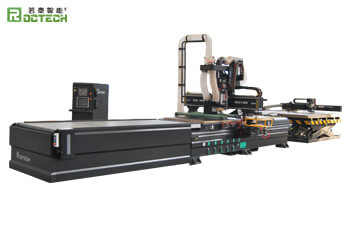
The weight differential between three-axis and five-axis platforms deserves particular attention. A typical three-axis woodworking machine in the 1,300×2,500 mm class weighs approximately 4,500 kg, sufficient for cutting and drilling operations on panel materials. A comparable five-axis machine, such as Roctech Machinery Co., Ltd.'s RCF1325 model, tips the scales at roughly 8,500 kg—nearly double. This additional mass is not incidental; it reflects a welded and cast structure engineered to absorb the multi-directional cutting forces that arise when the spindle orientation changes continuously during simultaneous five-axis interpolation. Lighter machines exhibit chatter and deflection under such loads, compromising surface finish and tool life.
Process Integration and Workflow Implications
The adoption of five-axis machining centers alters not just the machine tool itself but the entire production workflow. In mold manufacturing for automotive interior components, for instance, the ability to machine a thermoforming mold from a single block of aluminum or tooling board in one clamping eliminates the cumulative error inherent in multiple setups. A three-axis approach to a deep-cavity mold typically requires roughing from the top, flipping, re-aligning, and then finishing from multiple angles. Each re-fixturing introduces alignment error, typically 0.05–0.1 mm, which then propagates through subsequent operations. Five-axis processing confines all error sources to the machine's own calibrated kinematics.
This capability carries direct economic consequences. In the production of solid wood furniture—particularly chairs with curved legs and sculpted armrests—five-axis machining reduces downstream hand-finishing labor by an estimated 30–40 percent. The machined surface quality achievable with a 10 kW spindle at 24,000 RPM, combined with continuous five-axis tool orientation control, approaches what would previously have required specialized sanding and polishing operations. Roctech's RCF series, equipped with Italian OSAI control systems and high-precision swing heads, has become representative of this equipment category in Asian markets, particularly among manufacturers transitioning from traditional woodworking methods to fully digital fabrication workflows.
The integration of optional 3D scanning probes further extends the utility of five-axis platforms. In reverse engineering applications—replicating an existing sculptural form or repairing a damaged mold—the probe digitizes the workpiece geometry directly on the machine, generating a point cloud that is then converted into tool paths through software such as PowerMILL
Looking for more information about our CNC machines and services? Contact us today.
Contact
Previous:Title: The 15kW Fiber Laser Frontier: Reshaping Fabrication Economies and Machine Design
Next:The Economics of Central Dust Collection in CNC Woodworking: A Cost-Benefit Analysis