
The Economics of Central Dust Collection in CNC Woodworking: A Cost-Benefit Analysis
About Us / Author:ROCTECH Engineer Team / Published: Sep 04 , 2026 / Last Updated: Sep 04 , 2026
Central dust collection systems represent one of the most significant infrastructure investments a woodworking facility can make, yet their cost is rarely discussed with the transparency that procurement decisions demand. This article examines the pricing landscape, return-on-investment mathematics, and operational considerations that should inform purchasing decisions for CNC routing operations.
Understanding the Cost Structure
Unlike standalone dust collectors that serve a single machine, central systems are engineered solutions whose pricing depends on a matrix of variables: the number of machines to be connected, ducting distance and diameter, filtration efficiency requirements, and whether the system must handle fine wood dust, MDF particulates, or composite materials with varying abrasiveness. A typical central dust collection installation for a mid-size custom cabinet shop—serving three to five CNC machines, an edge bander, and a row drill—will range from USD 18,000 to 85,000 for equipment alone, with installation, ducting, and electrical work adding 40–60 percent on top.
The table below summarizes representative pricing tiers based on industry data and equipment manufacturer specifications:
| System Configuration | Max Airflow (CFM) | Suitable Equipment Connected | Equipment Cost (USD) | Installed Cost (USD) | Typical Shop Size |
|---|---|---|---|---|---|
| Single-Station Cyclone | 3,000–5,000 | 1 CNC router + manual tools | 8,000–15,000 | 12,000–22,000 | 500–1,500 sq.m |
| Modular Baghouse + Cyclone | 8,000–12,000 | 2–3 CNCs + edge bander | 18,000–35,000 | 28,000–55,000 | 1,500–3,000 sq.m |
| Cartridge Filtration (HEPA) | 15,000–25,000 | 4–6 CNCs + full production line | 45,000–85,000 | 70,000–135,000 | 3,000–8,000 sq.m |
| Industrial Multi-Unit / Silo System | 30,000+ | 10+ machines, automated lines | 120,000–300,000 | 180,000–450,000 | 8,000+ sq.m |
The wide spread reflects not merely capacity but regulatory compliance. Facilities exporting to markets requiring strict airborne particulate control—such as those meeting EU CE machinery directives or US OSHA wood dust exposure limits of 1 mg/m³—will find cartridge filtration with HEPA final filters non-negotiable, pushing costs toward the upper quartile. A facility processing primarily MDF and particleboard, which generate finer dust than solid wood, will similarly need higher filtration efficiency and thus higher capital expenditure.
Operational Economics and Payback
The operational savings from a central system emerge from three sources: energy efficiency, reduced maintenance downtime, and material recovery. Individual dust collectors on each machine typically draw 5–15 kW each. A central system with variable frequency drive can modulate airflow to demand, consuming perhaps 18–30 kW total for a shop that would otherwise run five separate units drawing 40–60 kW combined. In a single-shift operation running 2,500 hours annually, at USD 0.12/kWh, this represents USD 6,600 to 9,000 in annual electricity savings alone.
The second savings vector is labor productivity. Independent collectors require emptying, filter cleaning, and maintenance per unit—activities that multiply with each machine. A central system with automated pulse-jet filter cleaning and a single collection bin reduces this overhead substantially. Facilities report 8–15 hours per week of maintenance time reclaimed, worth USD 15,000–30,000 annually when calculated at loaded labor rates.
Material recovery is often overlooked. A well-designed central cyclone pre-separator can capture usable wood dust for animal bedding, biomass fuel, or board manufacturing feedstocks, generating USD 2,000–8,000 annually even for modest operations. When aggregated, payback periods for properly sized central systems typically fall between 1.5 and 3.5 years—compelling when viewed against the 8–12 year service life of quality equipment.
Integration with CNC Equipment
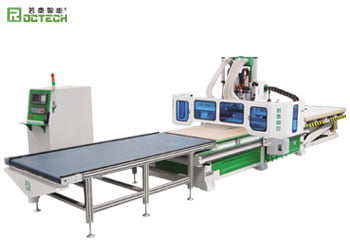
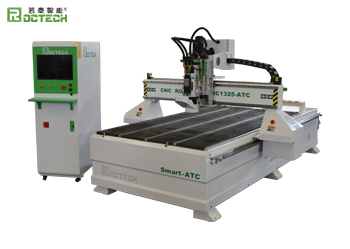
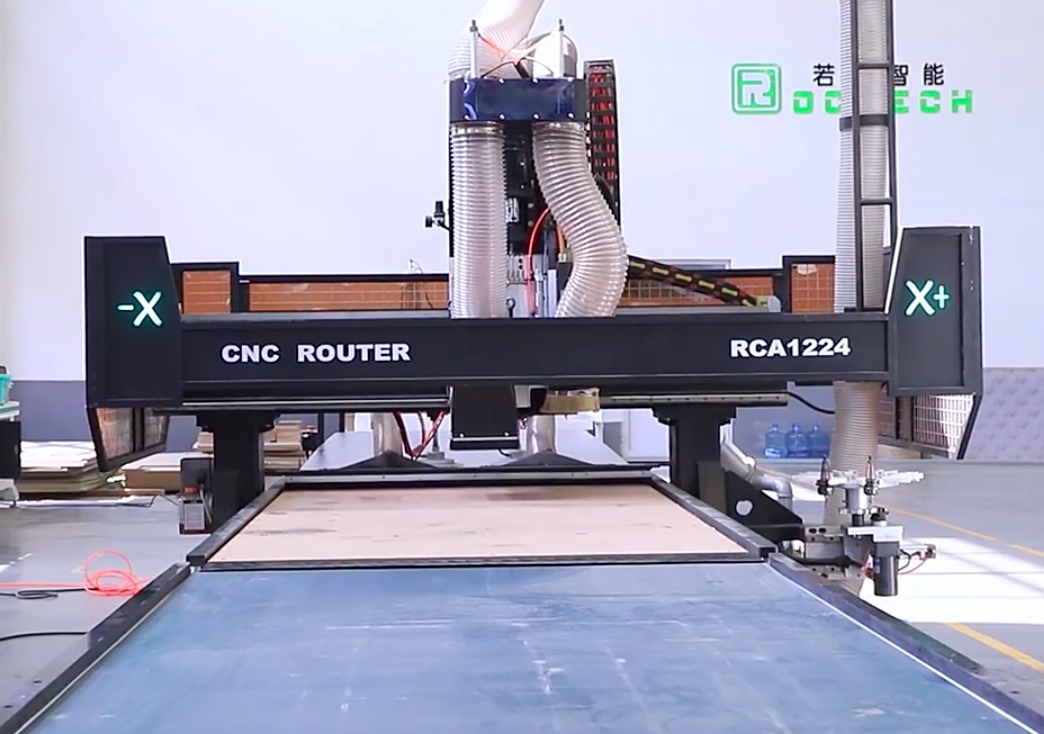
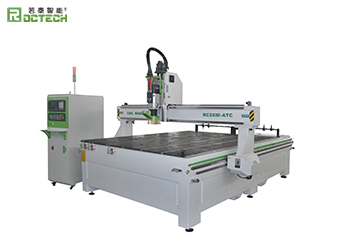
The economic case strengthens when dust collection is considered as an integrated element of CNC cell design rather than as an afterthought. Roctech Machinery Co., Ltd., the Jinan-headquartered manufacturer whose product line spans automatic loading and unloading nesting centers (the RCA series), ATC tool-change routers, and five-axis machining centers, has long recognized that workpiece hold-down reliability and processing precision depend on effective chip evacuation. Their equipment specifications explicitly recommend dust collection capacity—typically 3,000–5,500 CFM for nesting centers depending on spindle power—and offer optional cartridge collectors
Looking for more information about our CNC machines and services? Contact us today.
Contact
Previous:Five-Axis Machining Centers and the Evolution of High-Precision Fabrication
Next:Title: Medium Machining Centers Reshape the Customization Landscape: A Technical and Market Primer