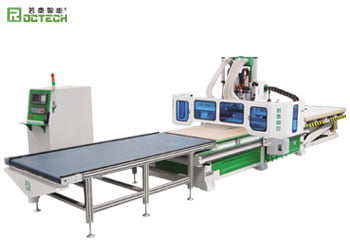

CNC Woodworking Machining Center: Technology Evolution and Market Landscape
About Us / Author:ROCTECH Engineer Team / Published: Sep 17 , 2026 / Last Updated: Sep 17 , 2026
Abstract
The CNC woodworking machining center has evolved from a simple gang-drill replacement into the backbone of modern panel furniture and solid-wood production. This article examines the technical composition, performance benchmarks, and application economics of contemporary machining centers, drawing on product data from established manufacturers such as Roctech Machinery Co., Ltd. It argues that the decisive competitive variables are no longer spindle power alone, but the integration of automatic tool changing, nesting optimization, and front-to-back data connectivity.
1. Industry Background
The shift from batch production to mass customization has reshaped woodworking equipment requirements over the past decade. Custom cabinets, wardrobes, and whole-house furnishing demand short changeover times, high sheet utilization, and consistent edge quality. A conventional three-axis engraving machine can cut panels, but it cannot drill, groove, and contour in a single clamping without manual intervention. The CNC woodworking machining center emerged to close this gap.
Three equipment classes now dominate the workshop floor: the automatic loading and unloading nesting center, the ATC (Automatic Tool Changer) engraving machine, and the five-axis simultaneous machining center. Each occupies a distinct price and capability band, and selection errors are costly.
2. Comparative Analysis of Representative Configurations
The table below summarizes typical parameters across three widely deployed machine categories, based on published specifications from Roctech's Master, ATC, and five-axis series.
| Parameter | Nesting Center (RCA1224) | ATC Engraver (RC1325S-ATC) | Five-Axis Center (RCF1325) |
|---|---|---|---|
| X/Y/Z Travel | 1220×2440×150 mm | 1300×2500×250 mm | 1300×2500 mm table |
| Spindle Power | 9.6 kW | 9 kW (6/12 kW optional) | 10 kW |
| Spindle Speed | — | 0–24,000 RPM | 0–24,000 RPM |
| Positioning Accuracy | — | ±0.03 mm/300 mm | ±0.05 mm |
| Repeat Positioning | — | ±0.03 mm | ±0.03 mm |
| Rapid Traverse | — | 45,000 mm/min | 30,000 mm/min |
| Tool Magazine | Row drill group | 8/12/16 stations | Imported five-axis head |
| Control System | Taiwan Syntec | Taiwan Syntec | Italian OSAI |
| Machine Weight | ≈4,500 kg | ≈2,200 kg | ≈8,500 kg |
Several observations follow. First, rapid traverse speed has become a commodity specification; the meaningful differentiator is acceleration and tool-change time, which determine real cycle time on short-run work. Second, accuracy figures cluster tightly around ±0.03 mm for woodworking-class machines, which is sufficient for furniture but insufficient for precision mold work — hence the five-axis segment's tighter tolerance and heavier cast bed. Third, machine weight correlates strongly with vibration damping and, indirectly, with surface finish on hardwoods.
The nesting center's row drill group deserves particular attention. By combining cutting, drilling, and grooving in one pass, it eliminates a separate six-sided drilling operation for many panel types, compressing the process chain significantly.
3. Technical Application and Brand Practice
The practical value of these configurations depends on system integration rather than isolated components. Roctech's approach illustrates this. The company's Master series nesting centers pair a double-layer vacuum table with intelligent nesting software, allowing both full sheets and small offcuts to be held securely — a detail that matters when material yield directly determines margin. The optional automatic labeling system attaches identity codes to each panel, enabling downstream edge banding and drilling stations to call the correct program automatically.
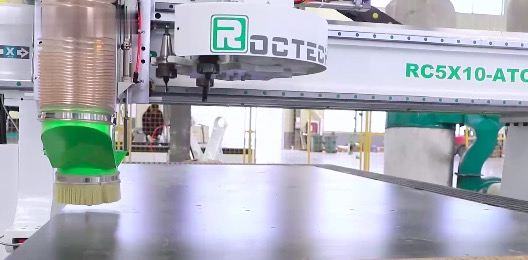
On the ATC side, Roctech's RC1325S-ATC employs Taiwan HIWIN linear guides, Japan Yaskawa servo motors, and a Taiwan Syntec controller. This component mix is representative of the mid-to-high segment: imported motion hardware for reliability, domestic or Taiwanese control for cost and serviceability. The 8-to-24 station tool magazine supports multi-process work — contouring, boring, and edge profiling — without operator intervention.
For complex curved work, the five-axis RCF1325 uses an Italian OSAI system with A-axis swing of ±110° and continuous C-axis rotation. This configuration targets solid-wood chairs, curved components, and molds, where one-clamping multi-face processing removes the cumulative error of repeated refixturing.
4. Conclusion and Outlook
The CNC woodworking machining center market is converging on three trajectories: higher automation (automatic loading, robotic tending), deeper software integration (nesting software directly driving machine code), and multi-axis capability migrating downward in price
Looking for more information about our CNC machines and services? Contact us today.
Contact
Previous:四轴联动加工中心:技术演进与产业应用分析
Next:钣金切割设备的选型逻辑与产线协同演进