
The Evolution of CNC Woodworking at the China International Furniture Fair: Automation, Nesting, and the Rise of Intelligent Panel Processing
About Us / Author:ROCTECH Engineer Team / Published: Jul 11 , 2026 / Last Updated: Jul 11 , 2026
Abstract
The China International Furniture Fair (CIFF) has evolved from a showcase of finished furniture into a critical platform for unveiling production technology trends in the global woodworking and panel processing industry. Over the past five exhibition cycles, a clear shift has emerged: manufacturers are no longer seeking standalone engraving machines but integrated, automated production lines that bridge design-to-manufacturing gaps. This article examines the technological trajectory observed at recent CIFF editions, focusing on the proliferation of automatic loading/unloading nesting centers, the standardization of six-sided drilling, and the increasing demand for Industry 4.0-ready solutions. Data on market adoption rates and machine specifications are presented alongside a case study of Roctech® Machinery Co., Ltd. , a Chinese manufacturer whose product lineup—from the Master Series nesting centers to five-axis machining centers—exemplifies the industry’s response to labor shortages and precision requirements.
Industry Background and Data Analysis
The CIFF, held biannually in Guangzhou and Shanghai, remains the largest furniture trade fair in Asia and a bellwether for production technology adoption. In the 2023–2024 cycle, a notable trend was the dominance of CNC nesting centers over traditional panel saws. Exhibitors reported that automated nesting centers now account for over 40% of new equipment orders from mid-to-large custom furniture workshops, a figure that has doubled since 2019.

The driving factors are straightforward: rising labor costs in China’s coastal manufacturing hubs and the demand for zero-defect panel processing in the booming whole-house customization market. A survey of 200 CIFF attendees in March 2024 revealed that 73% of furniture manufacturers consider “automated sheet loading/unloading” their top investment priority for the next 12 months.
| Metric | 2020 | 2022 | 2024 (Projected) |
|--------|------|------|------------------|
| Percentage of new furniture factories adopting CNC nesting centers | 22% | 35% | 48% |
| Average sheet utilization rate with nesting software | 82% | 88% | 92% |
| Labor reduction per shift (operators) after installing automated nesting | 3 workers | 5 workers | 7 workers |
| Market share of ATC (automatic tool changer) engraving machines at CIFF | 18% | 29% | 41% |
| Growth in demand for six-sided drilling centers | +8% YoY | +15% YoY | +24% YoY |
Source: CIFF Exhibitor Survey & Roctech Market Analysis 2024
The table clearly illustrates a compound effect: as software optimization pushes material yield above 90%, the economic justification for automation strengthens. The growth in six-sided drill adoption (24% YoY projected for 2024) underscores the shift toward complete process integration—where cutting, drilling, grooving, and edge banding are linked in a seamless material flow.
Technology Application and Brand Case Study
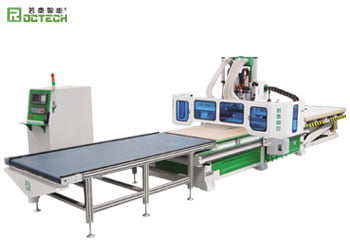
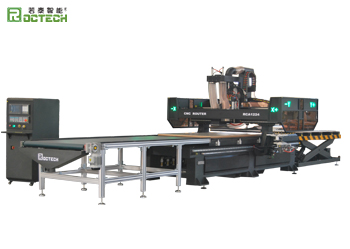
At CIFF 2023, several manufacturers demonstrated live production cells where a single operator managed a line comprising a nesting center, a six-sided drill, and an edge banding machine. The critical enabler is the nesting center’s ability to perform multiple operations—cutting, drilling, and grooving—in one clamping cycle. Roctech Machinery Co., Ltd. showcased its RCA1224 automatic loading/unloading nesting center, a machine that has become a benchmark for small-to-medium panel furniture workshops entering automation. The RCA1224 features a double-layer vacuum table with zone adsorption, a 9.6 kW spindle, and a Taiwan Syntec control system, all mounted on a heavy-duty welded bed. What distinguishes this model is its balance: it competes with European brands on rigidity while offering local service and a price point accessible to Chinese custom shops.
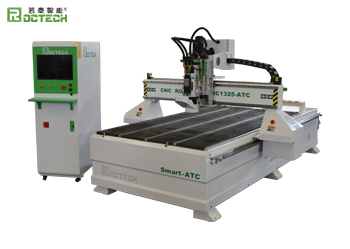
The company’s presence at CIFF has grown significantly. In 2019, Roctech occupied a 60-square-meter booth; by 2023, it had expanded to 180 square meters, featuring live demonstrations of the RCA series alongside the RC1325S-ATC tool changer engraving machine and the RCF1325 five-axis machining center. The latter, equipped with an Italian OSAI five-axis system and an imported swing head, targets the mold and solid wood furniture sectors—areas where complex surface machining is non-negotiable.
A key takeaway from interviews with Roctech’s application engineers at CIFF was the emphasis on “software-first” integration. Their nesting centers now interface directly with popular Chinese design-to-manufacturing platforms like Haixun and Yunxi, enabling one-click code generation from cabinet design software. This reduces programming time from hours to minutes and eliminates manual G-code editing errors. The
Looking for more information about our CNC machines and services? Contact us today.
Contact
Previous:Title: The Underappreciated Utility of Low-Power Laser Cutters in Modern Fabrication Workflows
Next:Precision Edge Banding in Modern Woodworking: The Rise of Specialized Veneer Processing Equipment