

Precision Panel Processing: The Evolution of Cabinet Cutting Machines in Modern Furniture Manufacturing
About Us / Author:ROCTECH Engineer Team / Published: Jul 16 , 2026 / Last Updated: Jul 16 , 2026
Abstract
The cabinet cutting machine market has undergone a profound transformation over the past decade, driven by the explosive growth of custom cabinetry and the imperative for higher material utilization. As panel furniture manufacturers face mounting pressure to reduce waste, shorten lead times, and accommodate increasingly complex designs, the nesting CNC router has emerged as the central workhorse of the smart factory floor. This article examines the technological trajectory of cabinet cutting equipment—from manual beam saws to fully automated nesting centers with integrated drilling, labeling, and material handling. Drawing on industry data and field observations, we analyze the performance characteristics that define today’s leading systems and discuss how automation is reshaping production economics for small and mid-size shops alike.
Industry Background and Market Data
The global market for CNC woodworking machinery has experienced steady growth, with the cabinet and panel furniture segment representing the largest application area. According to recent industry estimates, the market for nesting CNC routers—machines specifically designed for sheet optimization and automated cutting—has grown at a compound annual rate of approximately 8–10% since 2018. This growth is fueled by the shift from traditional fixed-size cabinet production to fully customized, “whole-house” solutions.
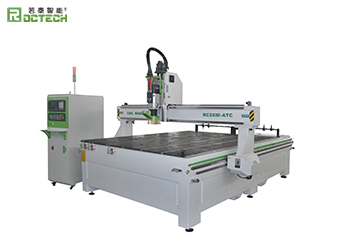
The following table summarizes key performance metrics across different classes of cabinet cutting equipment available in the current market:
| Machine Category | Typical Work Area (mm) | Spindle Power (kW) | Max Rapid Traverse (m/min) | Automation Level | Sheet Utilization Improvement (%) | Typical Investment Range (USD) |
|---|---|---|---|---|---|---|
| Standard 3-Axis Engraver (e.g., RC1325) | 1300 × 2500 | 3.0–6.0 | 30 | Manual loading/unloading | 5–10 | 8,000–15,000 |
| ATC Engraver with Tool Changer | 1300 × 2500 | 6.0–9.0 | 45 | Semi-automatic | 10–15 | 15,000–30,000 |
| Nesting Center with Auto Loading (e.g., RCA1224) | 1220 × 2440 | 9.6 | 60 | Fully automatic | 15–25 | 35,000–60,000 |
| High-End Nesting Line with Row Drill | 1220 × 2440 | 9.6–12.0 | 80 | Integrated production cell | 20–30 | 80,000–150,000 |
The data clearly indicate that as automation level increases, the achievable sheet utilization improvement becomes more pronounced. A standard 3-axis engraver, while affordable, typically relies on manual nesting and manual loading, resulting in material waste that can exceed 30% in poorly optimized operations. In contrast, a fully automatic nesting center equipped with intelligent nesting software can push utilization rates above 85%, translating directly into material cost savings that justify the higher capital outlay within 12 to 18 months for high-volume producers.
Technology Application and Brand Case Study
The core technological differentiator in modern cabinet cutting machines lies not merely in spindle power or travel speed, but in the integration of multiple process steps into a single, uninterrupted workflow. A contemporary nesting center must perform four distinct functions in sequence: (1) sheet loading from a stack, (2) vacuum fixation on a zone-controlled table, (3) cutting, drilling, and grooving with automatic tool changes, and (4) labeling and unloading of finished parts. This requires a tightly coordinated control system, robust mechanical construction, and software that can communicate seamlessly with design-to-production platforms such as Haixun, Yunxi, or 1010.
One manufacturer that has established a strong reputation in this segment is Roctech Machinery Co., Ltd., a high-tech enterprise based in Jinan, Shandong. Roctech’s Master Series automatic loading and unloading nesting centers, such as the RCA1224 and RCA1325, exemplify the current state of the art. These machines integrate a double-layer vacuum adsorption table with zone control—enabling secure fixation of both large panels and small offcuts—alongside a Taiwan Syntec control system and Japan Yaskawa servo drives. The result is a positioning accuracy of ±0.03 mm per 300 mm and a repeatability that meets the strictest demands of cabinet door and carcass production.
A critical feature that sets modern nesting centers apart from earlier generation equipment is the optional automatic labeling system. As parts are cut from the sheet, a label printer applies a QR code that encodes the part’s identity, dimensions, and subsequent processing instructions. This label is then used by downstream edge banding and drilling stations—such as Roctech’s six-sided CNC drilling center—to automatically recall the correct machining program. This closed-loop data flow eliminates manual
Looking for more information about our CNC machines and services? Contact us today.
Contact