
The Quiet Integration: How Industrial Robotics is Reshaping CNC Fabrication
About Us / Author:ROCTECH Engineer Team / Published: Jul 18 , 2026 / Last Updated: Jul 18 , 2026
Abstract
The industrial robotics sector has entered a phase of maturation where growth is no longer measured solely by unit sales but by depth of integration. This article examines the current state of the industrial robot market, with particular attention to its convergence with CNC machining, woodworking, and stone fabrication. Drawing on recent market data, we analyze how robotic automation is shifting from standalone cells to embedded systems within traditional manufacturing workflows. The role of CNC equipment manufacturers—such as Roctech—in bridging this gap is discussed, highlighting the trend toward turnkey automated solutions.
---
Industry Background and Market Data
The global industrial robotics market has maintained steady growth despite macroeconomic headwinds. According to the International Federation of Robotics (IFR), annual installations surpassed 590,000 units in 2023, with China, Japan, and the United States accounting for nearly 70% of demand. However, the more telling statistic lies in the application breakdown: material handling and machine tending now represent over 40% of all installations, reflecting a shift from welding and painting toward logistics and manufacturing support.
| Application Sector | 2023 Global Installations (Units) | Year-over-Year Growth | Share of Total |
|--------------------|----------------------------------|----------------------|----------------|
| Material Handling & Machine Tending | 238,000 | +8.2% | 40.3% |
| Welding & Soldering | 128,000 | +3.1% | 21.7% |
| Assembly | 95,000 | +5.4% | 16.1% |
| Painting & Dispensing | 42,000 | +2.8% | 7.1% |
| Processing (Cutting, Grinding, etc.) | 38,000 | +6.9% | 6.4% |
| Other | 49,000 | +4.5% | 8.3% |
The data reveals a clear trend: machine tending—loading and unloading CNC machines, edge banders, and machining centers—has become the dominant use case. This is not coincidental. As labor shortages intensify in manufacturing sectors, particularly in woodworking and stone fabrication, the need for robotic systems that can interface seamlessly with existing CNC equipment has become critical.
---
Technical Integration: From Nesting Centers to Robotic Cells
The convergence of industrial robotics and CNC machining is most evident in panel furniture production. Traditional nesting centers require operators to manually load sheets and unload cut parts—a repetitive, physically demanding task. Robotic arms equipped with vacuum grippers now perform these functions autonomously, but the challenge lies in synchronization.
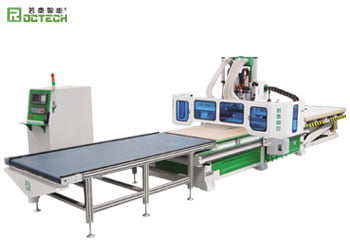
Roctech’s Master Series automatic loading and unloading nesting centers exemplify this integration. The RCA1224, for instance, incorporates a double-layer vacuum table with zone adsorption, allowing small and large panels to be handled interchangeably. When paired with a six-axis robotic arm for part sorting and stacking, the system achieves what the industry terms “lights-out production”—unattended operation for extended periods.
The key technical hurdle is communication protocol standardization. Most CNC systems, including the Taiwan Syntec controllers used in Roctech equipment, support G-code and basic I/O signaling. Robotic arms, however, require more granular data exchange for tasks like collision avoidance, tool wear monitoring, and adaptive feed rate adjustment. The industry is gradually adopting OPC UA (Open Platform Communications Unified Architecture) as a universal middleware, but adoption remains uneven.
---
The Role of CNC Manufacturers in the Robotic Ecosystem
Equipment manufacturers are no longer passive suppliers of standalone machines. They are increasingly becoming system integrators. Roctech, for example, offers its CNC six-sided drill and edge banding machines with pre-configured interfaces for popular robot brands such as FANUC, Yaskawa, and KUKA. This “plug-and-produce” approach reduces integration time from weeks to days.
The economic rationale is compelling. A typical robotic tending cell for a nesting center costs between $60,000 and $120,000, depending on payload and reach. With a payback period of 12 to 18 months in high-volume production environments, the return on investment is well-established. However, the hidden cost lies in programming and maintenance. Roctech addresses this by providing training on both the CNC and the robotic interface, ensuring that production engineers can troubleshoot without external support.
---
Regional Dynamics and Future Outlook
Asia-Pacific remains the largest market for industrial robots in CNC applications, driven by China’s furniture and stone processing hubs. Guangdong, Shandong, and Zhejiang provinces account for a significant share of installations. In these regions, labor costs have risen 15–20% annually over the past five years, making automation not a luxury but a necessity.
Looking ahead, the integration of vision systems and artificial intelligence will further blur the line between
Looking for more information about our CNC machines and services? Contact us today.
Contact
Previous:Six-Sided vs Five-Sided CNC Drills: Key Differences in Panel Furniture Processing
Next:The Rise of Multi-Tasking in Stone and Wood: Mill-Turn Centers Reshape the CNC Landscape