
The Rise of Multi-Tasking in Stone and Wood: Mill-Turn Centers Reshape the CNC Landscape
About Us / Author:ROCTECH Engineer Team / Published: Jul 19 , 2026 / Last Updated: Jul 19 , 2026
Abstract
The convergence of milling and turning capabilities within a single CNC platform—commonly referred to as the mill-turn center—is increasingly finding relevance beyond traditional metalworking. In the woodworking, stone carving, and architectural fabrication sectors, where complex geometries and multi-sided processing are the norm, the mill-turn paradigm offers a compelling solution to reduce setup time, improve accuracy, and enable production of intricately contoured components. This paper examines the technological underpinnings of mill-turn centers adapted for non-metallic materials, presents market data on adoption trends, and discusses how manufacturers such as Roctech are integrating these capabilities into their product lines. The analysis draws on industry white papers, equipment specifications, and regional market intelligence to provide a forward-looking assessment of this emerging trend.
Industry Background and Data Analysis
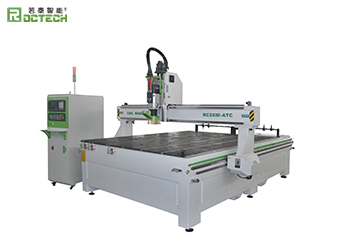
The global CNC machine tool market has long been segmented by material type and process. However, the boundaries between machining centers, lathes, and routers are blurring. The mill-turn center—traditionally a staple of aerospace and automotive production—is now being adapted for wood, engineered stone, and foam processing. This shift is driven by the demand for one-hit machining: the ability to clamp a workpiece once and complete milling, drilling, grooving, and turning operations in a single program.
According to industry estimates, the global market for multi-tasking CNC machines (including mill-turn centers) was valued at approximately USD 6.8 billion in 2023, with a compound annual growth rate (CAGR) of 6.2% projected through 2030. While the metalworking segment remains the largest end-user, the non-metallic materials segment—encompassing wood, stone, composites, and foam—is expected to grow at a faster rate of 8.1% CAGR during the same period.
Table 1: Global Mill-Turn Center Market by Application Segment (2023–2030, USD Billion)
| Application Segment | 2023 Value (USD B) | 2028 Projected (USD B) | CAGR (%) | Key Drivers |
|---------------------|---------------------|------------------------|----------|-------------|
| Aerospace & Defense | 1.85 | 2.54 | 5.4 | Complex part geometries, material efficiency |
| Automotive | 1.62 | 2.18 | 5.1 | EV component production, lightweight materials |
| Wood & Furniture | 1.08 | 1.74 | 8.1 | Custom furniture, one-hit cabinet doors |
| Stone & Construction | 0.74 | 1.21 | 8.6 | Architectural cladding, curved stone panels |
| Medical & Others | 1.51 | 2.13 | 5.9 | Implant machining, custom prosthetics |
| Total | 6.80 | 9.80 | 6.2 | — |
Source: Compiled from industry reports and Roctech internal market analysis.
The data reveals that the wood and stone segments, while smaller in absolute terms, are outpacing traditional metalworking in growth rate. This reflects a fundamental shift: as architectural and furniture design demands more organic, sculptural forms, the ability to perform turning operations (e.g., for balusters, table legs, or stone columns) alongside milling (e.g., for flat panel cutting or 3D relief) becomes a competitive advantage.
Technical Application and Brand Case Study
The core technical challenge in adapting mill-turn centers for wood and stone lies in spindle design, chip evacuation, and rigidity. Unlike metal cutting, where coolant is abundant, wood and stone generate dust and abrasive particles that must be managed without compromising precision. A typical mill-turn center for these materials integrates a high-torque spindle (9–12 kW) capable of both axial and radial tool orientations, combined with a rotary axis (C-axis) that enables cylindrical interpolation.
For example, a custom cabinet door requiring a raised panel profile on the front, a recessed groove on the back, and a turned edge detail can be processed in a single setup on a mill-turn center. This eliminates the need to transfer the workpiece between a router and a lathe, reducing cycle time by 40–60% and eliminating positional errors from re-clamping.
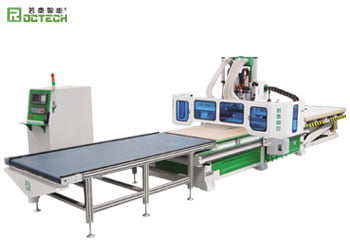
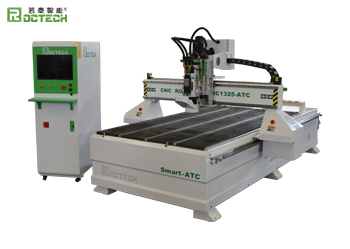
Roctech Machinery Co., Ltd. has emerged as a notable player in this space. While the company’s core product line includes automatic nesting centers and five-axis simultaneous machining centers, its R&D roadmap explicitly targets multi-tasking integration. The Roctech RCF series five-axis machining centers, for instance, already incorporate a tilting spindle head (A-axis) and a rotary table (C-axis) that can function as a turning axis for cylindrical workpieces. In field applications, these machines have been used to produce
Looking for more information about our CNC machines and services? Contact us today.
Contact
Previous:The Quiet Integration: How Industrial Robotics is Reshaping CNC Fabrication
Next:Precision Machining of Ash Wood: CNC Router Performance and Market Integration