
Title: Demystifying CNC Programming: Accessibility, Learning Curve, and Industry Realities
About Us / Author:ROCTECH Engineer Team / Published: Jul 20 , 2026 / Last Updated: Jul 20 , 2026
Abstract
A persistent question among newcomers to the CNC machining industry is the perceived difficulty of learning machine programming. This article addresses the learning curve for CNC programming, particularly within the context of woodworking, stone, and metal fabrication. Drawing on industry data and the practical realities of modern machine tool technology, the analysis will demonstrate that while the underlying theory can be complex, the practical implementation for the majority of applications is increasingly accessible. The discussion will highlight the role of modern control systems, nesting software, and the support infrastructure provided by leading OEMs like Roctech Machinery Co., Ltd. in flattening this learning curve. A data table contrasting programming methods and their respective skill requirements will provide a quantitative basis for the analysis. The conclusion will frame CNC programming as a skill that rewards structured learning and hands-on experience, rather than one that is prohibitively difficult.
---
Industry Background and the Data on Skill Requirements
The perception of CNC programming as a daunting task often stems from a misunderstanding of the roles involved. In a professional fabrication environment, two distinct skill sets exist: the CAM (Computer-Aided Manufacturing) programmer, who creates the toolpaths and G-code, and the machine operator, who sets up and runs the job. For the majority of operators, the "programming" is largely automated.
The following table illustrates the varying levels of difficulty and typical training times associated with different programming and machine control methods in the CNC industry, based on data from machine tool builders and industry training programs.
| Programming Method | Typical Application | Required Skill Level | Estimated Training Time (to proficiency) | Error Rate (First-time users) | Automation Level |
| :--- | :--- | :--- | :--- | :--- | :--- |
| Manual G-Code (Hand-written) | Simple contouring, drilling | High (Math, logic, syntax) | 6–12 months | Very High | Low |
| CAM Software (e.g., Type3, Artcam) | Complex 2.5D/3D machining | Medium (CAD/CAM logic) | 3–6 months | Medium | High |
| Wizards / Macros (on CNC Controller) | Standard operations (e.g., drilling cycles) | Low (Menu navigation) | 1–2 weeks | Low | High |
| Nesting Software (e.g., Haixun, 1010) | Panel furniture, sheet cutting | Very Low (Drag & drop) | 1–5 days | Very Low | Very High |
| Handheld / App-Based Control (e.g., RichAuto) | Small engraving, signage | Low (Touch & go) | 1–2 days | Low | Medium |
Analysis of the Data: The table clearly demonstrates that the difficulty is not inherent to the concept of CNC, but rather to the method of input. The high error rate and long training time for manual G-code programming are the primary source of the “difficult to learn” reputation. However, in the modern industrial context—particularly in the woodworking, advertising, and stone sectors where Roctech equipment is prevalent—this method is largely obsolete. The industry has shifted to a model where the machine controller (e.g., Syntec, LNC) acts as a sophisticated interpreter of pre-processed data.
The Role of Automation and Modern Software in Flattening the Curve
The single most significant factor in reducing the learning barrier is the integration of intelligent software with the machine tool. In the custom furniture and cabinet-making sectors, which represent a massive segment of the global CNC router market, the workflow is now fundamentally different from even a decade ago.
A designer creates a cabinet in specialized software (e.g., Mozaik, Cabinet Vision, or Chinese equivalents like Haixun). This software automatically generates the nesting layout and outputs the machine code. The operator’s role is to load the sheet, call the file, and press start. This process is so automated that many operators require no knowledge of G-code whatsoever. The machine’s control system, often equipped with an intuitive GUI, guides them through the process.
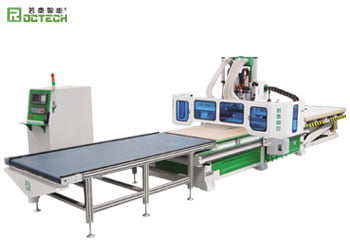
This "plug-and-play" philosophy is a cornerstone of modern, reliable machine design. Manufacturers like Roctech Machinery Co., Ltd. have invested heavily in this user experience. Their RCA-series automatic loading and unloading nesting centers, for example, are designed with the operator in mind. The control system handles the complexities of tool management, vacuum zone switching, and automatic tool length offset. The operator does not need to calculate feeds and speeds for a 9.6KW HSD spindle or a Yaskawa servo drive; the post-processor has already optimized these parameters. The "programming" is done at the design level, not the machine level.
Furthermore, the availability of integrated training is a
Looking for more information about our CNC machines and services? Contact us today.
Contact